
This Is The Biggest V-Twin Cruiser Japan Ever Built
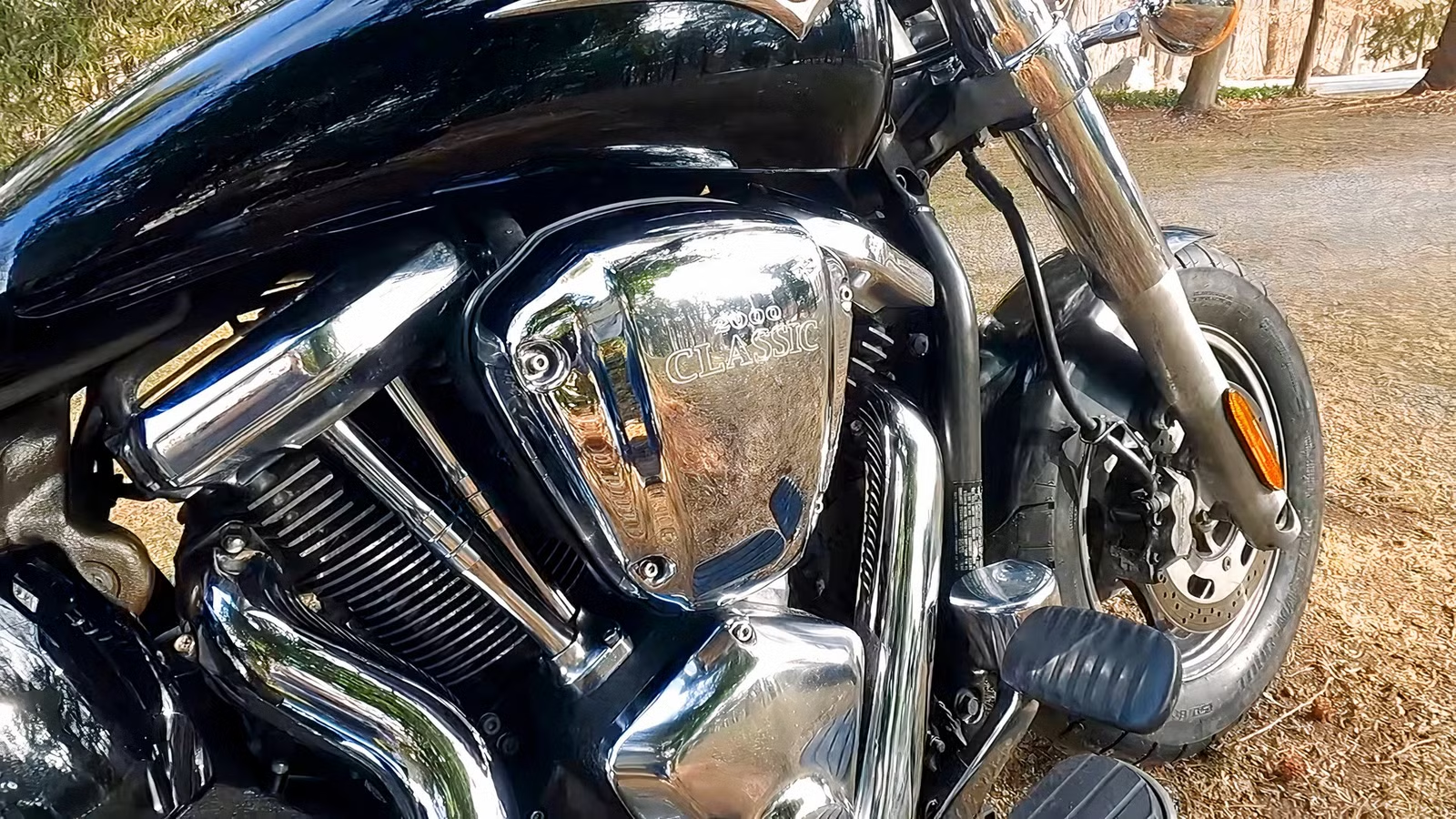
For American riders, the large V-twin cruiser measurement yardstick was more than just displacement. For them, it was about tons of torque, aggressive attitude, mechanical soul, and the heady feeling of straddling a huge V-twin between your legs. Harley-Davidson might have written the large V-twin rulebook, but Japan has spent decades pushing its boundaries. Since the early 2000s, Japanese bikemakers have been building increasingly large cruisers aimed squarely at the American market. One Japanese bikemaker eventually pushed the large V-twin formula beyond the two-liter mark, creating a motorcycle that could stand toe to toe with the best America had to offer. This motorcycle wasn’t trying to build a Harley clone; it set out to prove that Japan could also build a truly gargantuan American-style V-twin.
The Kawasaki Cruiser: Japan’s Answer to American Big-Inch Motorcycles

For most of the 20th century, the traditional American cruiser was defined by a simple formula — a long wheelbase, relaxed riding position, lots of chrome, and a massive, torquey V-twin. It was a formula completely owned by Harley-Davidson motorcycles. However, by the late 1990s and early 2000s, Japanese bikemakers started getting serious about American Big-Inch cruisers.
Honda, Kawasaki, Suzuki, and Yamaha were all bringing increasingly large V-twin cruisers to America. These were designed to appeal to riders looking for serious engine displacement but beyond the usual Milwaukee fare. Honda introduced the VTX1800, Suzuki brought in its Boulevard range, and Yamaha pushed its Road Star models to the U.S. shores. These weren’t small or medium-sized cruisers. They were large, heavy, and powerful machines built with the American formula — a large V-twin.
Kawasaki decided to push that philosophy even further. Instead of simply enlarging its existing 1,500cc and 1,600cc engine platforms, Kawasaki developed an all-new V-twin that pushed the boundaries of engine displacement — a motor pushing past 2.000cc or 122 cubic inches.

The Kawasaki Vulcan 2000: The 2,053cc V-Twin Monster

The path-breaking motorcycle was the Kawasaki Vulcan 2000. Introduced in 2004, the Vulcan 2000 came with a gigantic 2,053cc, 52-degree V-twin. At 125.3 cubic inches, it crossed the two-liter engine barrier, becoming one of the biggest production V-twins to be sold in America.
The Vulcan 2000 made a lot of sense to American riders. Its engine used a massive 103mm bore and an exceptionally long 123.3mm stroke. It was clear that Kawasaki wasn’t chasing high-end horsepower with this engine. The long-stroke engine layout was developed for American-cruiser-style effortless low-end torque. This engine made around 116 hp at 5,000rpm and a humongous 141 lb-ft of torque at just 3,000rpm. In the real world, the V-twin produced more than enough torque to effortlessly move the Vulcan’s hefty 820-pound weight without constant gearchanges.
Interestingly, the engine used a hybrid air- and liquid-cooled setup. The top part of the V-twin, including the cylinder heads, was liquid-cooled, while the bottom part, including the cylinders, used air cooling, with fins to better dissipate heat and give the motorcycle that classic old-school American cruiser look. The motorcycle also used traditional American V-twin cues by utilizing a push-rod arrangement and a belt final drive.
The Kawasaki Vulcan 2000: More Than A Two-Wheeled Giant

Developing a two-liter engine is an impressive feat. Designing an entire motorcycle around it is a different ballgame altogether. The Vulcan 2000 was a massive motorcycle. It stretched around 8.5 feet, with a 68.3-inch wheelbase giving it a long, low-slung American cruiser silhouette. The seat sat at just 26.8 inches above ground, allowing riders to easily plant both their feet firmly on the ground. The low-mounted engine and chassis also helped keep the center of gravity low. That said, there was no way to hide the motorcycle’s considerable heft. Unlike the modern Honda Gold Wings, you did not get reverse gear. That meant parking lot maneuvers and U-turn executions needed planning. However, once on the move, the Vulcan’s weight and long wheelbase felt less intimidating.
The Vulcan 2000 had substantial cycle parts as well. It got 49mm thick front forks, while braking duties were handled by dual front discs and four-piston calipers. Another highlight that gave the Vulcan 2000 that typical big-inch American motorcycle stance was the huge 200-section rear tire.
Why The Kawasaki Vulcan 2000 Was Japan’s Ultimate American-Style Cruiser

The Vulcan 2000 is an important motorcycle because Kawasaki understood the assignment — The American cruiser buyer wants a lot more than impressive specs; they want character. The Vulcan 2000 had it in spades. It had a long, low profile, generous amounts of chrome, a huge, exposed V-twin, and massive physical dimensions that made other motorcycles look insignificant when parked beside it. Yet beneath all that was precision Japanese engineering. Features like hybrid liquid-cooling, fuel-injection, and four-valve cylinder heads gave the Vulcan 2000 a technological advantage that was well hidden by the old-school styling.
Kawasaki later expanded the Vulcan lineup with the Vulcan 2000 Classic and Classic LT, with the latter getting touring equipment like saddlebags, windshield, passenger floorboards, and a backrest, giving the motorcycle proper touring cred. Kawasaki eventually phased out the Vulcan 2000 in 2010, bringing an end to a glorious but short-lived era of Kawasaki’s big-inch motorcycles.
To be clear, the Kawasaki Vulcan 2000 wasn’t the largest non-American motorcycle ever made. Triumph’s Rocket III motorcycles went substantially further. But as far as Japanese V-twins go, there was none like the Vulcan 2000. Today, the short-lived Japanese cruiser holds an unusual appeal. It merges American cruiser tradition and Japan’s famed technical sophistication, making the Vulcan 2000 one of the most extraordinary motorcycles ever made.

Related posts
Latest Post


No Comments