
This Honda Sports Bike Cost As Much As An iPhone In The ’60s, Now It’s Worth Supercar Money
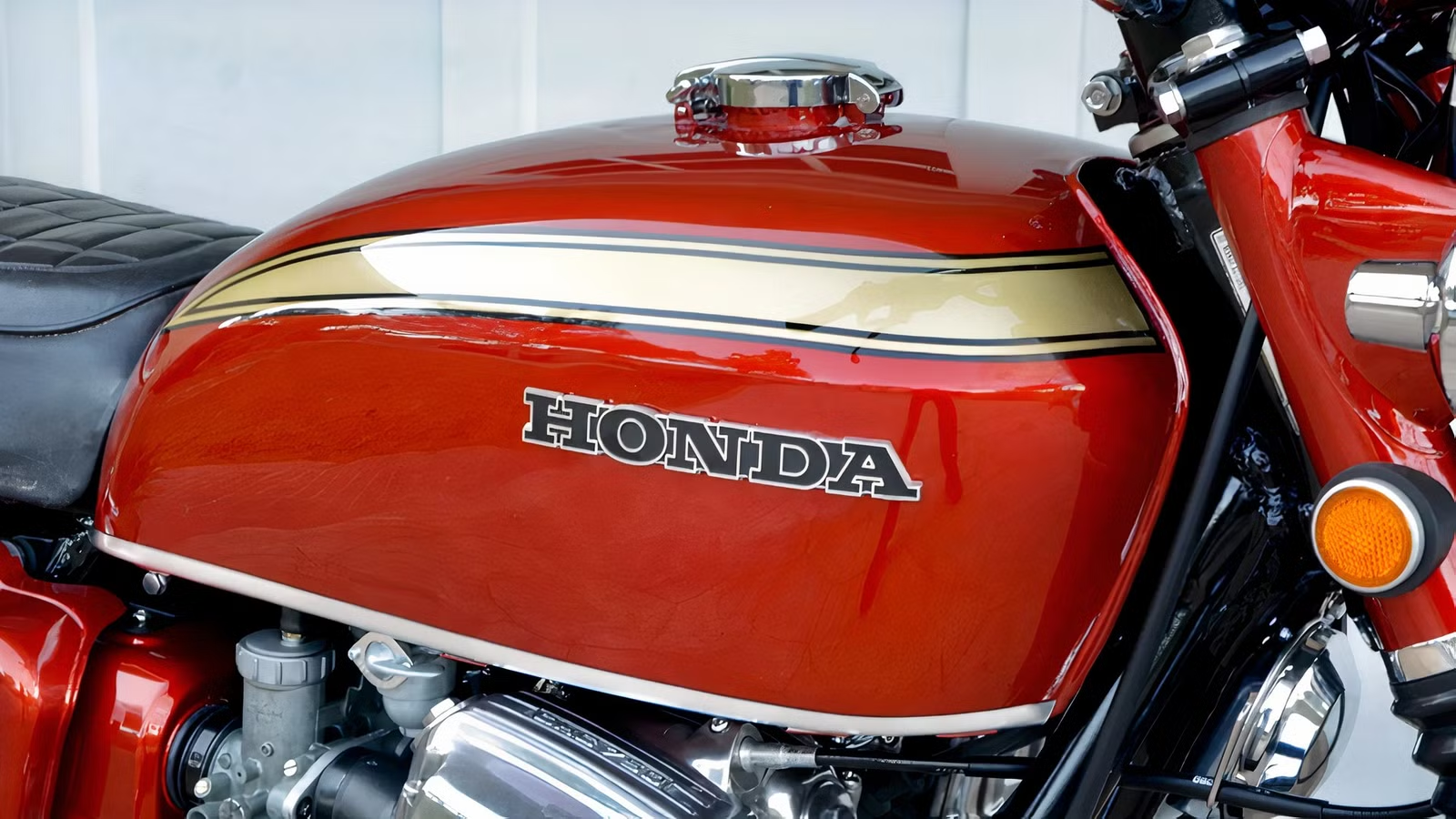
In 1969, a rider with $1,495 could buy a motorcycle that looked as if somebody had raided a race shop and forgotten to add the exotic-bike tax. That machine had four cylinders, four pipes, electric starting, a five-speed gearbox, and a front disc brake when much of the big-bike world still asked buyers to accept at least one obvious compromise. Today, the rarest surviving examples can cost more than many supercars. Yes, you read that right.
In 1969, Big Motorcycles Still Came With Compromises

Big motorcycles were already fast before 1969. The British industry had spent years proving that – Triumph Motorcycles and BSA twins brought speed and personality, Norton had freshened the formula with the Commando, and new three-cylinder machines pushed performance even further. The 1969 Norton Commando 750, for example, made a claimed 58 horsepower and could approach 117 mph. The British bikes had character by the gallon, and sometimes they appeared to store a little oil outside the engine for easy access, too.
Buyers therefore had plenty of tempting choices, but less choice if they wanted everything at once. Speed could come with vibration or extra maintenance, and prestige could bring a painful price. A smooth multicylinder engine still carried an exotic flavor, while features that now seem basic could remain optional, rare, or simply absent. The motorcycle industry had reached an awkward point where 100-plus-mph performance was possible, but the complete package had not caught up. A rider shopping for a large machine still had to decide which rough edges seemed charming and which ones seemed likely to ruin Sunday morning.

Honda had a different problem. By the late 1960s, it had become a motorcycle giant largely through smaller, approachable machines. Its sophisticated DOHC CB450 twin showed plenty of engineering ambition, but it did not directly answer America’s growing appetite for big displacement. The firm’s U.S. operation wanted a larger, more powerful road bike, with an important part of that pressure coming from American Honda service manager Bob Hansen’s 1967 trip to Japan.

Honda Put Exotic-Bike Hardware At A Mass-Market Price

What Honda prepared sounded more like a wish list than the specification sheet of an affordable production motorcycle. Displacement sat just below 750cc, four cylinders ran across the frame under a single overhead camshaft, and four carburetors fed them. The transmission had five speeds and riders could use an electric starter rather than beginning every trip with an unscheduled leg workout. Up front sat a hydraulic disc brake, and four separate exhaust pipes advertised exactly how many cylinders lived behind them.
Then came the figure that made the rest difficult to believe: $1,495 for a machine capable of more than 120 mph, with a standing quarter-mile trap speed around 100 mph. Reviewers from that era praised its cornering, braking, comfort, and ability to run smoothly at ordinary road speeds. Honda had built something that could crawl through traffic, cross states, and then move fast enough to make 1969 highway limits look like gentle suggestions.
Comparing the price against rivals, the Honda undercut major British two- and three-cylinder competition by roughly $400, although the exact gap varied by model. More important than a few hundred dollars either way was what the price said about Honda’s strategy – sophistication would not sit behind velvet ropes. Honda wanted to sell it in volume.
The Honda CB750 Changed What A Production Motorcycle Could Be

The motorcycle was the 1969 Honda CB750 Four, and its reputation now stretches far beyond Honda collectors. It became closely associated with the birth of the modern superbike formula because it combined serious power with equipment, usability, and production scale in a way buyers had not seen at that price.
The engine displaced 736cc and used a single overhead cam to operate the valves in its air-cooled inline-four. Four Keihin carburetors supplied fuel, while a five-speed gearbox sent power to the rear wheel. Period output figures hover around 67 to 68 horsepower. Honda gave riders both electric and kick starting, a hydraulic disc at the front, a drum at the rear, and four chrome exhaust pipes running into four mufflers.
Even inside, the design showed Honda thinking about production and durability. Highlights include a one-piece crankshaft, plain main bearings, horizontally split crankcase, and assembly methods influenced by automobile production. The engineering had to work on the road, but it also had to move down a factory line.

None of those ideas existed in a vacuum. Four-cylinder motorcycles had come before it – fast motorcycles certainly had – and disc brakes had already appeared outside mass production. Honda’s trick was integration – the CB750 put those ingredients into one dependable road bike that dealers could actually stock and ordinary customers could realistically buy.
That combination mattered more than any single specification. Honda even had to solve problems beyond the engine. Tires and drive chains had to cope with a new level of power and sustained speed, while the front disc also needed development before Honda could confidently put the system into large-scale production. The bike changed expectations because buyers no longer had to treat advanced equipment as a special favor from the factory.

Success then created the irony that drives today’s collector market. Honda built more than 400,000 examples over roughly a decade, with some sources putting the exact number at 448,900 before Honda moved to the later DOHC generation.
Honda initially expected far less demand – its corporate history says an early forecast of 1,500 bikes per year quickly became 1,500 per month, then production climbed again as orders piled up. Honda had made the extraordinary common, which was exactly the achievement.
All of that means collectors today do not treat every old CB750 like buried treasure. Later, ordinary examples can remain relatively affordable. The money follows the bikes closest to the moment before mass production turned a revolution into traffic.
The Word “Sandcast” Is Where CB750 Prices Get Serious

That trail leads straight to the early machines collectors call sandcast CB750s. The name refers to the rough-looking crankcases fitted before Honda switched to a faster die-casting process as demand exploded. It is estimated that roughly the first 7,000-plus engines belong to the desirable early group, with engine number CB750E-1007414 commonly used as the cutoff. These were a brief manufacturing solution created before Honda knew it had a sales monster on its hands.
But “sandcast” alone does not print money. Serial number, correct early parts, originality, restoration quality, documentation, and history can dramatically change the number on an auction screen. A restored 1969 sandcast with engine number 1005218 sold for $40,500 on Bring a Trailer in March 2025. Hagerty’s June 2026 price guide, meanwhile, values a 1969 K0 Sandcast in #3 “Good” condition at about $29,100. As you can see, early bikes can be expensive, but condition and story still matter.

Provenance can kick the price roof to the sky. A 1969 sandcast documented as having been supplied for Steve McQueen sold on Bring a Trailer for $155,000 in April 2022. Its paperwork included an American Honda invoice tied to dealer, racer, and McQueen friend Bud Ekins, plus documentation showing transfer to McQueen’s Solar Productions.
Then there are the pre-production bikes, which sit beyond normal sandcast collecting altogether. In February 2014, one of four hand-built pre-production CB750s sold on eBay for $148,100 after 102 bids. The differences included prototype engine parts, brake hardware, carburetors, and other pieces that never became normal production equipment. At that point, buyers were purchasing industrial history with a license plate.
A $1,495 Idea Became A $313,500 Piece Of Motorcycle History

The most extreme example surfaced again in 2026. A 1968 CB750 prototype, identified as the first CB750 sent to American Honda for testing and marketing work, crossed the block at Mecum’s Las Vegas motorcycle auction. Soichiro Honda sent the machine to Bob Hansen in October 1968, before the later group of pre-production dealer-show bikes. It carries frame number CB750-1102 and is packed with experimental details: a valve cover cast with “HONDA” rather than the production “OHC 750” marking, unusual sand-cast Keihin carburetors, prototype throttle hardware, a different starter cover, and even a rear-hinged seat
On January 31, 2026, it sold for $313,500 including buyer’s premium.

That brings the story back to the original $1,495. In simple face-value dollars, that sits remarkably close to modern flagship-phone money: Apple’s 2026 iPhone 18 Pro starts at $1,199 and the Pro Max at $1,299. Inflation makes the historical comparison very different, of course – using BLS CPI figures, $1,495 in 1969 carries roughly the buying power of $13,650 in August 2026, so nobody walked into a Honda dealer with pocket change and left on a superbike.
The important comparison is what buyers received for their money. Honda took technology that looked extravagant and made it reachable enough to sell by the hundreds of thousands. Nearly six decades later, collectors pay the wildest prices for the few surviving machines that show what that idea looked like before the rest of the world got used to it.
Source: Honda, Mecum, Bring a Trailer, CycleWorld, Hagerty

Related posts
Latest Post



No Comments