
Corvette Z06 vs 911 Turbo S High-Altitude Drag Race Results
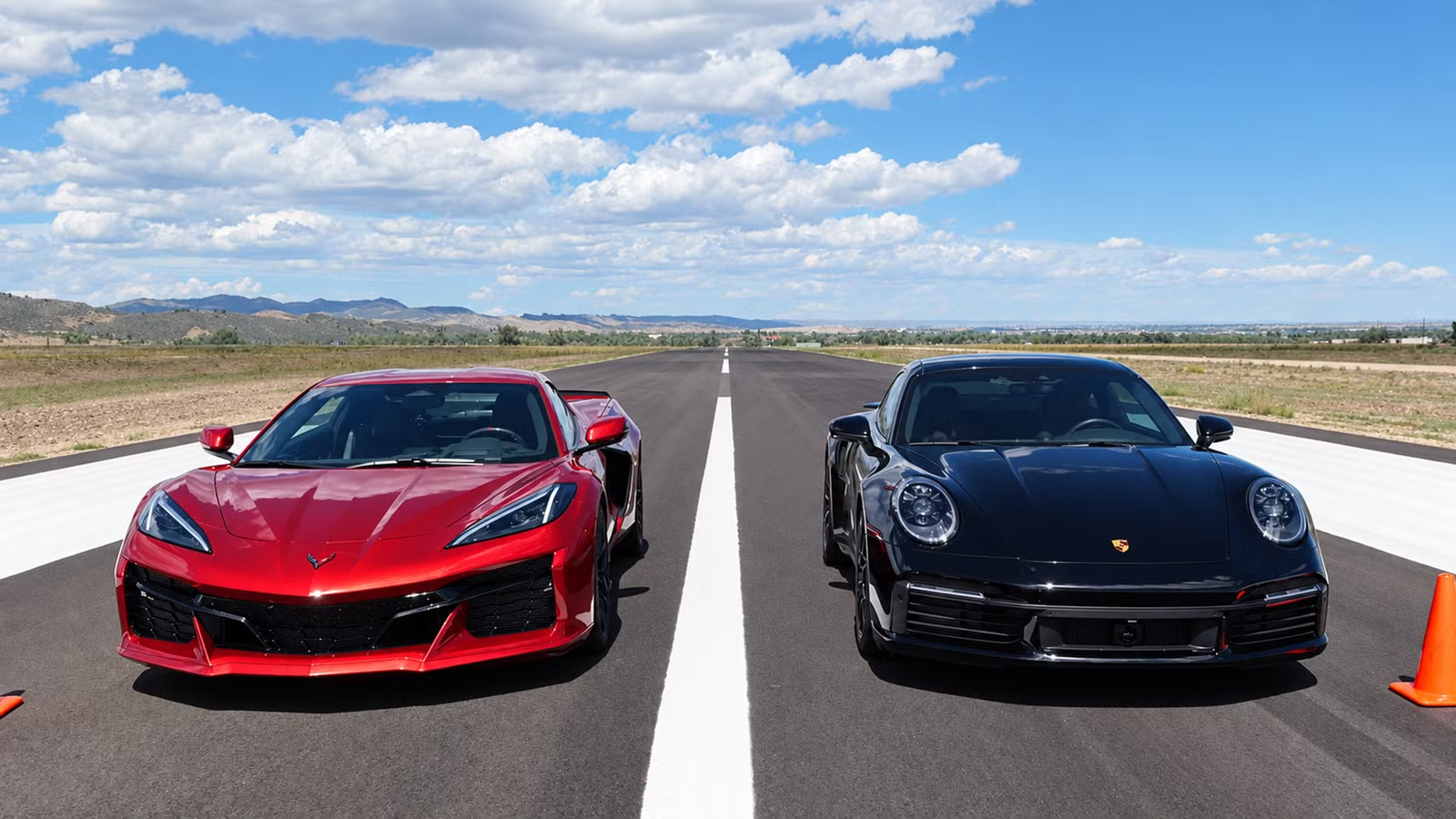
Thin air is the great equalizer — or, in this case, the great revealer. The Fast Lane Car recently staged a head-to-head drag and roll-race series between the C8 Corvette Z06 and the 992-generation Porsche 911 Turbo S on an airstrip sitting roughly a mile above sea level, and the altitude variable turned what would have been a close fight into a lopsided one. This wasn’t a controlled strip with prepped tarmac and sea-level oxygen. It was the kind of real-world stress test that separates powertrain philosophies from powertrain results.

On paper, the Z06 holds a meaningful edge in power-to-weight ratio. Its 5.5-liter flat-plane-crank V8 produces 670 horsepower and 460 lb-ft of torque in a car that weighs around 3,500 pounds, and it pulls all the way to 8,500 rpm. The 911 Turbo S answers with 640 horsepower and a substantially fatter 590 lb-ft of torque from a 3.8-liter twin-turbocharged flat-six, backed by all-wheel drive. It’s heavier, but its drivetrain is engineered to weaponize every pound of boost. At sea level, this matchup is genuinely close. A mile up, the equation shifts hard.
What Altitude Does To A Naturally Aspirated Engine
At roughly 5,280 feet above sea level, air density drops enough to meaningfully rob a naturally aspirated engine of oxygen — and therefore power. A turbocharged engine isn’t immune to altitude either, but its compressor can partially compensate by packing more of the thinner air into the combustion chamber. The Z06’s LT6 V8 has no such fallback. Whatever the atmosphere gives it is all it gets, and at a mile up, that’s measurably less than it would be at a sea-level drag strip.

The unprepped surface added another layer of difficulty. Without the sticky compound that a prepared strip provides, rear-wheel-drive launches become a traction management exercise rather than a pure power contest. The 911 Turbo S, with its AWD system distributing torque across all four wheels, was better equipped to exploit whatever grip the airstrip offered. The Z06 was fighting altitude and traction simultaneously from the moment the throttle went down.
The Quarter-Mile Numbers Tell The Story
The drag results were not subtle. The 911 Turbo S posted an 11.1-second quarter-mile pass at around 130 mph. The Z06 ran an 11.62 at 122 mph — more than half a second back and nearly 10 mph slower through the traps. That trap-speed gap is telling: the Z06 was still pulling hard at the line, but the thin air had already taken a significant bite out of its top-end velocity. The Porsche’s turbochargers were doing exactly what they’re supposed to do in conditions where a naturally aspirated engine is at its most vulnerable.
For context, the Z06’s sea-level quarter-mile capability sits around 10.6 seconds at 131 mph. The altitude cost it roughly a full second. The 911 Turbo S, by comparison, shed far less from its sea-level benchmark, which underscores just how differently forced induction handles the thin-air penalty.
The Roll Race Offered A Partial Redemption

Standing starts punish the Z06 twice over — once for the traction disadvantage of rear-wheel drive on an unprepped surface, and again for the altitude hit to its naturally aspirated output. Roll races remove the launch variable entirely, letting the engines fight on roughly equal footing once both cars are already moving. That’s where the Z06’s high-revving character and power-to-weight ratio are supposed to reassert themselves.
The roll race was considerably closer. The first attempt didn’t count — the Corvette driver jumped the start — but the second run showed the Z06 capable of genuinely pressuring the 911. It still lost, but the margin was tight enough to suggest that on a prepped surface at sea level, with clean launches, this fight looks very different. The flat-plane V8 isn’t broken. It was simply operating in the worst possible environment for what it is.
What This Means For The Z06’s Supercar Credentials

Losing to the 911 Turbo S at altitude on an unprepped strip is not the indictment it might look like at first glance. The Turbo S is one of the most sophisticated accelerating machines Stuttgart has ever built, with AWD, twin turbos, and a PDK transmission that has been refined over decades specifically to dominate exactly this kind of test. The Z06 showed up with a naturally aspirated engine and rear-wheel drive — a setup that demands ideal conditions to show its best.
What the test actually confirms is that the Z06 is a different kind of weapon. Its flat-plane V8 rewards drivers who can manage it, and its performance ceiling at sea level on a prepped surface remains genuinely world-class. The altitude test didn’t expose a weakness in the car so much as it exposed the fundamental physics of forced induction versus atmospheric breathing. Gearheads who’ve been making that argument for years now have a real-world data point to back it up. The Z06 deserves a rematch on even ground — and that roll-race result suggests it would make things very uncomfortable for the Porsche.

Related posts
Latest Post


No Comments