This Honda Engine Has Earned A Legendary Reputation For A Reason
11 minutes reading
Tuesday, 18 Aug 2026 13:00 0 26 autotech
Few automakers have an engine aura quite like Honda. Long before other manufacturers discovered the horsepower blessing of turbocharging and electrified boosting, and even dating back to the muscle-car age of “no replacement for displacement,” Honda was eeking every possible horsepower out of its tiny engines, often outperforming brute force through intelligent engineering.
The Japanese manufacturer’s secret was to make engines lighter, more efficient and more responsive, ultimately making them more durable regardless of how enthusiastically they were pushed. From championship-winning race cars to everyday work mules, Honda developed a reputation for extracting extraordinary performance from relatively small engines, and there was no better example than this one.
The F20C Was Honda’s Ultimate Naturally Aspirated Engine
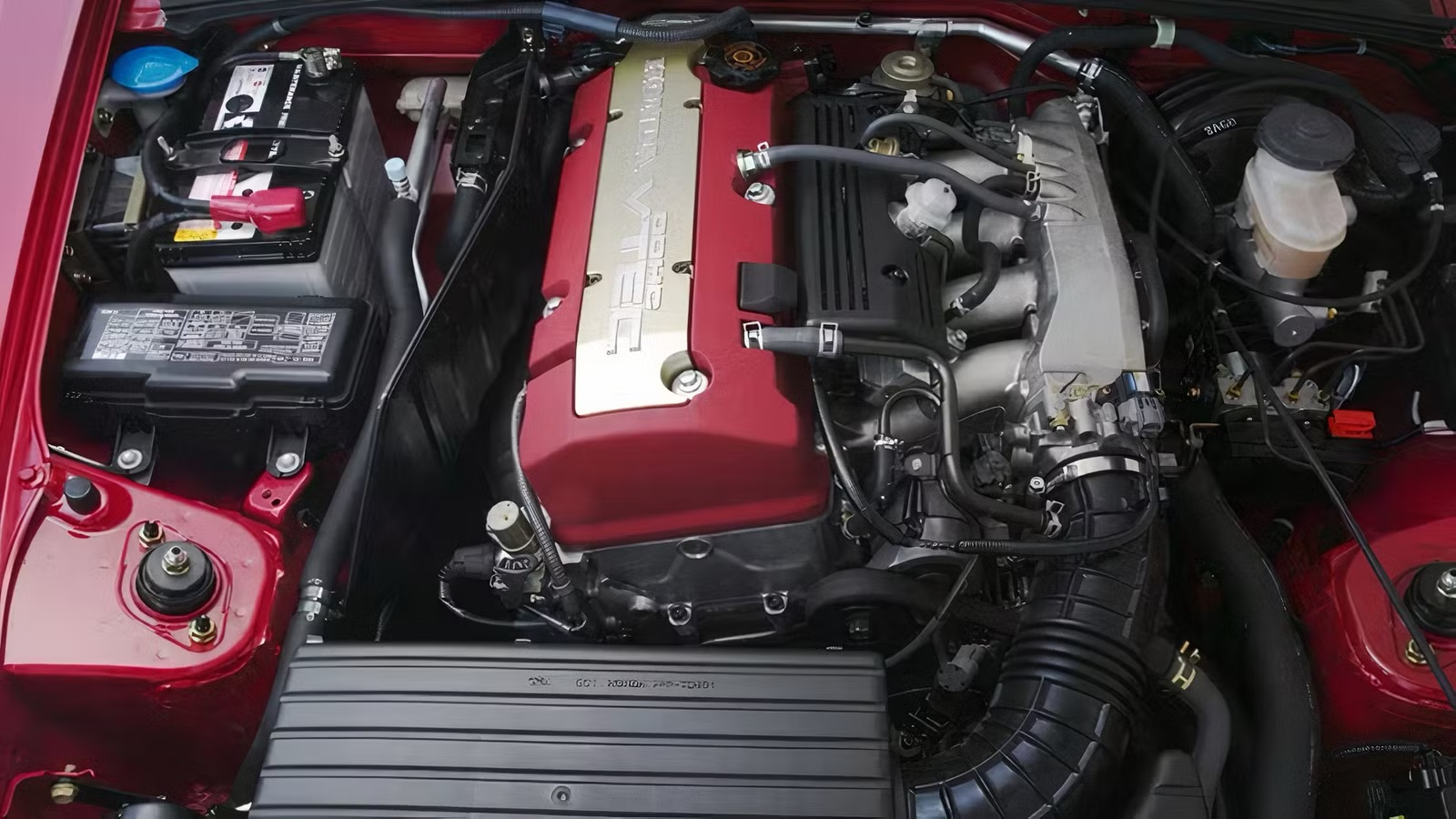
Underhood shot of the 2000 Honda S2000 showing the VTEC header on the 2.0-liter four-cylinder engineHONDA
When Honda introduced the F20C in the original Honda S2000 (2000 model year), it was immediately evident this wasn’t simply a tuned version of an existing engine (but Honda engineers have always been good at creating new engines for niche cars, like the 1991 Acura NSX). In the S2000, they focused on creating an engine that rewarded drivers who enjoyed exploring the upper reaches of the rev range.
The F20C also reflected lessons learned over decades of motorcycle and F1 racing, where high revs are more important than the low-end torque of drag-racing, which defined American sports cars of the time. To this day, few naturally aspirated engines deliver the same sense of urgency once the revs climb over the torque curve peak. Yet, it remained civil in everyday traffic, started reliably in varying conditions, and didn’t degrade into a maintenance nightmare.
How The F20C Earned Legendary Status
Underhood shot of a red 2000 Honda S2000 showing the VTEC header on the 2.0-liter four-cylinder engineHONDA
Throughout history, engines have earned admiration for specific characteristics like brute force (the Bugatti W-16, for example), aftermarket proliferation (the Chevrolet LS V-8) and bullet-proof reliability (Toyota’s 3.0-liter twin-turbo inline-six), to name but a few. The Honda F20C has acquired such status but not just for a singular trait, though its defining characteristic is producing 240 hp from just two liters of displacement.
It’s also known for its exclusivity (its sole application was in the S2000 roadster) and for its longevity, belying its high-stress, high-revving work environment. It powered the AP1 S2000 through its initial American run (2000–2003) and continued in other world markets for another six years, when the American S2000 switched to a de-powered larger engine—the 237-horsepower 2.2-liter naturally-aspirated “four.” The F20C then went away, save for a one-off application in the Spanish demonstration IFR Aspid, and in about 15 Australian Skelta G-Force hand-built sports cars.
The Peak Of Honda’s High-Revving Golden Era
Underhood shot of a gray 2000 Honda S2000 showing the VTEC header on the 2.0-liter four-cylinder engineHONDA
At a time when competitors were increasingly relying on larger engines to produce higher outputs, Honda engineers set about accomplishing the same objective without sacrificing exceptional fuel efficiency. The F20C’s signature feature is its 9,000-rpm redline, which encouraged drivers to rev the little engine into a frenzy and make the acceleration experience feel motorcycle-like.
1991 Acura NSX engineering schematicAcura
The F20C didn’t launch Honda’s reputation for exciting four-cylinder engines (that happened with the C-Series VTEC engine a decade earlier in the 1991 Acura NSX), nor would it become the most widely produced performance engine for Honda. Instead, it represents the peak of an era defined by uncompromising naturally aspirated ICEs, and the final chapter before tightening emissions regulations, changing consumer expectations and the invasion of turbocharging (and now electrification) reshaped the performance landscape.
How Honda Created Its Most Ambitious Four-Cylinder Engine
How Honda’s F1 And Motorcycle Racing DNA Shaped Every F20C Design Decision
Close-up shot of 2009 Honda S2000 engine bay showing the 2.2-liter four-cylinder engineHonda
Developing the F20C required Honda to resist every manufacturer’s temptation of taking familiar shortcuts. Instead of modifying an existing production engine, engineers approached the project by jumping through a series of hoops. The engine needed to rev higher than almost anything else in its class, yet remain smooth enough for daily driving; it had to produce exceptional specific output without resorting to forced induction; and it had to maintain emissions compliance and long-term durability.
Although the F20C was never intended to be a race engine, it carried many of the same engineering principles gained through Honda’s experience in motorcycle and Formula One racing. Not many daily drivers understand the importance of reducing reciprocating mass, optimizing engine breathing, maintaining stability at extremely high rpm, managing internal friction, combustion efficiency, and component strength, but they grew to appreciate that attention to detail as they drove every day.
Building On The Success Of Honda’s B-Series Engines
1999 Acura Integra Type R engineBring a Trailer
The F20C was a giant leap forward, but it didn’t happen overnight. Honda had spent more than a decade refining the formula for compact, high-revving performance engines through its B-Series (initially in the 1990 Acura Integra and Honda Prelude), later infused with VTEC technology (in the Acura Integra, and Honda Civic and Del Sol). The combination made the B-Series famous for its willingness to rev, its durability under hard use, and its remarkable adaptability for modifications.
1997 Acura Integra Type R front 3/4 shotBring a Trailer
The F20C wasn’t meant to be a mass-market replacement for the B-Series. Rather, it was an opportunity for Honda engineers to showcase performance by pushing the B-Series VTEC strategy much farther, with higher rotational speeds, greater specific output and even more refined operation to not just outperform the B-Series, but to push the limits of a naturally aspirated four-cylinder engine in a reliable production package.
A Bridge To The Modern K-Series
2025 Acura Integra Type S EngineAcura
Although the F20C occupied a niche role, its influence extended beyond the Honda S2000, with many lessons learned in exceptional airflow, combustion efficiency and mechanical durability. These are most evident in the K-Series engine family that debuted in the 2002 Acura RSX, and Honda Civic and CR-V, all of which used the new “intelligent” VTEC system (i-VTEC).
Unlike the single-model F20C application, the K-Series had to satisfy a much broader audience, and it made it into almost every model in the Acura and Honda lineups, from family sedans like the Honda Accord and CR-V, to enthusiast favorites like the Acura Integra Type S and Honda Civic Type R. It dialed back the high-revving personality of the F20C while forwarding Honda’s hallmark engine traits—efficient breathing, advanced valve timing and impressive durability.
What Made The F20C An Engineering Marvel
Cutaway illustration of a 2000 Honda S2000HONDA
In hindsight, the progression from B-Series to K-Series tells a coherent story, with the B-Series establishing Honda’s credibility and the K-Series successfully translating many of those engineering ideals into an engine family capable of moving millions of vehicles worldwide. The transition from B to K, though, might not have been as smooth, were it not for the forward-thinking of the F20C, and the generational sports car it powered.
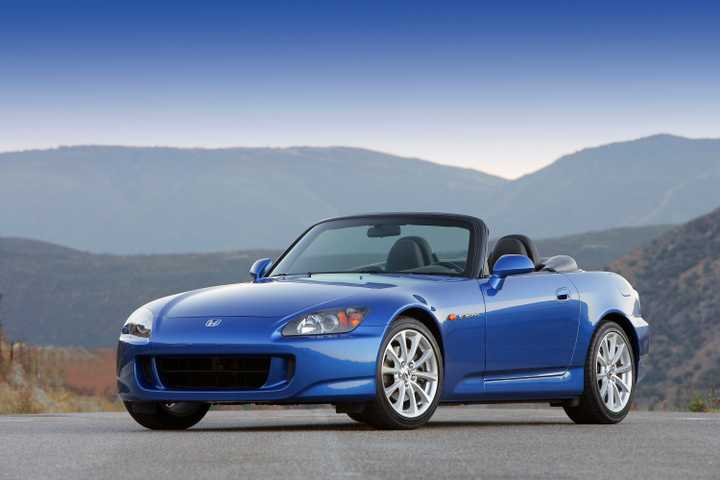
A side angle shot of a 1999–2003 Honda S2000 drivingHonda
Ask Honda S2000 enthusiasts what they remember best about the F20C, and the answer is rarely the 240 horsepower or 11.0:1 compression ratio. Instead, they talk about how the engine felt. Modern performance cars deliver enormous torque almost immediately, thanks to turbochargers, electric motors and sophisticated powertrain management systems. The F20C took a different approach. It rewarded patience, steadily building power as engine speed and sound climbed until it reached a euphoric crescendo near the 9,000-rpm redline.
High Revs Changed Performance Car Expectations
Front 3/4 of 2009 Honda S2000 going fast on a racetrackHonda
A rear three-quarter shot of a 1999–2003 Honda S2000 drivingHonda
Instead of short-shifting through the gears to make the most of peak bottom-end torque, Honda S2000 drivers held onto the six manual gears longer to explore the engine’s full operating range. The rising induction note, increasingly urgent acceleration and instinctual throttle response all collaborated to create an experience that remains distinctive to this day, and make many performance marques hang their heads.
Yet those high revs never felt forced or strained. The F20C retained an impressive level of smoothness and composure, reinforcing the impression that every internal component had been carefully engineered to perform flawlessly together toward the common goal of thrilling the driver pushing an engine to its high-speed limits. There are very few cars outside of ultra-performance models that can replicate it.
The Power Curve Is The F20C Party Trick
Detail shot of a blue 2002 Honda S2000 showing the instrument panel from the perspective of the driver’s seatHONDA
Like other 2.0-liter naturally aspirated ICEs, the F20C doesn’t generate explosive torque at low rpm (that’s usually a turbocharger’s or supercharger’s job). It just makes an adequate amount of torque. To take advantage of it, it’s incumbent on the driver to keep rpm around the torque peak, which is where automatic transmissions stumble and why the Honda S2000’s manual gearbox is so important, so the driver can work the gears to keep taking advantage of that adequate torque over and over again.
Torque builds as revs climb through the midrange (3,500–5,000, where a non-boosted ICE’s torque peaks then tapers down). At around 5,500 rpm, the VTEC system takes over engine breathing, and torque continues to build to a peak of 153 pound-feet at 7,500 rpm before falling off, but not fast enough to offset the tremendous engine speed. The F20C’s 240 horsepower peaks at 8,300 rpm, a blink before the 9,000 rpm redline, with the rev limiter starting to cut fuel off at 8,800 rpm. Shift up; do it again.
The Engineering Behind The Bulletproof F20C
rear 3/4 view of a grey 2008 Honda S2000 Type-S driving on a racetrackHonda
High-performance engines, especially high-revving units that extract large hp numbers from small displacements, tend to acquire a reputation for fragility. The F20C, though, has behaved in the opposite manner, provided it has been well maintained. Impressive build features include carbon-fiber-reinforced composite cylinder liners (instead of the traditional iron), a rigid aluminum ladder-type girdle housing for the main bearings (instead of conventional bearing caps), forged aluminum pistons and forged steel crankshaft and connecting rods.
Owners on S2KI forums regularly report meticulously-maintained original engines in the 200,000–300,000-mile range, with some documented around the 400,000-mile mark and one found with over 500,000. Wear items such as the timing-chain tensioner, intake valve retainers, and oil banjo bolts tend to need the most attention, and some owners swap them out for upgraded aftermarket components.
The Engine That Still Defines Honda At Its Best
Close-up shot of 2000 Honda S2000 engine bayBring A Trailer
The F20C occupies a unique place in automotive history because it represents more than impressive specifications. It embodies engineering excellence meant to deliver exceptional performance from a naturally aspirated engine, without compromising refinement or reliability. It was a bridge between the B-Series that gave Honda credibility, and the K-Series that became the company’s most influential modern engine family. But it was also the emotional centerpiece of the Honda engine lineup.
The F20C demonstrated that precision, efficiency and driver engagement could rival larger and more powerful engines by creating an experience that still resonates in today’s turbocharged landscape. The engine doesn’t simply provide propulsion and give the driver everything immediately; it makes the driver earn it by choosing the gear, managing the revs, anticipating the VTEC transition, and deciding how long to hold near its limit.
front 3/4 view of a white 2009 Honda S2000 Ultimate Edition drivingHonda
It enjoys enduring respect among enthusiasts, restorers, and aftermarket specialists alike, while its sole recipient—the Honda S2000 sports car—has become one of the most collectible Japanese sports cars of its generation. Replacement parts, performance upgrades and dedicated communities are plentiful and widespread, decades after production ended.











No Comments