
Royal Enfield Copied A German Design To Build A 56-KG Paratrooper Bike
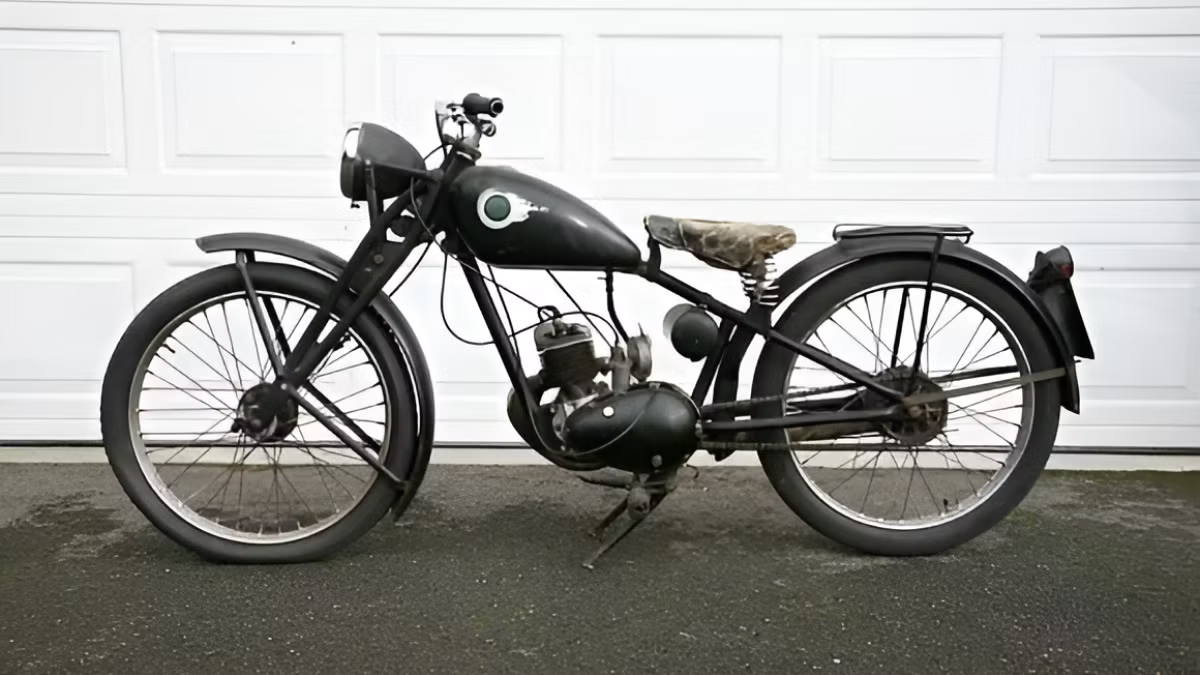
A motorcycle weighing just 56 kg (or 123 pounds) that could travel approximately 150 miles on 1.5 gallons of fuel sounds like an engineering marvel. It was. This tiny two-stroke was built for one of the most demanding environments imaginable: World War II battlefields. Its origins are even more unusual. A German motorcycle design reached Britain after its Dutch distributor refused Nazi demands to dismiss its Jewish directors. British engineers subsequently enlarged the engine, adapted it to run on poor-quality wartime fuel, and developed a way to parachute it behind enemy lines. It became one of the most ingenious lightweight military motorcycles of its era.
A German Motorcycle Inspired An Unlikely British Military Project

The story begins with the DKW RT100, a lightweight German two-stroke motorcycle. Its journey to Britain was prompted by political pressure rather than a conventional military espionage exercise. In 1938, the Nazi regime pressured Dutch DKW distributor R S Stokvis & Zonen to dismiss its Jewish directors. Rather than comply, the company reportedly sent an RT100 to Royal Enfield in England, asking the British bikemaker to reverse-engineer the motorcycle and develop an improved version.
The German motorcycle offered an attractive starting point. Its compact engine, simple construction, and lightweight chassis made it suitable for a military application where conventional motorcycles would be unnecessarily cumbersome. Royal Enfield could retain the basic engineering while modifying the components that needed to withstand more demanding conditions.
Royal Enfield’s Chief designer, Ted Pardoe, was tasked with developing the machine further. His most significant change involved increasing the engine’s displacement to provide more usable performance for military duties.

Royal Enfield Enlarged The Engine To Create The 126cc Flying Flea

The resulting Royal Enfield WD/RE, better known as the Flying Flea, used a 126cc air-cooled single-cylinder two-stroke engine. This was an increase over the DKW RT100’s original 98cc displacement, giving the British motorcycle more capacity for carrying military equipment and navigating difficult terrain.
However, increasing displacement was only part of the engineering exercise. The motorcycle needed to operate reliably with inconsistent, low-octane gasoline commonly encountered in wartime conditions. Royal Enfield addressed this by fitting a low-compression piston, allowing the engine to tolerate poorer-quality fuel. At approximately 56 kg (123 lbs), the Flying Flea was exceptionally lightweight. Its 1.5-gallon fuel tank reportedly provided around 150 miles of range at speeds of around 35 to 40 mph. Some historical accounts even claim a 250-mile range.
The motorcycle also featured a three-speed hand-change gearbox and a distinctive front suspension arrangement. Instead of conventional coil springs, its pressed-steel forks used rubber bands to provide suspension, reducing weight and mechanical complexity. One particular thoughtful feature was incorporated into the fuel cap. A measuring tube helped soldiers determine the correct quantity of lubricating oil when mixing two-stroke fuel.
The Flying Flea Was Designed To Be Dropped Behind Enemy Lines

Getting a motorcycle onto a battlefield was a considerable logistical challenge. Conventional motorcycles were too heavy and cumbersome for airborne deployment, so Royal Enfield developed a tubular steel cradle to protect the Flying Flea during parachute drops. The motorcycle could be secured inside this structure and released after landing, giving paratroopers access to transportation without requiring a conventional vehicle transport system.
However, parachuting the motorcycle was not always straightforward. The combined weight of the motorcycle and its cradle exceeded 200 lbs, making it difficult for soldiers to handle when exiting an aircraft. Consequently, many were transported using military gliders, which could carry four motorcycles at a time.
The War Department initially ordered 4,000 examples. However, according to the BBC, eventually around 8,000 Flying Fleas were built. The motorcycles saw action during the D-Day landings, and close to 600 examples accompanied the 3rd Infantry onto Sword Beach, where mounted beachmasters used them to coordinate troops and navigate the obstacle-strewn coastline. The Flying Flea was never intended to win races or carry heavy loads. Its purpose was to give soldiers mobility where larger vehicles could not go. In that respect, its low weight was arguably its greatest military advantage.
Royal Enfield’s Electric Flying Flea Is A Very Different Motorcycle

The Flying Flea name has returned through Royal Enfield’s dedicated electric motorcycle brand, although the modern interpretation is considerably different from its wartime predecessor. The first model, the C6, brings retro-inspired styling together with an electric powertrain, a forged aluminum girder fork, and a magnesium battery casing. It weighs approximately 124 kg (273 lbs), more than twice the original motorcycle’s 56 kg figure. The C6’s 3.91 kWh battery is claimed to deliver an Indian Driving Cycle (IDC) range of 154 km (96 miles). That’s a substantial difference from the original Flying Flea’s commonly quoted 150-mile range.
Royal Enfield has also expanded the electric family with the Flying Flea S6, a scrambler-inspired motorcycle showcased at EICMA 2026. It retains the C6’s basic platform but adds longer-travel suspension, wire-spoke wheels, an enduro-style seat, and a dedicated off-road riding mode.
The original Flying Flea demonstrated how much a small motorcycle could accomplish when its engineering matched its purpose. Its electric successor has a very different mission, but it carries forward a name earned by an unusually resourceful piece of engineering.

Related posts

Latest Post


No Comments