
The Roadster That Reminds You Why You Fell In Love With Motorcycles
The love for motorcycles is usually a personal story, and for some, racing sowed the seeds. Back in 1958, a young Mike “the Bike” Hailwood rode a 650cc Triumph twin to victory in the grueling Thruxton 500, a result that built Triumph’s reputation for a decade before Malcolm Uphill cemented it at the Isle of Man TT. Getting a production bike around the fearsome TT course at 100mph took a stripped chassis, a rider crouched low over the tank, and a ton of courage for three laps straight. What followed was a nine-time world champion’s career, and a bike that became the genesis of a custom generation, built in sheds, admired in café parking lots, raced against a stopwatch.
Triumph’s Obsession And The Race To Hit The Ton And

The Ace Café sat on London’s North Circular Road, a transport stop for truck drivers until the jukebox behind the counter started pulling in a very different kind of crowd. Riders would drop a coin, pick a record, then try to circle the roundabout up the road, and go back to the counter before the song ended. These were the Ton-Up Boys, donning leather jackets with rock and roll setting the theme.

Triumph’s own racing department was chasing the same goal at race circuits. Hailwood’s Thruxton 500 win stuck a nickname on the T120 engine that raced there, and by 1965, Triumph turned it into an actual production bike. A limited 52-unit homologation special built at the Meriden Works was sold under the Thruxton name for the first time. Six decades and several engine generations later, one version of that name still carried the highest state of tune Triumph had ever put into a road-going Bonneville.
The Triumph Thruxton RS Reminds You Why You Fell In Love With Motorcycles


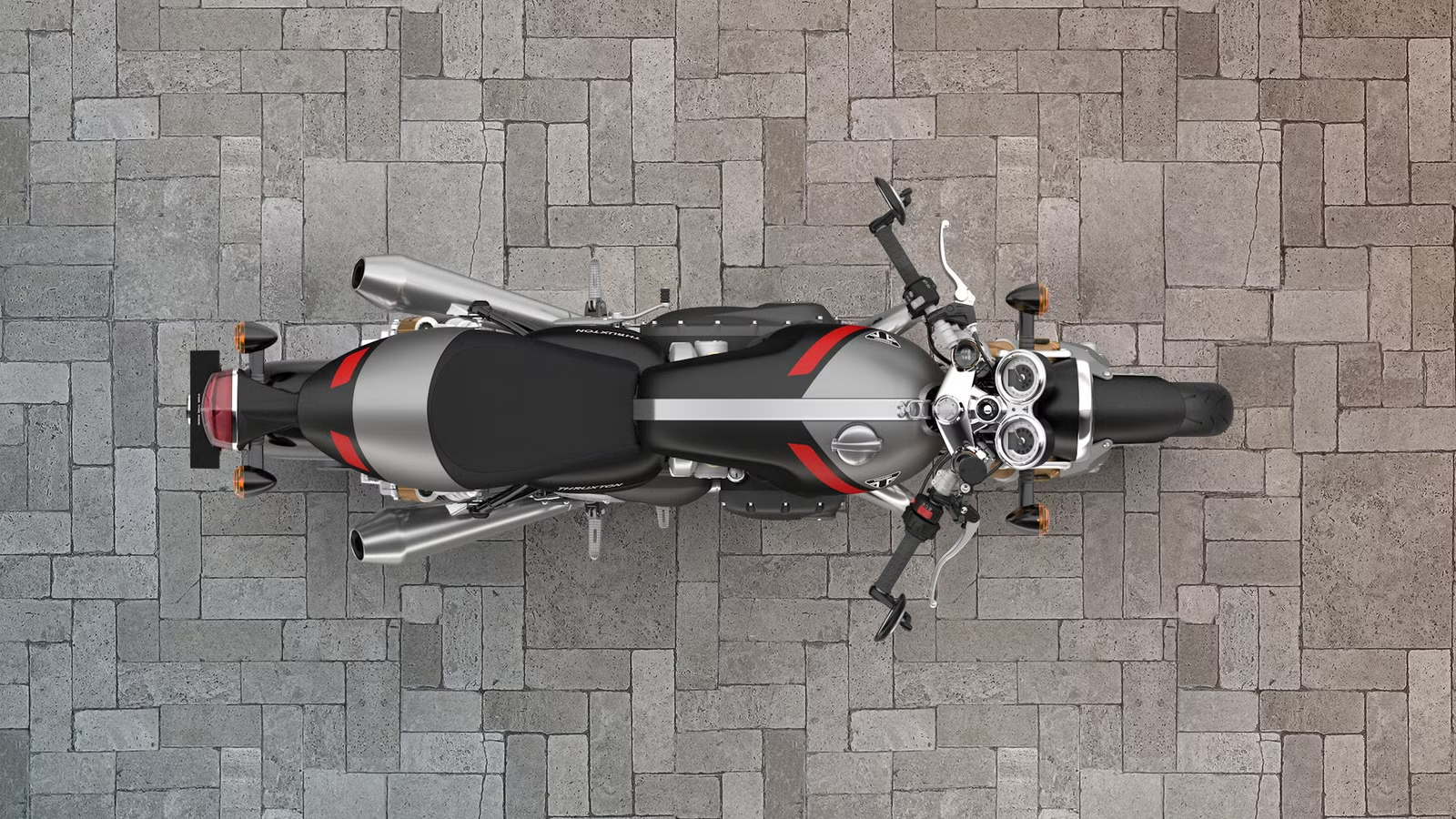
Triumph built the Thruxton RS from 2020 through the 2024 model years before Triumph pulled the plug on it. Built off the same Bonneville platform that underpins every other Triumph modern classic, the RS took the High Power 1200cc parallel twin and pushed it further than any road-going Bonneville Triumph had tuned before. It was then wrapped in sports bike-derived suspension and brakes for the RS trim.
The Most Powerful Bonneville Triumph Has Built

With its vintage racing DNA still alive and active, Triumph fitted the RS with a low-inertia 270-degree crankshaft, lightweight clutch, balance shafts, a rare-earth alternator, a magnesium cam cover, and thin-walled engine covers, all to cut rotational inertia by 20 percent against the standard Thruxton R engine it’s based on.

This lets the Thruxton RS’ parallel-twin rev 500 rpms higher before hitting the limiter and deliver peak torque 700 rpms lower in the range, so the power arrives sooner and keeps building longer instead of running out of breath. The result is 104 horsepower at 7,500rpm and 83 lb-ft at 4,250rpm, eight more horsepower than the standard version made and the highest output road-legal Bonneville twin.
Hardware That Separates The RS From Other Bonnevilles

Triumph’s other modern classics run chassis setups that are understandably tuned for comfort. The RS breaks the norms and runs a 43mm Showa Big Piston fork with a pair of fully adjustable Öhlins piggyback shocks, both good for 4.7 inches of travel. Twin 310mm floating discs and Brembo M50 radial monobloc calipers handle the stopping power. Triumph even specced Metzeler’s Racetec RR tire as standard, a tire favored for track days more than daily use. The RS package came in under a claimed dry weight of 434 pounds.
Clip-Ons And A Solo Seat Set The Riding Position

Triumph mounted the clip-on bars just 29.3 inches apart and low, just as an authentic café racer ought to have. Coupled with rearset footpegs pulling the knees up and back into a crouch apt for leaning into a corner aggressively, the riding position is pretty committed for regular use. A single bullet seat comes standard, with a body-colored rear cowl to match the tank, while a pillion seat kit was sold separately.

The dash swaps a modern TFT screen for twin analog clocks with small LCD inserts, tracking gear position, range, and fuel consumption. LED lighting up front and at the rear is the one nod to 2020s expectations, but everything else about the Thruxton RS was built keeping in mind the retro-cool of the original, for a generation that wants modernity underneath.
You Can Get A Thruxton RS From The Used Market

The Thruxton is truly a beautiful motorcycle, and you’d wish that you got one earlier. However, the only way you can get one now is by scanning through the used listings today; that already reflects a bike that’s becoming hard to find in good condition. While high-mileage Thruxtons are available for just under $10,000, early 2020 examples with low mileage are priced around $11,000, while later examples push toward $15,000. There are a handful of sub-2,000-mile examples even asking for prices above the original tag of $16,995.

A five-year-old motorcycle asking for more than its new price is unusual, and that says more about how few RS models Triumph actually built as well as its enduring legacy that riders are chasing. A thing to look out for while shopping is to confirm if the bike is genuinely an RS and not a standard Thruxton R wearing aftermarket badges. The two share the bodywork but not the tuned engine or Brembo M50 calipers that justify the RS premium.
The Thruxton RS Against Its Closest Café Racer Rivals

Kawasaki’s Z900RS Café ABS is the closest match in spirit and price, $13,299 for a classic half-faired café silhouette wrapped around a 948cc inline-four making 115 horsepower and 73 lb-ft. It carries a full electronics suite that the RS never offered, including IMU-based traction control and a bidirectional quickshifter. Despite these features, the Z900RS is simply a neo-retro example among the others and carries no real lineage and history as the Thruxton, and that’s precisely why the latter is a hidden gem.

Royal Enfield’s Continental GT 650 undercuts both by a wide margin at $6,349, for which you get a 648cc parallel twin making 47 horsepower and 38 lb-ft that trades outright pace for accessibility. And there’s Moto Guzzi’s V7 Sport, which too is competitively priced at $10,990, with an 853cc V-twin making 67 horsepower and 58 lb-ft.

Then again, the whole point of the Thruxton RS is its history, and the connection comes from the very love for that history, thus motorcycles, and names from that era. And that’s exactly why you’d painstakingly hunt for a good, well-kept example. No wonder we crowned it “The Best Café Racer of 2024,” and two years on, we’re willing to stand by the claim.
Source: Triumph Motorcycles, Cycle Trader

Related posts

Latest Post


No Comments