The Toyota That Has A More Upscale Interior Than You’d Expect
8 minutes reading
Saturday, 12 Sep 2026 17:00 0 53 autotech
Luxury cars are typically niche and low-volume sellers, with margins decreasing with each year that passes. Cars that operate in this segment often make for poor investments, with depreciation rates being one of the worst across the entire car market, primarily due to their poor long-term reliability standards.
Maintaining an out-of-warranty luxury car often requires hefty investments to keep it on the road, ultimately making such cars undesirable. This is one of the most noteworthy reasons why many steer clear of these products. However, demand for more premium features across the new car market has exponentially increased in recent years, resulting in formerly budget offerings evolving into somewhat more luxurious cars.
2027 Mercedes-Benz S-Class front cabinMercedes-Benz
Modern European luxury car interior design centers around expansive digital screens, dynamic ambient lighting, and eco-conscious synthetic textiles. Manufacturers prioritize immersive cockpit experiences, integrating full-width dashboard glass displays, augmented reality heads-up projections, and software-driven personalized interfaces. Cabin layouts lean heavily into ultra-minimalism, eliminating traditional physical switchgear to present seamless visual surfaces. Ambient illumination functions as both a decorative highlight and an interactive driver-alert system. Manufacturers also replace traditional leather options with high-end sustainable alternatives, including recycled microfibers, bio-based vinyls, and open-pore wood finishes.
However, this technology-driven direction faces growing consumer and industry criticism. Critics argue that excessive screen dominance creates dangerous driver distraction by forcing simple functions into complex touchscreen menus. The extensive replacement of physical knobs with touch-capacitive controls generates frustration due to imprecise haptic feedback and accidental inputs. Furthermore, reviewers highlight noticeable declines in tactile quality. The reliance on glossy piano-black plastics, fingerprint-prone glass surfaces, and lightweight synthetic materials draws sharp disapproval. Automotive analysts note that these cost-cutting measures are disguised as modern minimalist tech, compromising the substantial material solidity historically expected from German luxury cabins.
Toyota Ups Cabin Refinements Across Its Catalog
Shot of 2026 Toyota Camry interior showing dashboardToyota
Toyota’s North American lineup has undergone a strategic transformation, pivoting toward a more aspirational identity by integrating premium materials and sophisticated technology into its top-tier grades. This evolution is most evident in the brand’s highest trims, which now feature high-grade leathers, advanced acoustic glass, and premium audio systems that rival dedicated luxury marques. By focusing on elevated interior aesthetics and refined driving dynamics, the brand has successfully captured a demographic of buyers seeking a sophisticated experience without the perceived pretension of a traditional luxury badge.
Crucially, this move upmarket has been executed without compromising the core mechanical integrity that underpins the brand’s reputation. By sharing global architectures and applying proven powertrain configurations across these premium trims, the manufacturer ensures that increased complexity does not undermine its industry-leading reliability or the exceptional value retention that remains a primary motivator for its customer base.
The Camry XLE And XSE’s Premium Interiors
An interior shot of the front of the cabin of the 2025 Toyota Camry XSE.Toyota
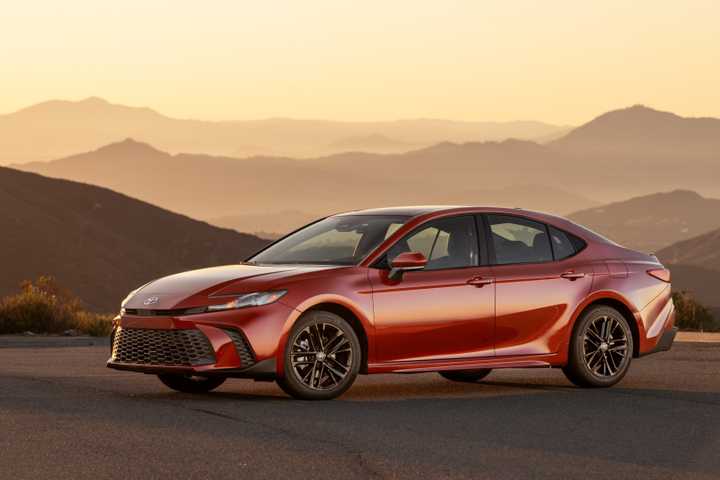
The most expensive Camry options are the XLE and XSE, priced at $34,800 and $36,000, respectively. For reference, the base Mercedes-Benz C-Class equivalent costs $49,650. On the exterior front, the XLE comes standard with heated and electrically adjustable door mirrors, LED exterior lighting, blacked-out exterior trimmings, and a dark metallic gray horizontal bar front grille. The standard wheel of choice is the 18-inch two-tone multi-spoke alloy set. The XSE follows the same design language, but with a more athletic approach. This includes dual chrome exhausts, racing-inspired gloss-black air curtains, color-keyed front-side canards, sport mesh front grille and rear lower diffuser, and 19-inch smoked gray and black-finished alloy wheels.
2025 Toyota Camry XLE AWD Interior showing front cabinCraig Cole | TopSpeed
The interior is where these two trims start to feel a bit more special. Here you’ll find white ambient interior lighting, an auto-dimming rearview mirror with HomeLink, a wireless smartphone charger, and a collection of five USB ports located across the front and rear for charging and data transfers. Additional comfort features include dual-zone climate control, leather- and microfiber-trimmed seats, front electrically adjustable seats with heating, and Toyota’s 12.3-inch digital instrument cluster. At the center of the dash, you get a 12.3-inch touchscreen infotainment system, including wireless Android Auto and Apple CarPlay. Appearance-wise, the XSE takes the same cabin and adds a layer of sportiness.
Spacious And Practical Interior Packaging
Side shot of 2026 Toyota Camry interior showing front seatsToyota
The 2026 Toyota Camry provides a spacious five-passenger cabin with 99.9 cubic feet of overall passenger volume. Front occupants receive 38.3 inches of headroom, which adjusts to 37.5 inches when equipped with a sunroof, and a generous 42.1 inches of legroom. Rear-seat passengers get 37.6 inches of headroom alongside 38.0 inches of legroom. For luggage and daily cargo, the trunk offers 15.1 cubic feet of storage space, which can be expanded by utilizing the standard 60/40 split-folding rear seatbacks.
Premium Reliability At Its Best
Shot of 2026 Toyota Camry lineupToyota
In terms of depreciation, iSeeCars indicates that the model will lose $10,829 or 37.7 percent of its resale value after five years or 60,000 miles, which is a bit less than the average competitor in the midsize hybrid sedan segment.
J.D. Power gives the 2026 Toyota Camry model year an 82/100 consumer-verified overall score, including 80/100 for quality and reliability, 82/100 for the driving experience, 92/100 for resale, and 76/100 for the dealership experience.
This generation of the Toyota Camry currently holds a 4.2/5 owner review score on Edmunds, with key strengths being its reliability and manufacturing quality, driving experience, and fuel efficiency. It does lose some points for offering uncomfortable seating and a poor standard sound system.
Impressive Long-Term Ownership Appeal
Front 3/4 action shot of 2026 Toyota Camry in blue being drivenToyota
The Camry’s impressively low maintenance and long-term running costs are a major reason why so many American consumers continue to back it as their daily driver. According to Edmunds‘ True Cost To Own calculator, you can expect a new front-wheel-drive 2026 Toyota Camry XLE to cost you an additional $37,085 over the course of five years and 60,000 miles. This includes $14,591 worth of depreciation. You’ll also find yourself spending $3,290 on maintenance and $601 on repairs. Fuel is also only likely to cost you around $4,985.
According to CarEdge, you can expect to spend $36,433 on your Camry over the same period, which includes $14,274 on depreciation, $4,530 on fuel, and $1,512 on maintenance.
iSeeCars gives the Camry range an 8.2/10 overall score, including 8.1/10 for reliability, 8.6/10 for retained value, and 8.0/10 for safety. The publication indicates that the model will run for 13.1 years or 171,785 miles without encountering any noteworthy mechanical issues, together with a 31.7 percent probability of hitting 200,000 miles.
The Added Benefit Of Low Fuel Consumption
Rear 3/4 action shot of 2026 Toyota Camry in red being drivenToyota
The main reason why you’d even be considering a new Toyota Camry is for its impressively low fuel consumption figures. Based on the EPA’s testing of the model, the new-generation midsize sedan excels at optimizing both range and fuel consumption. The front-wheel-drive XLE and XSE are the most preferable of the lot, boasting a 46 MPG combined fuel consumption estimate and a 598-mile range claim. The all-wheel drive XSE sits at the opposite end of the spectrum, with its 43 MPG combined fuel consumption estimate and 559-mile range figure.
The 2026 Toyota Camry HEV AWD XLE carries an MSRP of $35,825 and generates estimated five-year fuel savings of $4,250 compared to the average new vehicle. It requires an annual fuel cost of $1,350, with a cost of $2.23 to drive 25 miles. The higher-trim 2026 Toyota Camry HEV AWD XSE has an MSRP of $37,025 and saves $3,750 in fuel costs over five years. This model incurs an annual fuel cost of $1,450, translating to a cost of $2.38 to drive 25 miles. Both trim levels feature a 13.0-gallon fuel tank that costs $53 to fill completely.
Performance Figures Reflect Its Mainstream Status
Close-up shot of 2026 Toyota Camry engine bayToyota
The current-generation Camry range carries over the previous-generation model’s trusted naturally aspirated 2.5-liter four-cylinder Atkinson-cycle engine, which produces 184 horsepower and 163 pound-feet of torque.
The front-wheel-drive model features a pair of electric motors that generate a combined 134 horsepower and 153 pound-feet. Toyota doesn’t give us a combined torque figure, but it confirms that it limits peak power to 225 hp.
The all-wheel drive model adds a third electric motor to the rear axle, producing 40 hp, 62 lb-ft, which increases the peak output to 232 hp.
Why America Continues To Support The Camry
Front view of 2026 Toyota Camry in red parkedToyota
The 2026 Toyota Camry remains a cornerstone of the American automotive sedan segment, functioning as a primary volume-seller for the Japanese company. This is despite Toyota adopting an SUV and crossover-focused strategy. Toyota markets this model to a broad demographic of pragmatic buyers, including daily commuters and growing families who prioritize long-term value, reliability, and low maintenance costs over the rugged image of an SUV.
Toyota has pivoted the current-generation model’s strategy to focus more on electrification by adopting a hybrid-only powertrain offering. This evolves the Camry into a leader in efficiency and environmental consciousness without sacrificing its core reputation for durability. Toyota also manages to maintain a competitive entry price and offer optional all-wheel drive across every trim level.
Base Trim Engine
2.5-liter Four-Cylinder Hybrid
Base Trim Transmission
CVTi-S CVT
Base Trim Drivetrain
Front-Wheel Drive
Base Trim Horsepower
184 HP @6000 RPM
Base Trim Torque
163 lb.-ft. @ 5200 RPM
Make
Toyota
Model
Camry
Segment
Midsize Sedan
Sources: Edmunds, iSeeCars, J.D. Power, and the EPA.










No Comments