The Toyota SUV With Honda Reliability And Range Rover-Level Comfort
9 minutes reading
Sunday, 4 Oct 2026 12:00 0 43 autotech
Luxury SUVs promise quiet cabins, supple rides, and seats comfortable enough to make a long drive feel short. Unfortunately, that experience can arrive with a painful catch. Air suspension, complicated drivetrains, and layers of electronic equipment can turn yesterday’s luxury bargain into tomorrow’s repair bill. At the other end of the showroom, dependable mainstream SUVs frequently sacrifice refinement for practicality. One Japanese crossover challenges that division. It combines the low-stress character expected from Honda or Toyota with cabin comfort that approaches vehicles wearing far more prestigious badges, and it starts for nearly $17,000 less than a Range Rover Velar.
Comfort is easy to appreciate during a test drive, but the systems producing it can become liabilities after the warranty ends. Height-adjustable air suspension, adaptive dampers, turbocharged engines, and complicated AWD systems help luxury SUVs feel special. They also add components that can eventually require expensive repairs.
That does not make a Range Rover Velar a bad SUV. Its polished cabin, 14-way memory front seats, panoramic roof, and composed highway manners establish a legitimate luxury benchmark. However, its $61,600 starting price also places it in a different financial category from a typical family crossover.
The mystery Toyota takes a simpler route. It uses a naturally aspirated engine, an established hybrid layout, an eCVT, and a conventional suspension. That hardware cannot replicate a Range Rover’s complete driving experience, but it can deliver the comfort most commuters actually use without carrying the same degree of mechanical complexity.
Reliability Has To Be Supported By More Than A Badge
Shot of 2026 Toyota Crown Signia Limited front seatsLyndon Conrad Bel | TopSpeed
No responsible reliability verdict can be made from a nameplate alone. This particular Toyota is still too new to have meaningful 10-year ownership data, making any claim that it is already bulletproof premature. The evidence instead comes from its underlying hardware and Toyota’s broader dependability record.
The 2026 J.D. Power Vehicle Dependability Study gave Toyota Motor Corporation eight model-level awards, more than any other manufacturer. Those winners included the Toyota Camry, Corolla, 4Runner, Sienna, and Tacoma, as well as three Lexus models. That does not guarantee the same outcome for a newer vehicle, but it demonstrates that Toyota continues to produce award-winning models across several segments.
The hybrid components also receive eight years/100,000 miles of warranty coverage, while the hybrid battery is covered for 10 years/150,000 miles. This is the Honda-like ownership argument: proven-style engineering, meaningful warranty protection, and fewer exotic chassis systems that are likely to become expensive. Warranty coverage and awards can make the ownership argument — but they don’t explain why driving this SUV feels unexpectedly close to something that costs $17,000 more. That part requires getting inside.
The Toyota Crown Signia Connects Both Worlds
Its Hybrid Powertrain Prioritizes Smoothness Over Speed
2026 Toyota Crown Signia Limited front shotLyndon Conrad Bell | TopSpeed
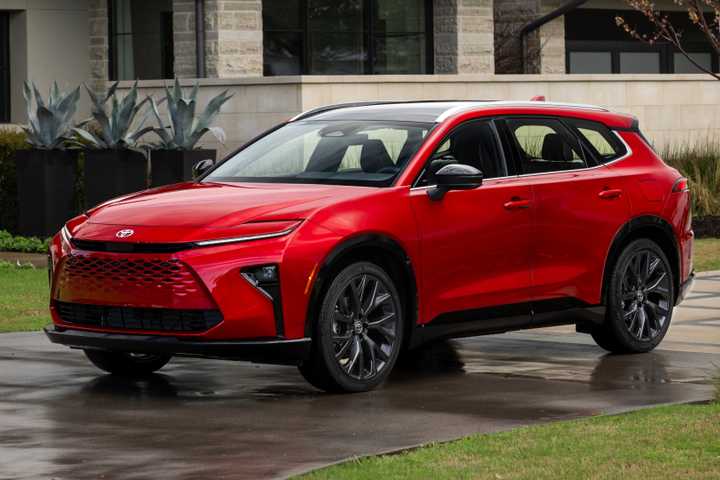
The SUV filling this unusual gap is the 2026 Toyota Crown Signia. It sits somewhere between a traditional midsize SUV and a tall luxury wagon, giving it a lower, sleeker profile than a Highlander without sacrificing the versatility of a liftgate.
Every Crown Signia uses a 2.5-liter four-cylinder hybrid system producing 240 horsepower. An eCVT delivers power via standard electronic on-demand AWD, which uses an electric motor to drive the rear wheels when additional traction is needed.
This is not a performance SUV, recording a 7.8-second 0-60-mph sprint time, and the four-cylinder engine becomes noticeable when you demand full acceleration. Around town, however, electric assistance provides a smooth initial response without the repeated gear changes of a conventional automatic transmission. The powertrain is best when you stop chasing speed and let it settle into its relaxed character.
38 MPG Combined Changes The Luxury Equation
A front view of a 2026 Toyota Crown Signia being driven on a roadToyota
The Crown Signia returns 39 city/ 37 highway mpg, and 38 mpg combined. Those figures make it considerably more efficient than most similarly sized luxury SUVs, especially models powered exclusively by gasoline engines.
The difference becomes substantial over time. At 12,000 miles per year, a Crown Signia achieving 38 MPG would consume approximately 316 gallons. A luxury SUV returning 23 MPG would require about 522 gallons to travel the same distance. That is a difference of roughly 206 gallons every year.
Efficiency is not its only practical advantage. The Crown Signia runs on regular gasoline, comes standard with AWD, and can tow up to 2,700 pounds. It will not replace a body-on-frame SUV for pulling a large camper, but it can handle a small utility trailer without forcing you into a larger, thirstier vehicle.
The Cabin Comes Surprisingly Close To Luxury-SUV Standards
Toyota Used More Than Leather To Create A Premium Experience
Front interior picture of a 2026 Toyota Crown SigniaToyota
The Range Rover comparison begins making sense once you get inside. Toyota fitted the Crown Signia with acoustic front-side glass and additional sound insulation to reduce wind and road noise. These details are less visible than a large touchscreen, but they contribute more to how expensive a vehicle feels during a long trip.
The standard equipment reinforces that impression. The XLE includes leather upholstery, heated and ventilated front seats, heated rear seats, a heated steering wheel, and dual 12.3-inch displays. Edmunds described its front seats as being among the best available in a current Toyota, citing their cushioning, support, and adjustability.
A Range Rover still offers more design theater, richer materials in certain areas, and greater opportunity for personalization. The Crown Signia’s achievement is not that it perfectly copies a Range Rover. It is that it delivers the quietness, seating comfort, and relaxed atmosphere many buyers want at a much lower price.
Its Suspension Is Tuned For Relaxation
2026 Toyota Crown Signia front 3/4 shotToyota
The Crown Signia does not pretend to be a tall sports sedan. Its steering and suspension prioritize stability and comfort rather than aggressive cornering. A 112.2-inch wheelbase helps it settle into a composed highway ride, while its relatively low body reduces the top-heavy sensation found in taller crossovers.
Wheel selection matters, though. The XLE rides on 19-inch wheels, while the Limited uses 21-inch wheels. The larger wheels give the Limited more visual presence, but their shorter tire sidewalls provide less cushioning between the cabin and damaged pavement. If ride comfort is the priority, the less expensive XLE may have the more appropriate setup.
The compromise appears under hard acceleration, when the engine note interrupts the otherwise quiet experience. Once cruising, the Crown Signia returns to what it does best: covering distance without constantly calling attention to its powertrain or chassis.
Practicality Comes With A Few Important Limits
The Crown Signia Trades Third-Row Space For A Quieter, Sleeker Profile
A picture showcasing the 2026 Toyota Crown Signia’s cargo spaceToyota
The Crown Signia is strictly a five-passenger vehicle. It provides approximately 25 cubic feet of cargo space behind its second row and up to 68.8 cubic feet with those seats folded. That gives it more flexibility than a sedan, but it cannot replace a Grand Highlander for a family that regularly needs three rows.
Its front compartment is the more convincing half of the cabin. You get 42.1 inches of front legroom, but the sloping roof creates a tighter second row than the exterior dimensions might suggest. Taller rear passengers may notice less headroom and legroom than in a more upright midsize SUV.
You are ultimately trading some passenger volume for the Crown Signia’s lower roof, quieter highway character, and wagon-like appearance. That works for a couple or a small family, but buyers carrying several adults should sit in the rear seat before making a decision.
Standard AWD Does Not Make It A Range Rover Off-Road
Rear three-quarter shot of a 2026 Toyota Crown Signia in bronzeToyota
The Crown Signia’s standard AWD adds confidence in rain and snow, but its 6.7 inches of ground clearance, road-focused tires, and lack of low-range gearing clearly define its mission. It can handle a well-maintained gravel road or a slippery driveway, but it is not engineered for deep water, difficult trails, or serious rock crawling. The Range Rover comparison should end with cabin comfort, since the two vehicles’ off-road capabilities fall into entirely different categories.
The XLE May Be The Smarter Crown Signia To Buy
The Base Model Keeps Heated Seats, Ventilation, And 38 MPG — And Saves You $4,400
The 2026 Crown Signia XLE starts at $44,690, while the Limited begins at $49,090. That $4,400 difference makes the XLE the more convincing expression of the Crown Signia’s value.
Choosing the XLE does not mean giving up the fundamentals. It retains the same 240-horsepower hybrid system, standard AWD, leather-trimmed seating, heated and ventilated front seats, heated rear seats, and 12.3-inch displays. It also wears the smaller 19-inch wheels, which better support the vehicle’s comfort-first personality.
More importantly, the XLE delivers the same 38 combined MPG rating, 2,700-pound towing capacity, cargo dimensions, and passenger space as the Limited. You are not paying less for a weaker powertrain or a compromised cabin.
The Limited’s $4,400 Upgrade Is Panoramic Roofs And Sound — Not Performance
Prorile shot of 2026 Toyota Crown Signia Limited parked off-roadLyndon Conrad Bell | TopSpeed
The Limited adds 21-inch wheels, a fixed panoramic glass roof, rain-sensing wipers, an 11-speaker JBL audio system, a digital rearview mirror, and additional available technology. Those features make it look and feel more expensive, but they do not improve its performance, fuel economy, or practicality.
If the panoramic roof and upgraded stereo matter, the Limited remains a reasonable indulgence. If comfort, efficiency, and long-term value are the priorities, the XLE is difficult to ignore.
The Crown Signia cannot tow, accelerate, or travel off-road like some luxury SUVs, and its short history prevents any definitive long-term reliability verdict. What it offers is arguably more relevant to everyday ownership: quiet cruising, excellent front seats, standard AWD, 38 combined mpg, and familiar Toyota hybrid engineering. That combination does not reproduce everything a Range Rover represents, but it delivers much of the comfort without asking you to accept the same purchase price or mechanical complexity.
Base Trim Engine
2.5-liter 4-Cylinder Hybrid
Base Trim Transmission
CVTi-S
Base Trim Drivetrain
All-Wheel Drive
Base Trim Horsepower
188 HP @6000 RPM
Base Trim Torque
178 lb.-ft. @ 4300 RPM
Make
Toyota
Model
Crown Signia SUV
Segment
Compact SUV
Sources: Toyota, Edmunds, J.D. Power, Range Rover, Kelley Blue Book









No Comments