
The Three-Wheeler That Quietly Masters Cross-Country Travel
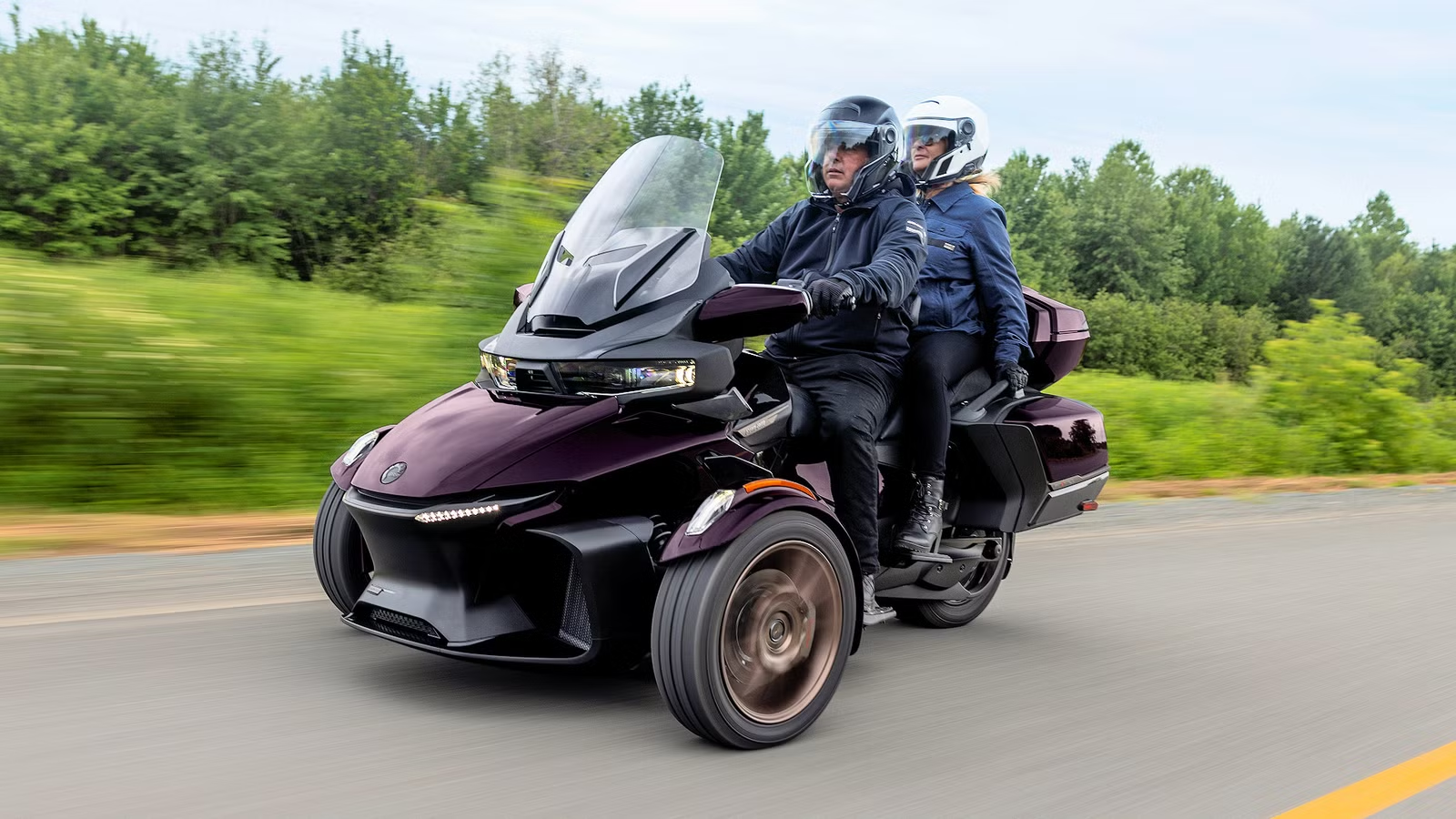
Two wheels move the soul, they say, so three wheels should, err… move two at least, and some cargo as well, right? It only seems fair, since an added extra wheel should mean more convenience than just two wheels on a motorcycle and the need to actively balance them. A passenger and a load of luggage hanging at the back and sides don’t make it any easier to handle a big touring bike. So it seems that a three-wheeler or, as more commonly known here, a trike is the better option as far as practicality is concerned. And if you’re in the market for one such tour-friendly trike, we have a recommendation.
A Trike Simply Makes Cross-Country Travel Easier

A road trip that starts in the snow and ends with your boots in the sand sounds like the whole point of owning a motorcycle, the two-wheeled version, mind you. The mountain passes at dawn to a beach boardwalk by sunset; it’s the kind of range only two wheels are supposed to deliver. That’s a picture-perfect painting of motorcycling; however, it’s a bit astray from reality.

What comes in between are the packing dilemmas: choosing proper hard luggage over soft so you’re not tightening bungee cords at every stop. It’s the extra weight hanging over the rear axle in the panniers your touring bike may have come with. It’s in the traffic that you get into between highway stretches, having to then account for the added width. The little but annoying things that can make or break a cross-country ride.

Then there’s the very behavior of the bike itself. A rider spends years on various motorcycles to hone their skills in multiple disciplines, like track riding, where learning to countersteer is fundamental. Push left to go left, and similar phrases are ingrained in a motorcyclist’s brain, but a trike behaves much differently, more attuned to an ATV or a car.


With countersteering out of the window, a new learning curve is established for the more car-like dynamics, and that barely takes minutes. And that’s about it, really. Everything else — the luggage capacity, comfort, stability, and road presence is arguably exceeded on three wheels. So, for all practical reasons, the trike seems to be the ideal solution for cross-country jaunts. And Can-Am names one just as appropriately.
The Can-Am Spyder RT Sea-To-Sky Is A Master Of Touring

The $33,999 Can-Am Spyder RT Sea-To-Sky sits atop the brand’s Spyder RT lineup, above the base RT and the RT Limited. It shares its platform with the reverse-trike family that parent company BRP has built since 2007. The Sea-To-Sky trim, as the name would suggest, is the one built specifically for touring, covering great distances with an ease that may give two-wheeled alternatives a run for their money. Appropriately named, it borrows its name from a highway running from the Pacific coast to the alpine passes above Whistler, British Columbia, Canada.
Not Your Usual Trike Layout With Two Front Wheels

Trikes use what’s called an inverted-Y layout, one wheel steering up front, two driven wheels out back. Can-Am flipped that for its three-wheelers, running two wheels up front on double A-arm suspension with an anti-roll bar, and a single wheel doing the driving at the rear. It’s also what makes a Can-Am easily identifiable on the road, and it simply can’t be mistaken for a motorcycle.

Turn the bars hard enough on an inverted-Y trike, and it tends to plow as one steering wheel does all the work while the rear end wants to keep traveling straight. On the Spyder RT, two tires share that job, and with the help of Dynamic Power Steering that weights the assist, you never feel like you have to wrestle the bars, especially at slow speeds or out touring on a set of twisties.
The Rotax 1330 ACE Triple Is Tuned For Distances

The entire Can-Am Spyder RT range is powered by the Rotax 1330 ACE liquid-cooled engine. This is an inline-three (fitting to the theme), and on the Sea-To-Sky variant it makes 115 hp at 7,250 rpm and 96 lb-ft of torque at 5,000 rpm. It runs with a six-speed semi-automatic gearbox with a paddle shifter and a reverse gear.

It’s the same engine that serves the faster and lighter Can-Am Spyder F3-S. But moving 1,021 lb of trike plus a passenger and luggage needs more than just a high horsepower number. The triple spreads its torque through the middle of the rev range to deal with that. A seven-gallon fuel tank and an Eco mode that trims throttle response for steadier fuel economy figures round out an engine tuned for logging hours in the saddle.
A Self-Leveling Rear Shock And Electronics Focused On Changing Roads

The rear shock is a Sachs unit with self-leveling air damping, much like the off-road-focused Canyon XT, that automatically adjusts ride height for a passenger and a packed trunk. With 6 inches of travel on offer, the Spyder RT Sea-To-Sky can absorb a rough stretch of pavement without squatting under load. Stability control and traction control catch a front wheel or the rear tire losing grip mid-corner, and Hill Hold Control stops the trike from rolling backward on a grade. There’s even an electrically actuated parking brake, with the main braking units being a four-piston Brembo caliper up front and a single-piston caliper at the rear.
47 Gallons Of Storage And Weather Protection Built For The Long Haul

The Sea-To-Sky’s storage adds up to 47 gallons (up from 31 gallons in the base Spyder RT) across the integrated hard-side luggage and the top case, room enough for gear on a trip that runs longer than a weekend. An electric windshield with a memory setting adjusts for the climb into an alpine pass or a coastal stretch where a rider wants the wind instead of deflection. Speaking of which, there are adjustable upper and lower wind deflectors as well to cover the gap in between.

The rest of the trim leans toward comfort over a full day in the saddle. Adaptive foam seats cover both riders, along with heated grips and heated seats, and a removable driver backrest that can also adjust to a particular riding position. There’s a 10.25-inch touchscreen that runs Apple CarPlay alongside cruise control for the miles that blur together. The trike is also calibrated to tow 400 lbs, with Can-Am selling hitch kits and other accessories for a proper multi-day itinerary.
The Can-Am Spyder RT Sea-To-Sky Against The Harley-Davidson Street Glide 3 Limited

The closest alternative to the Sea-To-Sky is Harley-Davidson’s Street Glide 3 Limited or even the higher-specced and arguably overpriced CVO version. At $39,199, the Street Glide 3’s Milwaukee-Eight VVT 117 boasts better low-end torque with 129 lb-ft coming in at 3,250 rpm instead of the Sea-To-Sky’s 5,000 rpm. It also carries more, with a storage capacity topping at 53.1 gallons between the Grand Tour-Pak and trunk, and you get a bigger 12.3-inch display.

The Sea-To-Sky, however, is a whole $5,200 less, and you still get a self-leveling rear shock for a passenger and luggage without the manually adjustable preload knob of Harley’s de Dion suspension. Moreover, the Spyder RT Sea-To-Sky’s Dynamic Power Steering adds an incredible advantage to steer two wheels through touring scenarios like a set of tight switchbacks, or parking lot maneuvers instead of one heavier, unassisted wheel. So for a rider who isn’t gravitating towards a heritage brand with a thumping V-twin, the Sea-To-Sky is a value alternative that does the same job of climbing from the coast to a mountain pass equally well, if not better.
Source: Can-Am

Related posts




Latest Post


No Comments