The Three-Row Lexus That’s Faster And More Efficient Than Its Base Trim
14 minutes reading
Friday, 18 Sep 2026 11:00 0 38 autotech
There is usually a simple logic to buying a luxury SUV. Start with the base trim if you want to keep the price sensible, then move up the range if you want more power, more technology, or more prestige. The trade-off is usually straightforward: the more you spend, the more you get, but the gains in performance tend to come with higher fuel consumption. The Lexus TX complicates that formula.
As a three-row luxury SUV, the TX already has to balance conflicting priorities. It needs to be comfortable enough for family duty, spacious enough to carry passengers and luggage, and refined enough to wear the Lexus badge. Yet higher up the range, its electrified powertrains don’t simply promise better fuel economy; they also deliver substantially more performance than the entry-level model.
This makes the TX unusual. The more expensive version isn’t merely the enthusiast’s choice, and the hybrid isn’t simply the environmentally conscious alternative. Instead, the numbers create a situation where spending more can get you a vehicle that is both faster and more efficient than the model sitting beneath it. And that raises an awkward question for anyone shopping the TX: if the cheaper model is slower and thirstier, is it really the sensible choice?
The Lexus TX 350 occupies exactly the position you’d expect from the entry point to a luxury three-row SUV. It provides the conventional gas-powered route into the range, giving buyers a lower starting price without forcing them to step into the more expensive electrified models.
Under its hood is a 2.4-liter turbocharged four-cylinder engine that churns out 275 horsepower and 317 pound-feet of torque. It is not an especially exotic powertrain, and that’s precisely the point. The TX 350 is the straightforward choice for buyers who want a large Lexus SUV without paying the premium associated with the higher-output hybrid models.
Lexus TX 350 F Sport rear 3/4 shotLyndon Conrad Bell – Top Speed
That should make it the rational option. If you’re buying a family SUV and don’t necessarily care about outright acceleration, why spend thousands more on a hybrid? The TX 350 gives you the space, comfort, and luxury expected of the TX while keeping the initial purchase price down. There is just one problem with that logic: the TX 350 isn’t particularly quick.
The gas-powered model takes roughly eight seconds to reach 60 mph, depending on the specification and testing conditions. That’s hardly disastrous for a three-row family SUV, but it becomes more difficult to ignore once the higher trims enter the picture. Because the TX isn’t competing in a vacuum. A buyer isn’t deciding whether eight seconds is fast enough in isolation. They’re deciding whether it makes sense to accept that performance when another version of essentially the same SUV can cut a significant amount from that acceleration time while also improving efficiency.
The Usual Luxury Hierarchy Starts To Fall Apart
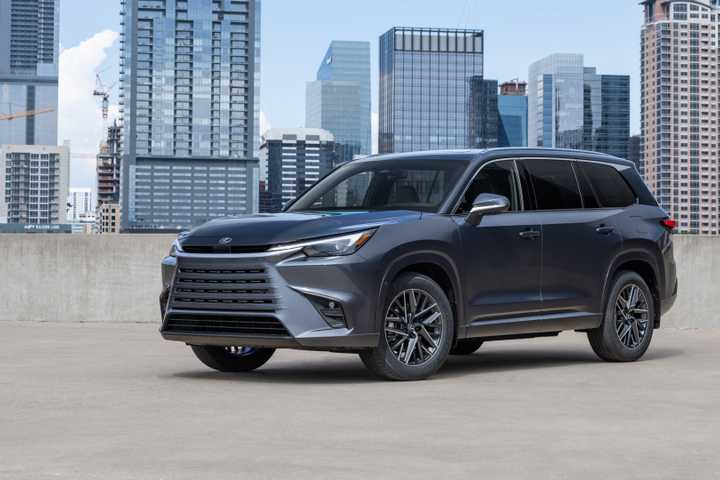
Dynamic Front 3/4 Shot of Grey 2026 Lexus TX 350 Premium 4DR SUVLexus
Dynamic Front 3/4 Shot of Blue 2026 Lexus TX 550h + 4DR SUVLexus
The traditional luxury-SUV hierarchy normally makes this decision easy. The base model is for buyers who want the badge and the fundamentals without spending excessively. Higher trims are for those willing to pay more for additional luxury, performance, or technology. If you want the quickest version, you accept that you’re probably going to sacrifice something elsewhere, particularly at the fuel pump.
The TX turns that relationship on its head. Its higher-priced electrified models don’t force buyers to choose between efficiency and performance. Instead, they make the base model’s biggest advantages increasingly difficult to defend.
Lexus TX 350 F Sport Exterior – Right Front TireTopSpeed
That’s important because the TX 350 isn’t simply being challenged by a more powerful engine. It is being challenged by a powertrain philosophy that combines electrification with performance. The result is an SUV that can deliver the sort of acceleration traditionally reserved for sportier luxury trims without becoming the thirstiest model in the lineup.
Suddenly, the question isn’t whether you should spend more to get a faster TX. It’s whether spending less to get the slower one is actually the better financial decision. That’s where the 2026 Lexus TX 500h enters the conversation.
The 2026 Lexus TX 500h Turns The Formula Upside Down
The Hybrid Is Almost Two Seconds Quicker
2025 Lexus TX 500h F-Sport front 3/4 shotLexus
The TX 500h is the point at which Lexus’s unusual approach becomes impossible to ignore. Rather than using a hybrid system purely to reduce fuel consumption, Lexus pairs electrification with a turbocharged 2.4-liter four-cylinder engine to create a considerably more powerful version of the TX. Total output rises to 366 horsepower and 406 pound-feet of torque.
That is a significant jump over the base TX 350, but the more revealing figure is acceleration. Lexus estimates that the TX 500h can reach 60 mph in 6.1 seconds. The manufacturer’s official estimate provides a consistent benchmark against the roughly eight-second pace of the TX 350. On paper, that puts the hybrid around two seconds ahead of the gas-only model.
2025 Lexus TX 500h F Sport engineChris Chin | TopSpeed
Independent testing has produced a wider range of results. AutoTechSpot recorded 5.7 seconds, while MotorTrend reported 6.8 seconds. Those differences aren’t surprising given variations in testing equipment, conditions, launch techniques, and vehicle specifications, but they do mean the 6.1-second manufacturer estimate is the safer headline figure.
Regardless of which number you use, the fundamental point doesn’t change: the TX 500h is substantially quicker than the TX 350. And this isn’t a small, barely noticeable difference. Nearly two seconds is meaningful when you’re merging onto a highway, overtaking slower traffic, or simply getting a heavily loaded family SUV moving. The hybrid’s additional torque and electric assistance give it an entirely different character from the entry-level TX.
It Is Faster And More Efficient At The Same Time
Lexus TX 500h driving on a highway next to water with trees in the backgroundLexus
This is where the TX 500h becomes genuinely interesting. The hybrid isn’t just faster. It’s also more efficient. The EPA rates the TX 500h at 27 mpg in the city and 28 mpg on the highway. In real-world mixed driving, testing has returned around 25 mpg. Those figures aren’t going to turn the TX into a fuel-sipping economy car, but that’s not the point. The point is that the more powerful version doesn’t punish the buyer with worse fuel economy.
That’s an unusual proposition in the luxury-SUV market. Performance upgrades typically mean bigger engines, more fuel consumption and a higher running cost. Here, the powertrain uses electrification to improve the relationship between performance and efficiency rather than forcing a compromise between them. That changes the meaning of the hybrid premium.
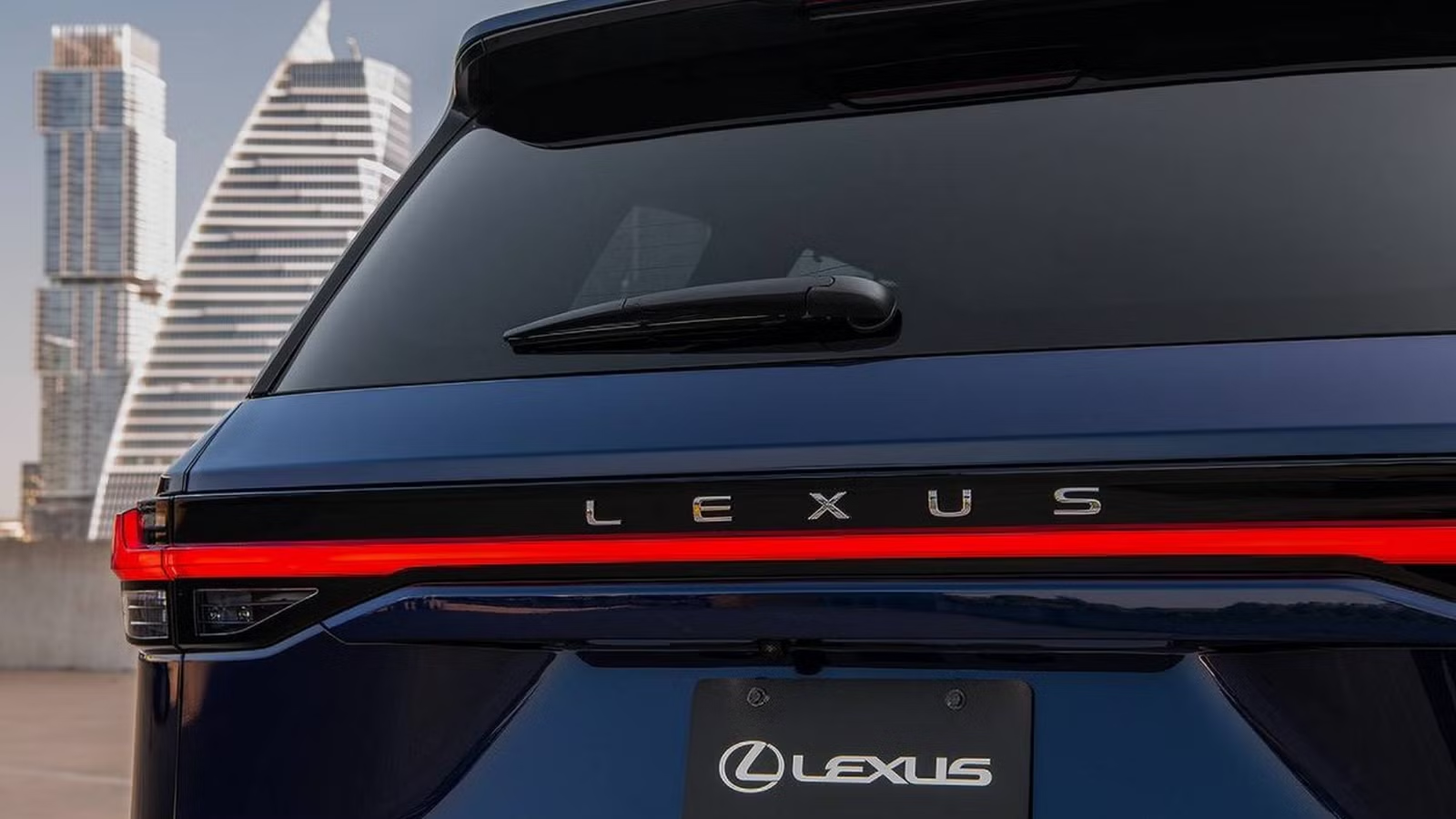
2025 Lexus TX 500h F Sport rear badgeChris Chin | TopSpeed
According to Edmunds, the TX 500h has a starting MSRP of around the $70,000-$71,000 mark, putting it just under $12,000 above the base model TX 350 AWD. Viewed purely through the lens of purchase price, that’s a significant jump. But viewed through the lens of what the extra money buys, the calculation becomes much less straightforward.
You’re not paying roughly $12,000 simply to use less fuel. You’re paying for 366 horsepower, considerably stronger acceleration and a powertrain that still manages respectable fuel economy. The hybrid isn’t asking the buyer to make a virtue-signaling decision. It’s making a performance decision that happens to come with an efficiency benefit.
The TX 550h+ Pushes The Advantage Even Further
404 Horsepower Makes The Plug-In Hybrid The Performance Flagship
Front Dynamic 3/4 Shot of Blue 2026 Lexus TX 550h + 4DR SUVLexus
If the TX 500h is enough to disrupt the conventional hierarchy, the TX 550h+ takes that argument to its logical conclusion. The plug-in hybrid SUV uses a 3.5-liter V6-based powertrain and produces 404 horsepower, making it the most powerful version of the TX lineup. More importantly, it shows that Lexus isn’t treating electrification as something that has to come at the expense of performance.
The numbers are striking for a three-row luxury SUV. The TX 550h+ can hit 60 mph in approximately 5.2 seconds, with both Car and Driver and MotorTrend recording times in the low-five-second range. That’s a very different proposition from the roughly eight-second TX 350.
2026 Lexus TX 550h + 4DR SUV PHEV PowertrainLexus
The TX 550h+ therefore pushes the TX beyond simply being a sensible family SUV. It gives buyers the ability to combine three-row practicality with acceleration that would have seemed out of place in a large luxury crossover only a few years ago. Yet even here, Lexus hasn’t abandoned the efficiency side of the equation.
33 Miles Of Electric Range Changes Everyday Ownership
Front 3/4 Shot of Blue 2026 Lexus TX 550h + 4DR SUVLexus
The biggest difference between the TX 500h and TX 550h+ isn’t simply the additional horsepower. It’s the plug-in hybrid system and the flexibility that comes with it. The TX 550h+ has an EPA-estimated 33 miles of all-electric range. For buyers whose daily commute or routine errands fall within that distance, the potential to complete shorter journeys primarily on electric power changes how the SUV can be used.
That doesn’t mean every owner will achieve exactly 33 miles in everyday conditions. Weather, driving style, passenger load, and other factors can affect electric range. But the capability is significant because it gives the TX 550h+ something the regular hybrid cannot: the ability to cover meaningful daily distances without relying primarily on its gasoline engine.
Rear 3/4 Shot of Blue 2026 Lexus TX 550h + 4DR SUVLexus
Once the battery’s available charge is depleted, the vehicle can continue operating as a hybrid rather than leaving the driver with a conventional gas-powered SUV. Fuel economy remains impressive, too. The TX 550h+ is rated at around 29 mpg combined, while real-world testing has reached approximately 30 mpg. Again, the significance isn’t that the TX is suddenly economical by compact-car standards. It’s that a 404-horsepower three-row luxury SUV can return those kinds of numbers while offering genuinely strong acceleration.
The TX 550h+ therefore reinforces the broader point made by the TX 500h: Lexus has managed to separate performance from the traditional fuel-economy penalty.
The Hybrid TX Makes The Base Trim Hard To Justify
The $12,000 Premium Buys More Than Better Fuel Economy
2024 Lexus TX 550h+ PHEV Exterior Side ProfileLexus
The easiest way to defend the Lexus TX 350 is its price. There will always be buyers for whom saving nearly $12,000 upfront matters more than shaving seconds off a 0-60 run. The TX 350 remains the entry point, and not everyone needs 366 horsepower or wants to pay for a more complex electrified powertrain. But the usual argument for buying the cheaper model starts to weaken once performance and efficiency are considered together.
The TX 500h isn’t simply a luxury upgrade with a bigger price tag. It delivers 366 horsepower versus the TX 350’s less powerful gas setup, while its 6.1-second manufacturer-estimated 0-60 mph time puts it around two seconds ahead of the base model. Then there’s fuel economy. The TX 500h’s 27 mpg city and 28 mpg highway EPA ratings are remarkably competitive considering the additional performance. Real-world mixed driving at around 25 mpg reinforces that this isn’t a hybrid that only looks efficient on paper.
Rear Dynamic 3/4 Shot of Blue 2026 Lexus TX 550h + 4DR SUVLexus
That’s what makes the $12,000 premium so interesting. If the TX 500h were merely faster, it would be easier to dismiss it as a performance upgrade. If it were merely more efficient, it could be treated as a conventional hybrid premium. But because it is both faster and more efficient, the additional cost starts to look less like an indulgence and more like a purchase decision based on capability. The TX 550h+ makes the equation even more dramatic, although its higher price and plug-in functionality will naturally appeal to a narrower group of buyers.
It is worth noting, however, that Lexus halted production of the TX 550h+ after the 2026 model year in the USA, with the apex TX removed from the lineup. Dealerships may still have a few unsold units on their lots, but finding a new factory order is no longer possible, making the TX 550h+ primarily available on the used market, at least for now.
Lexus Has Quietly Inverted The Luxury-SUV Hierarchy
A passenger rear three quarter shot of a dark grey 2024 Lexus TX 500hLexus
The most interesting thing about the TX lineup isn’t any single horsepower figure or fuel-economy rating. It’s what those numbers do to the traditional luxury-SUV buying hierarchy. For years, the sensible luxury SUV has generally been the lower trim. Buy the base engine, accept slightly less performance and avoid paying for features you don’t need. Move up the range because you want more, not because the cheaper model somehow fails to make sense. The TX challenges that assumption.
The TX 350 remains the cheaper route into the lineup, but it is also the slower and thirstier one. The TX 500h costs more, yet brings considerably stronger performance while delivering better EPA fuel-economy figures. The TX 550h+ goes even further, combining 404 horsepower with 33 miles of electric range and roughly 29 mpg combined. That is an unusual value proposition.
Front Shot of Blue 2026 Lexus TX 550h + 4DR SUVLexus
It also means the argument for buying a hybrid TX doesn’t need to revolve around environmental credentials. There’s no need to pretend buyers are choosing electrification purely because they want to reduce their carbon footprint. The more compelling argument is considerably simpler: the hybrid versions make more sense because they do more. They are quicker when you need the performance, more efficient when you’re simply commuting, and, in the case of the plug-in, capable of covering everyday trips on electric power.
That being said, the TX 350 still has its place. Its lower starting price matters, and for buyers determined to minimize the initial outlay, it remains the obvious choice. But once the budget stretches toward the TX 500h, the conventional logic of choosing the base trim becomes much harder to defend. Lexus has, perhaps quietly, created a luxury SUV where the traditional upsell doesn’t feel like an indulgence. It feels like the rational move.
2026 Lexus TX 550h + 4DR SUV Interior Front FasciaLexus
The 2026 Lexus TX presents an unusual problem for anyone who assumes the base trim is automatically the sensible choice. The TX 350 is cheaper and uses a straightforward 2.4-liter turbocharged four-cylinder engine, but its roughly eight-second 0-60 mph pace leaves it well behind the electrified models. Step up to the TX 500h and Lexus gives you 366 horsepower, 406 lb-ft of torque and a 6.1-second manufacturer-estimated 0-60 mph time, while also delivering EPA ratings of 27 mpg city and 28 mpg highway. Then there’s the TX 550h+, which raises output to 404 horsepower and adds 33 miles of electric range while returning around 29 mpg combined.
None of that makes the TX 350 a bad SUV. It simply makes the decision more complicated than it should be. The usual luxury-SUV formula says you pay more for performance and accept the associated compromises. The TX quietly flips that logic. Its hybrid models aren’t merely faster than the base trim; they’re also more efficient. And that’s why the most rational TX may not be the cheapest one.
Front 3/4 action shot of 2025 Lexus TX 500h F-Sport In MotionChris Chin | Top Speed
For buyers who can absorb the roughly $12,000 premium, the TX 500h makes a particularly strong case, not because it’s the greenest choice, but because it’s the version that demands the fewest compromises from its owner. The three-row Lexus has quietly become faster and more efficient as you move up the range. That’s not how the luxury-SUV hierarchy is supposed to work. And it may be exactly why the base trim is now the hardest TX to justify.
Base Trim Engine
2.5L I4 ICE
Base Trim Transmission
8-Speed Automatic
Base Trim Drivetrain
Front-Wheel Drive
Base Trim Horsepower
275 hp
Base Trim Torque
317 lb-ft
Make
Lexus
Model
TX
Segment
Midsize Luxury SUV
Sources: Lexus, EPA, Edmunds, Car and Driver, MotorTrend












No Comments