
Pontiac’s Cheapest Mid-Size Of 1971 Secretly Packed Ram Air IV Heads
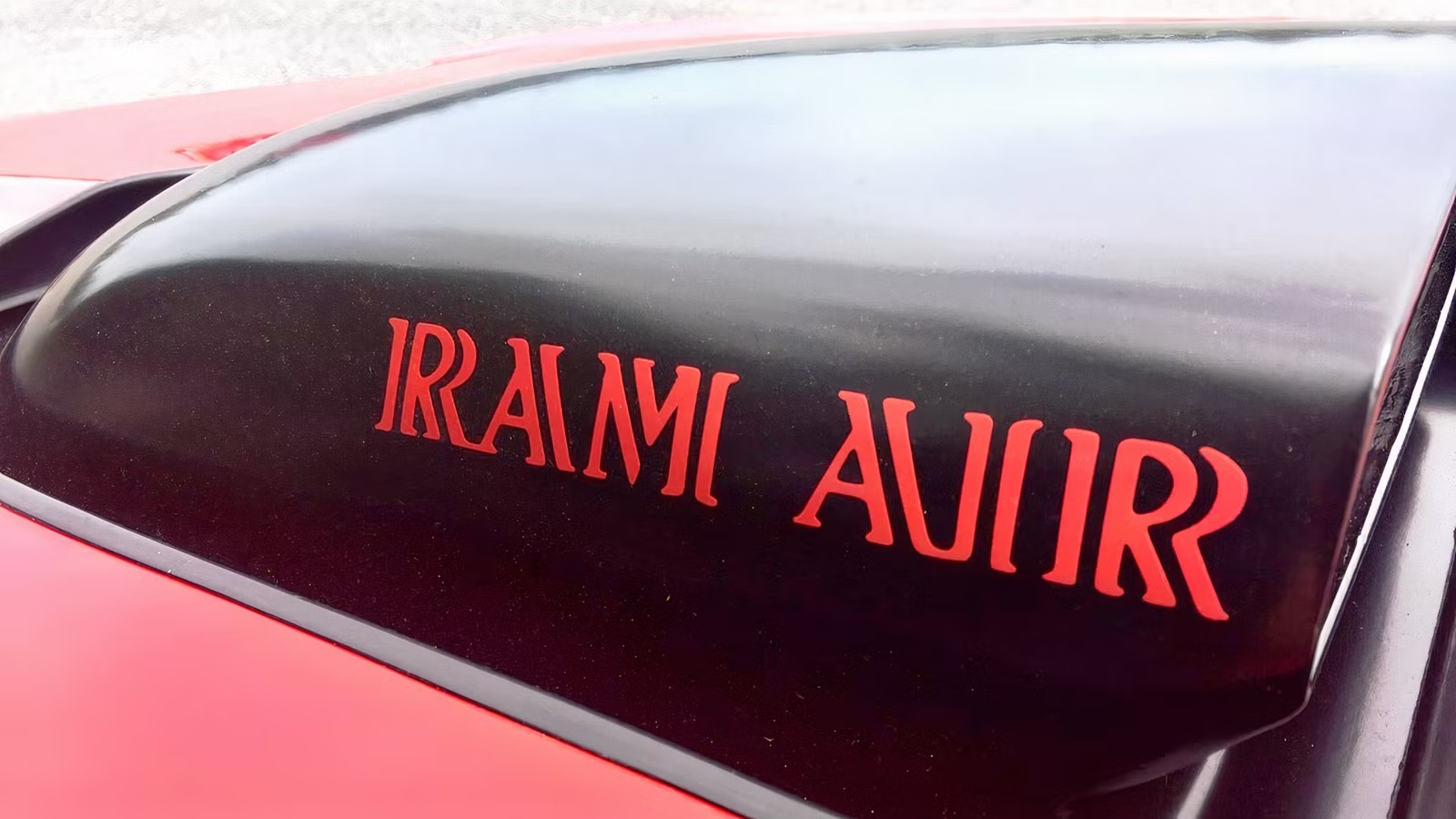
It’s 1971, and you’re cruising around town when you line up next to a brand-new two-door Pontiac. You don’t see any GTO badges. In fact, you don’t see any badges you recognize whatsoever on the budget-friendly car. Besides, you know Pontiac slashed the compression ratio of its hottest engines for 1971. You’re pretty confident you can take this guy. That is, until the light turns green and the absolute beast of a car launches. In a cloud of exhaust and tire smoke, the Pontiac disappears down the street. It blasts through the intersection a quarter mile away, a hair over 14 seconds later. You just got trounced by Detroit’s last great sleeper muscle car.
The Slow Death Of Detroit’s Factory Sleepers

There was a brief, glorious time when you could order some of Detroit’s most powerful V8s in nearly any trim level you wanted. It was a more democratic era of muscle cars. It was also the golden age of the factory-built sleeper.
You’ll want an example. In 1959, Dodge launched the Super D-500 version of its 383-cu-in V8. The big-block used two four-barrel carburetors to make 345 hp, and you could buy it in the plainest full-size Dodge. Heck, if you wanted a 345-horsepower station wagon, Mopar had your back.
In 1965, Chevrolet introduced the L79, a slightly detuned version of its 327-cu-in Corvette engine that made 350 hp in midsize cars. And you didn’t need the coin for a Malibu SS to pick one up. The low-trim Chevelle 300 and 300 Deluxe sedans and two-doors may have been some of the gnarliest sleepers around.

Pontiac itself perfected the formula with the 1964 GTO, the car widely credited with launching the muscle-car era. The original recipe was almost laughably simple: take the unassuming Tempest LeMans, install Pontiac’s 389-cu-in V8, and sell young buyers a family-sized car with enough power to embarrass dedicated sports cars.
But success changed the GTO. By 1971, it was no longer an anonymous option hiding in Pontiac’s order book. It was a prestigious model with recognizable badges, aggressive styling, higher insurance costs, and a reputation that preceded it. Both street racers and insurance companies had the car in their crosshairs. The GTO had become the opposite of a sleeper. Pontiac, however, had not forgotten the formula that made it a legend.
Pontiac Marched To The Beat Of Its Own Drum

During the 1970 model year, Pontiac did something no one was expecting: it moved down-market. In February, the automaker introduced the midsize T-37 as its lowest-priced two-door hardtop, a promotional model aimed at shoppers who were considering smaller compacts.
Even the name was bare-bones. The “37” echoed GM’s body-style code for a two-door hardtop coupe. This car might as well have had barcodes instead of fender badges.
Pontiac advertised the new T-37 at less than $2,750. Automotive historian Diego Rosenberg reports that the six-cylinder hardtop listed for $2,683. Pontiac’s pitch was equally blunt: “The newest lowest-priced hardtop you can buy.”
Chevrolet soon answered with a still-cheaper base Chevelle Sport Coupe and took the price crown. But the T-37 remained a bargain. And Pontiac wasn’t finished sweetening the deal.

If you wanted a bit more swagger, Pontiac added the $198 GT-37 package later that spring. Judge-inspired stripes, locking hood pins, Rally II wheels, raised-white-letter tires, dual exhaust, a Hurst-shifted heavy-duty three-speed, and the Y96 Ride and Handling package turned the bargain T-37 into a cut-price junior GTO.
Then Pontiac doubled down. For 1971, it made the T-37 its entry-level A-body line and retired the legendary Tempest name. Standard equipment still emphasized thrift: cloth-and-Morrokide bench seats, vinyl door covering, minimal exterior trim, and E78-14 blackwall tires. Yet Pontiac made front disc brakes standard, while some more expensive LeMans models still made do with drums. More importantly, Pontiac did not reserve its performance engines for the striped GT-37. One particular new engine option placed the plain T-37 among the greatest sleepers to ever sneak out of Detroit.
You Could Buy Pontiac’s Cheapest Midsize Hardtop With A 480-Lb-Ft V8

For the 1971 model year, Pontiac offered its 455-cu-in High Output V8 in every two-door midsize A-body. That meant you could order the 455 HO in a striped GT-37 or an unassuming T-37.
A T-37 with the 455 HO received a few necessary upgrades. The engine brought a 12-bolt rear axle and required the N10 dual exhaust upgrade. Its standard transmission was the heavy-duty M13 three-speed manual, with an M22 four-speed or TH400 automatic available. The GT-37’s heavy-duty suspension was not bundled with the engine, so a buyer could leave the rest of the car remarkably close to commuter specification.

How much would this sleeper set you back? Add the $358 engine and mandatory $41 dual exhaust, to a car listing for $2,683, and a bare-bones 455 HO T-37 could begin around $3,082 before destination or other options. The result was a bargain-basement Pontiac with 335 gross hp and 480 lb-ft of torque.
Fans of Pontiac muscle cars are familiar with the legendary 455 HO. But what many folks don’t know is that the engine nearly lost its mojo for the 1971 model year. Pontiac engineers pulled it back from the brink just in time to create the ultimate T-37 sleeper.
Pontiac’s Ram Air IV Head Design Beat The Low-Compression Squeeze

For 1971, GM ordered every division to prepare its engines for lower-octane, low-lead or unleaded gasoline. The 455 HO’s advertised compression ratio plummeted from 10.25:1 to 8.4:1. A normal company might have kissed the V8’s old 500-lb-ft rating goodbye. Not Pontiac.
Engineers dug into the company’s racing experience and came up with an ingenious solution. Inspired by the 1969–70 Ram Air IV design, they created new No. 197 round-port cylinder heads for the 455. These were not old Ram Air IV castings bolted onto a bigger engine. They were Ram Air IV-derived heads with approximately 111-cc chambers, 2.11-inch intake valves, and 1.77-inch exhaust valves.
For good measure, Pontiac added an aluminum intake, a four-bolt main block, the 068 hydraulic camshaft, and free-flowing round-port exhaust manifolds. The 068 cam was milder than the Ram Air IV’s 041 cam, helping the larger 455 remain flexible at street rpm despite its reduced compression.

The result came within spitting distance of the previous engine’s torque output. Pontiac rated the 1971 455 HO at 335 gross hp at 4,800 rpm and 480 lb-ft at 3,600 rpm. As Detroit began transitioning toward more conservative SAE-net ratings, Pontiac also published a 310-net-hp figure.
So how fast was a 455 HO T-37? That question has no clean period answer, but the car’s weight advantage gives us a clue. Automobile-Catalog’s specs estimate a three-speed 455 HO T-37 hardtop at 3,646 pounds and a similarly configured 455 HO Judge hardtop at 3,829 pounds. That would make the anonymous T-37 roughly 180 pounds lighter. Motor Trend tested a 1971 GTO Judge with the 455 HO, four-speed, 3.55 axle, and G60-15 tires, recording 14.9 seconds at 95 mph. Hot Rod tested a 400 cubic-inch/four-speed GT-37 and ran 14.40 seconds at 97.50 mph after removing the air cleaner.

Those tests were conducted by different magazines under different conditions, so the figures are clues rather than a clean head-to-head comparison. No contemporary test of a 455 HO T-37 or GT-37 has surfaced in the archives we found, so any exact quarter-mile claim for the ultimate sleeper remains an estimate. One journalist later recalled requesting a 455 HO-powered GT-37, only for Pontiac to supply a 400 instead.
How Many 455 HO T-37s Did Pontiac Hide In Plain Sight?

The production records that Pontiac kept don’t include a neat total for the plain 455 HO T-37. ClassicCars.com reports that 122 non-GTO Pontiac A-bodies received the 455 HO in 1971, across various models. Only 15 of them were plain T-37 two-door hardtops. Hot Rod magazine, drawing on research by Pontiac specialists, identifies another 11 pillared T-37 coupes with the engine, including seven manuals and four automatics. Taken together, those body-style figures point to just 26 genuinely plain T-37 455 HOs.
Then there were the striped cars. Hemmings’ production summary claims there were 69 GT-37s with the 455. A model-by-engine breakdown published by Street Muscle divides that group into 54 cars with the 455 HO and 15 with the regular 455.

The 1971 Pontiac T-37 455 HO represents a fascinating final chapter in Detroit’s factory-sleeper era. Rising insurance premiums and lower-octane fuel were ending the party. Some automakers were already throwing in the towel. Pontiac’s engineers responded by building one last brutally effective sleeper and all but snuck it out the factory’s back door.
Pontiac did not demand notoriety. It did not even demand that buyers write the biggest check. It simply offered one of its hottest drivetrains in an anonymous, entry-level midsize for anyone game enough to take one final lap.
Sources: Overdrive Magazine, Hot Rod Magazine, The Classic Cars Journal, Oregon News, AutomobileCatalogue.com, Hemmings, Street Muscle Magazine

Related posts




Latest Post


No Comments