
The Entry-Level Adventure Bike That Nails Versatility, Control, And Long-Distance Comfort
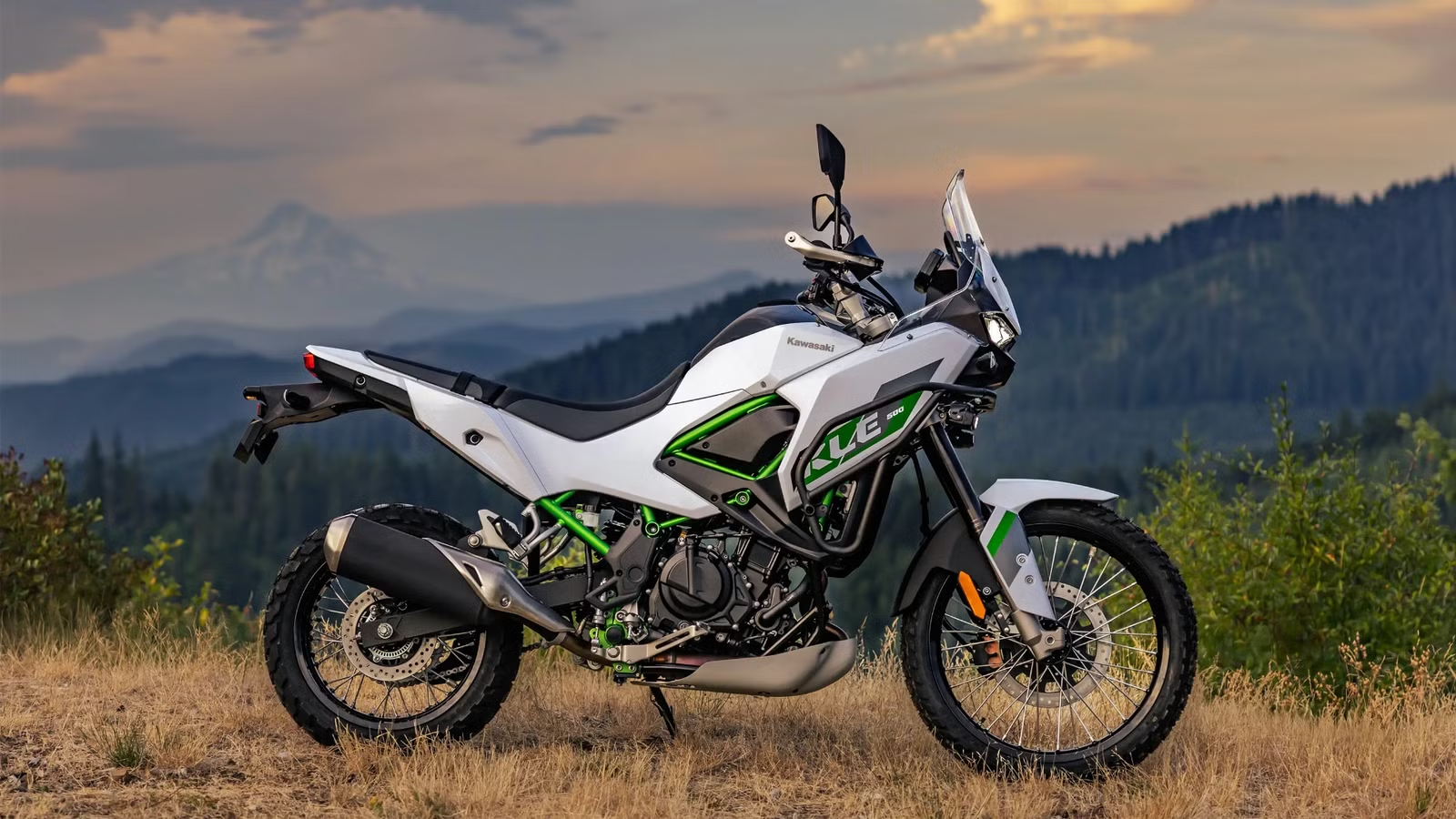
Adventure bikes continue to defy gravity while other motorcycle segments struggle to find their footing. Riders are drawn to the promise of a single machine that can handle a morning commute, a weekend tour, and a dirt road detour without breaking a sweat — and manufacturers are working harder than ever to deliver exactly that. With the segment more crowded than it has ever been, the bar for each new model keeps rising. Yet for all their popularity, adventure bikes remain among the most misunderstood motorcycles in the industry. The key distinction is worth repeating: an ADV is not a dirt bike. ADVs are street bikes engineered to work off-road, not the other way around.
How The Adventure Bike Has Aged Over The Years

Back in the early 2000s, adventure bikes were still very much a niche offering, with only a handful of manufacturers willing to build them. Most buyers gravitated toward lighter dual-sports for off-road travel, while the rest opted for a tourer and only ventured down the odd dirt road when left with no alternative. A certain TV show featuring two riders circumnavigating the globe on their BMW GS adventure bikes changed everything. Suddenly, the BMW GS became one of the most popular motorcycles of the decade, and rival manufacturers scrambled to respond.

From there, adventure bikes largely grew bigger and less capable off-road, as most buyers demanded more features and more power. That trend came to a dramatic halt with the introduction of the back-to-basics Yamaha Ténéré 700. Several lightweight middleweight machines followed, yet these bikes were still a handful for new riders or those new to off-roading. That gap gave rise to the latest crop of highly competent entry-level adventure bikes. While initially aimed at newer riders, more experienced riders have also come to appreciate the value of a smaller, lighter ADV.
The Kawasaki KLE500 Offers Impressive Versatility On A Budget
MSRP: $6,599


For several years, Kawasaki limped along without a genuine adventure bike in the lineup. The Versys-X 300, Versys 650, and the KLE650 Adventure were all plugging this gap in a combined effort, but for the most part, Kawasaki was effectively turning customers away. That is what makes the KLE500 such a significant model for the brand.
Other manufacturers have been building ADVs for decades and have all that accumulated experience to draw on. Kawasaki’s engineers certainly know how to build off-road bikes, and their street bike credentials are beyond question, but finding the right balance between these two disciplines is never straightforward. While the KLE500 delivers impressive versatility, it has also drawn criticism — some of it fair, much of it not.
Powered By A Reliable Sports Bike Engine
Power: 51 Horsepower

It is quite clear that Kawasaki chose to start with this engine and build the bike around it. The reasoning is easy to understand: the unit has proven itself as a reliable performer in every other model it has appeared in. It offers an almost ideal spread of performance that will appeal to a wide range of riders. As a relatively free-revving parallel-twin, it rewards more experienced riders higher up in the rev range while remaining approachable for newcomers. It also delivers decent mid-range torque — an important quality for off-road use. In many respects it is an ideal foundation, though it is evident that Kawasaki ran into some packaging challenges along the way.
The Problem With Building An ADV Around A Street Bike Engine

One of the central reasons adventure bikes are always a compromise is that they are, at their core, street bikes that must also function off-road. These two disciplines are constantly in tension, and it is clear that while the marketing team wanted to position this as an all-conquering off-roader, the engineers had different constraints to work within. The engine sits unusually low in the chassis — great for weight distribution, but it does nothing for ground clearance.
Brings A Healthy Dose Of Japanese Pragmatism To The Table
The main reason most riders were put off by the Versys-X 300 was not its displacement, but rather its roughly 7 inches of ground clearance. With “Versys” in the name and a 19-inch front wheel, nobody expected much from that little bike. Expectations for the KLE were naturally higher. With just 7.3 inches of ground clearance, disappointment was understandable. It actually has more suspension travel than ground clearance, so it came as no surprise that the bike bottomed out on virtually every real-world off-road test conducted since its launch. But to get hung up on this — sorry, couldn’t resist — is to misunderstand the model’s purpose.

Its primary role will always be to serve as a capable tourer, and the KLE500 is a far better tourer than the little 300cc Versys. It uses a sporty steel trellis chassis and handles well — better than most middleweights, in fact, thanks to its low center of gravity. Above all else, it is going to be more reliable than most competitors in this space, save for the NX500, which is even more street-oriented. Realistically, it will also meet the off-road needs of most riders. More accomplished adventure riders will find its limits quickly, but the majority will be perfectly content with what it offers. The 21/17-inch wheel combination is a little unconventional, but there are still plenty of tire options available in both sizes.
A Great New Bike That Really Can Do It All

In terms of features, the base KLE is relatively sparely equipped, but its ABS system is at least switchable — which is more than can be said for some competitors. The absence of extensive electronics may count against it in spec-sheet comparisons, but for riders who simply want a reliable, comfortable motorcycle with a genuine modicum of off-road capability, it is an ideal choice. It is not the lightest bike in the class, but it doesn’t need to be; it is light enough to serve as a city runabout and manageable enough for a new rider to pick up after a minor spill off-road. What counts against it most is the weight of expectation. Ever since the Ténéré 700 arrived, adventure enthusiasts have been waiting for the next big thing. The KLE500 is not that next “big thing” — but it is a whole lot better than some would have you believe.
Chassis, Suspension, And Weight Specifications
|
Chassis |
Steel trellis |
|
Front Suspension |
43mm inverted telescopic fork (8.3-in travel) |
|
Rear Suspension |
Bottom-link Uni-Trak with adjustable spring preload (7.7-in travel) |
|
Weight |
428 lbs |
Kawasaki KLE500 vs. The Rivals

In the sub-500cc adventure bike segment, the Kawasaki KLE500 faces a select group of rivals, several of which also use a parallel-twin engine. The most popular among them is the Honda NX500 — a mostly road-oriented adventure tourer built around a bulletproof parallel-twin. It offers lightweight handling and a linear power curve, making it one of the easiest bikes to live with day to day. Push it toward serious off-roading, however, and its limitations become apparent quickly.

For more committed off-road use, the CFMoto Ibex 450 enters the picture. It is more trail-focused than either the KLE500 or NX500, tipping the scales at 386 pounds and riding on fully adjustable KYB suspension with nearly 8 inches of travel, complemented by tubeless spoke wheels. As promising as the package is, some riders report that the bike feels larger than its dimensions suggest. CFMoto’s service network also remains limited compared to the established Japanese brands, which will give some buyers pause.

Drop a cylinder and two more compelling rivals emerge: the Royal Enfield Himalayan 450 and the KTM 390 Adventure. The Himalayan 450 makes off-roading feel accessible and confidence-inspiring while remaining comfortable enough for touring, courtesy of its linear power delivery and well-sorted suspension. The KTM 390 Adventure, meanwhile, is a punchy and agile machine — lighter on its feet, though it does trade some of the smooth, linear character of the KLE500’s twin-cylinder platform for a more urgent single-cylinder personality.
Measured against these rivals, it becomes clear why the KLE500 stands out for striking a strong balance of versatility, control, and long-distance comfort. The sports bike-derived parallel-twin is smooth and dependable, the handling is agile enough for mild off-roading, and the ergonomics are genuinely set up for touring. Unless you are tackling serious technical terrain, most riders will never have to worry about bottoming out the suspension.
|
Specs |
Kawasaki KLE500 |
Honda NX500 |
CFMoto Ibex 450 |
|---|---|---|---|
|
Engine |
451cc parallel-twin |
471cc parallel-twin |
449cc parallel-twin |
|
Power |
51 HP |
47 HP |
44 HP |
|
Torque |
31.7 LB-FT |
31.7 LB-FT |
32.5 LB-FT |
|
Ground Clearance |
7.3 in. |
7.1 in. |
N/A |
|
Seat Height |
34.3 in. |
32.8 in. |
386 LBS |
|
Weight |
425.6 LBS |
432 LBS |
386 LBS (Dry) |
Source: Kawasaki

Related posts



Latest Post


No Comments