
The Suzuki Cruiser That Offers Harley Presence With Japanese Dependability
Japanese motorcycles have long been at the forefront of reliability and refinement ratings. This is also evident on cruiser bikes with modern examples like the Honda Rebel series. Even metric V-twin cruiser bikes, rich in old-school charm, offer superior dependability. However, not all offer the grandeur of a big-twin Harley.

We do have classic-vibing options, like the Suzuki Boulevard and the Yamaha Bolt R-Spec, but they are limited to the middleweight size and muscle. Kawasaki does offer the Vulcan 1700 series to take on Harley’s big guns, but it lacks muscle. That leaves us with one option—a long-standing and currently underrated Suzuki muscle cruiser that surprises with its balance of raw performance, refinement, huge dimensions, and proven Japanese dependability, making it a formidable long-term choice.
The Undeniable Presence Of A Harley-Davidson
The head-turning appeal of a Harley-Davidson comes from its old-school charm. This is also why, even in 2026, we have far more chrome-laden, Milwaukee-Eight V-twin-equipped Softail cruisers than modern options like the Revolution Max-equipped Sport lineup. The fusion of muscular, old-school styling, heavy chrome accents, a wide stance, and its unmistakable low-revving V-twin rumble contributes to the assured presence of a Harley-Davidson cruiser bike.

Even the relaxed rider triangle and retro-modern paint jobs help increase the rider’s aura points by a few thousand. Harley’s expertise in building cruiser bikes for over 123 years has resulted in some of the most gorgeous-looking motorcycles today. Prime head-turning examples include the Fat Boy (that enjoys celebrity status), the revived Hydra-Glide, and the all-new Deadwood. It is safe to say that Harley-Davidson has perfected the art of making beautiful and timeless cruiser bikes.
Undisputed Reliability And Refinement Of A Japanese Motorcycle

Japanese motorcycle makers put refinement and reliability high on their priority list. Unlike Harley, looks are secondary. This doesn’t mean Japanese motorcycles (especially cruiser bikes) aren’t good-looking. They just don’t often pack the visual drama that Harley offers. Let’s explain this with a simple engine-related example.
Harley stuck with offering an air-cooled V-twin for the longest time because of its traditional value and brand identity. The exposed cooling fins and raw metal engine shape define the classic cruiser bike style. Also, the absence of a radiator and associated hoses/piping gives the engine bay a cleaner look. But Japanese manufacturers have been offering liquid-cooled V-twins on their cruiser bikes from as early as 1983 with the Honda VT750C Shadow.

The key to Japanese manufacturers achieving the “reliability” tag is their conservative engineering practices. The likes of Honda, Yamaha, Kawasaki, and Suzuki have strived to offer proven, robust engineering solutions to curb the risk of mechanical failure and, in turn, improve reliability ratings. Most motorcycles, including cruiser bikes, are designed with this ethos in mind. While we wholeheartedly enjoy the segment-defining dependability and practicality, it shouldn’t come at the expense of visual drama, especially with classic-looking cruiser bikes.
However, Head-Turning Japanese Cruiser Bikes Are A Rare Breed In 2026

The biggest repercussion of the Japanese cruiser segment’s overemphasis on practicality is evident in the 2026 lineup. There are barely any big-twin cruiser bikes left to take on Harley-Davidson and Indian Motorcycle. The most we get from Honda and Kawasaki are the Fury chopper and the Vulcan 1700 series, respectively.
The picture, however, was a lot livelier in the early 2000s with the Honda VTX series, the Yamaha Virago and Royal Star/Road Star series, and the Suzuki Intruder family all taking the fight to the big old American V-twins. The head-turning appeal of these huge metric cruisers was much better than that of the mostly middleweight offerings we have today. Yamaha has the V-Star 250 and the Bolt R-Spec in its V-twin portfolio.

However, these are no match for even the smallest Harley available today in terms of size and performance. Things are mostly boring too at Suzuki, with the Boulevard C50. But Suzuki does have a long-standing and underrated offering in the form of the Boulevard M109R that reminds us of the early 2000s, when Japanese manufacturers were hell-bent on stealing Harley’s thunder.
The Suzuki Boulevard M109R Fuses American Presence And Japanese Dependability
At $15,799, It Undercuts Most Comparable Harley Models By $10,000+

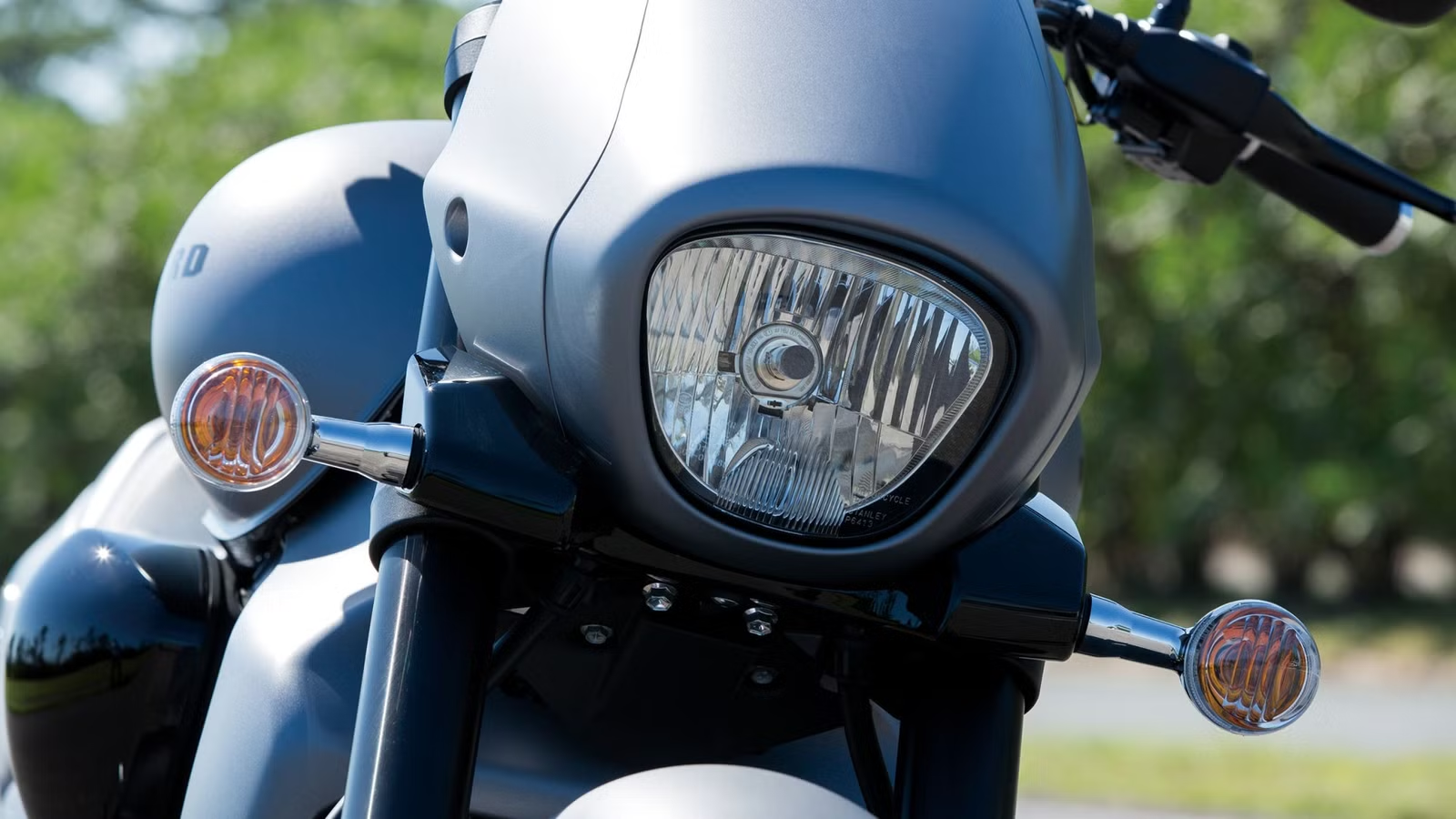
Its unapologetic size and performance are what set the Suzuki Boulevard M109R apart from its Japanese V-twin counterparts. The Kawasaki Vulcan 1700 sure has a similarly sized V-twin, but it is nowhere near as brawny or as muscular as the M109R. Furthermore, for under $16,000, the M109R is a bang-for-buck cruiser bike too. This 20-year-old power cruiser has remained largely unchanged since its introduction in 2006.
The dimensions are huge, and its V-twin has a unique rumble that sets it apart. While it looks simple on the outside, there is a lot of sophisticated technology inside, even for a 20-year-old motorcycle. As a Suzuki, it has an engine and other underpinnings designed with reliability in mind.

Also, with no major updates to this cruiser bike since its introduction, Suzuki has steadily refined every component on the M109R, which greatly contributes to its dependability. The result of all these factors is a metric cruiser with a rare fusion of top-spec dependability and raw American V-twin presence.
Its Profile Mirrors The Hayabusa — And It Makes The Harley Breakout Look Small

Suzuki has managed to balance beautiful curves and intimidating muscles on the M109R. Furthermore, all body panels are proportioned right and don’t look out of place. We highlight this because certain Suzuki Boulevard offerings are notorious for having oddly proportioned body panels. Take, for example, the Boulevard C90 Boss, which has a very odd-looking rear fender that protrudes much farther over the rear wheel.
The bulbous design with sweeping lines of the M109R strongly reminds us of the Hayabusa in profile. Notable visual cues include chunky front forks, a chrome-heavy two-into-two exhaust, a drag handlebar atop 10-inch brushed aluminum risers, and a chunky 240-section rear tire that adds to its intimidating, muscular stance. It has a wheelbase of 67.3 inches, a length of 96.5 inches, a width of 34.4 inches, and ground clearance of 5.1 inches.

The quintessential cruiser bike stance is maintained here with a rake angle of 31 degrees. This Suzuki power cruiser is so big that it even dwarfs the badass-looking Harley-Davidson Breakout. The rider sits a bit committed on the M109R with the torso having a slight forward lean. However, this muscle cruiser remains quite accessible, with a seat height of 27.8 inches.
The Most Powerful Cruiser Bike Under $20,000

Powering the Boulevard M109R is a huge 1,783 cc V-twin engine. This liquid-cooled mill packs the biggest pistons on a motorcycle with a bore size of 112.0 mm, even bigger than the Triumph Rocket 3 Storm’s 110.3 mm bore inline-three engine. It has a low compression ratio of 10.5:1. The M109R produces 128 horsepower and 118 pound-feet of torque. Power is sent to the rear wheel via a five-speed manual gearbox.
Its Gigantic V-Twin Gets Notable Features That Help With Refinement, Reliability, And Efficient Long-Term Performance

Despite being a 20-year-old engine design, this V-twin still impresses with its technological features, some of which are even derived from the track-going Suzuki Gixxer sportbikes. For a huge cruiser-bike V-twin engine, it has a short-stroke setup with eight valves and revs up to 7,500 RPM, which is “screaming” territory for big-block cruisers. Features like staggered crank pins and balancer shafts help reduce vibrations and offer Japanese-grade refinement.
It also gets a dual-throttle valve system with massive 56 mm bodies for optimized power and torque output. Its compact dry-sump lubrication setup is also a rare cruiser feature, which helps prevent oil starvation during extreme maneuvers like hard cornering. Also, Suzuki packs this V-twin with special spark plugs and individual maps to control and tweak ignition timing based on riding style.
Heavy-Duty Chassis With Hidden Sporty Bits

Underpinning the Boulevard M109R is a high-tensile steel double-cradle frame designed to withstand high stress. It is suspended on chunky 46 mm inverted front forks with 5.1 inches of travel. The rear comprises a preload-adjustable monoshock with 4.7 inches of travel.
The suspension travel is quite impressive for a cruiser bike that weighs over 700 pounds, especially compared to its less-powerful, relatively lighter rivals with shorter travel. For example, the 2026 Harley-Davidson Street Bob, despite weighing over 100 pounds less, offers just 5 inches and 3.4 inches of suspension travel at the front and rear. Braking duties are taken care of by dual 310 mm discs coupled to radially mounted four-piston fixed calipers at the front.

Not many know, but the front brakes on the M109R are actually shared with the 2000s Gixxer sportbike. The rear gets a 274 mm disc coupled to a two-piston floating caliper. Grip duties are handled by 130-section front and huge 240-section rear tubeless tires (the widest production-spec rear motorcycle tire size) on 18-inch alloy wheels at both ends.
Arguably The Best Fusion Of American Charm And Japanese Engineering In 2026

The M109R would have gone unnoticed in a sea of metric big-twin cruiser bikes in the 2000s. But today it stands out as the only Japanese muscle cruiser on sale. It’s raw, powerful, and intimidating. At the same time, it is also coupled with a level of refinement, reliability, and durability that no rival can replicate. This type of combination—grin-worthy muscle and intimidating looks on one side and the capability to last a lifetime on the other—is rare among dramatic big-twin cruiser bikes. Hopefully the Suzuki M109R’s consistency motivates Honda and Yamaha to bring back legendary models like the VTX 1800 and the VMax.
Source: Suzuki Cycles

Related posts
Latest Post


No Comments