
7 Inline-Four Touring Motorcycles That Make 500-Mile Days Feel Easy
Inline-four engines have an unmatched fan following in the motorcycle world. The way they sound, the linear power delivery, and overall character all deserve credit for that. But over the years, these engines have become synonymous with sports bikes and sporty naked bikes. We all know these aren’t the most versatile bikes, particularly if you plan to go long distances in a day.

So should you just ditch the I-4 dream and pick a parallel-twin for touring? Luckily, no. Part-sharing and industry improvements have enabled bikemakers to create some enticing inline-four touring bikes in the past decade. All of the bikes below are capable enough for 500-mile days, although some do it better than others.
Kawasaki Ninja 1100SX
Price: $13,999
The Ninja 1100SX is the cheapest touring bike here. Unlike its arch rival below, this has an inline-four engine built specifically for touring and road duties rather than being a retuned sports bike mill. So the 1,099cc four-pot setup produces 134 horsepower and 83 pound-feet, peaking at just 9,000 and 7,600 RPM, respectively. That’s plenty for powering through 500-mile days at freeway speeds (or going faster occasionally).


While at it, you’ll appreciate the features on offer. A six-axis IMU and ride-by-wire bring the safety features, while an adjustable windscreen, cruise control, and all-LED lights make up the creature comforts. The only bummer here is the lack of saddlebags as standard. These cost nearly $900, including the fitment kit.
Suzuki GSX-S1000GT+
Price: $14,399

The GSX-S1000GT+ is an actual sport-tourer, unlike the new-age crossover-type machines. So you get a sports bike-like design with aerodynamic full fairings and sporty suspension for a package that shines in the twisties. Even the engine is derived from the GSX-R1000, but retuned for more mid-range and usability.

Despite all that, you get all the 500-mile-day essentials. Integrated hard saddlebags? Check. A large fuel tank? Check (5 gallons). Well-padded rider and pillion seats? Check and check. Sweetening the deal is a large 6.5-inch TFT with phone connectivity for full-screen navigation and a new cruise control that remains operational even if you shift up or down via the quickshifter.
Suzuki GSX-S1000GX+
Price: $18,749

This right here is one of the most high-value crossovers on the market right now. For its $18,749 MSRP, Suzuki plonks it with nearly everything you’ll ever need for your 500-mile days. That includes an adjustable windscreen, hill hold, quick-release hard saddlebags, upright ergonomics (inspired by the flagship V-Strom 1050), and most importantly, long-travel electronic suspension. The latter is a big deal since it lets you glide over any undulation by softening or hardening the damping on its own.

Other than that, the engine and chassis are identical to the GT+ above. So you get the same 150 horsepower and 78 pound-feet, all sent to the wheel via a six-speed transmission. The electronics package is the same, too, with all the integral bits (traction control, wheelie control, slipper clutch, ride modes, power modes, and cornering ABS). All of those are right up there with its rivals (mentioned below), even though the GX+ is actually cheaper.
BMW S 1000 XR
Price: $18,825

The value proposition of the S 1000 XR has dropped a bit, thanks to repeated price revisions by the Bavarian giant. Still, this is one of the highest-value crossovers from a European brand. A lot of the credit goes to its S 1000 RR-derived elements all over. That includes the twin-spar aluminum frame and the stonking 170-horsepower inline-four engine with 84 pound-feet. That means this is one of the fastest crossover-type tourers under $20,000.A set of modern technological features sweeten the deal.

The headlight has a cornering function, the suspension is electronic, ignition is keyless, and a crisp 6.5-inch TFT is a gateway to top-drawer electronic aids. However, there are some big misses compared to its Japanese rivals. Chief among these are a set of saddlebags and a two-way quickshifter. Even cruise control is absent. You’ll have to pay around $2,400 extra for the ‘Premium Package’ to get these electronics, while saddlebags will cost around $2,800 more. So while it is capable of 500-mile-days, you will need to spend a bit more to enjoy the full experience.
Kawasaki Versys 1100 SE LT
Price: $19,499

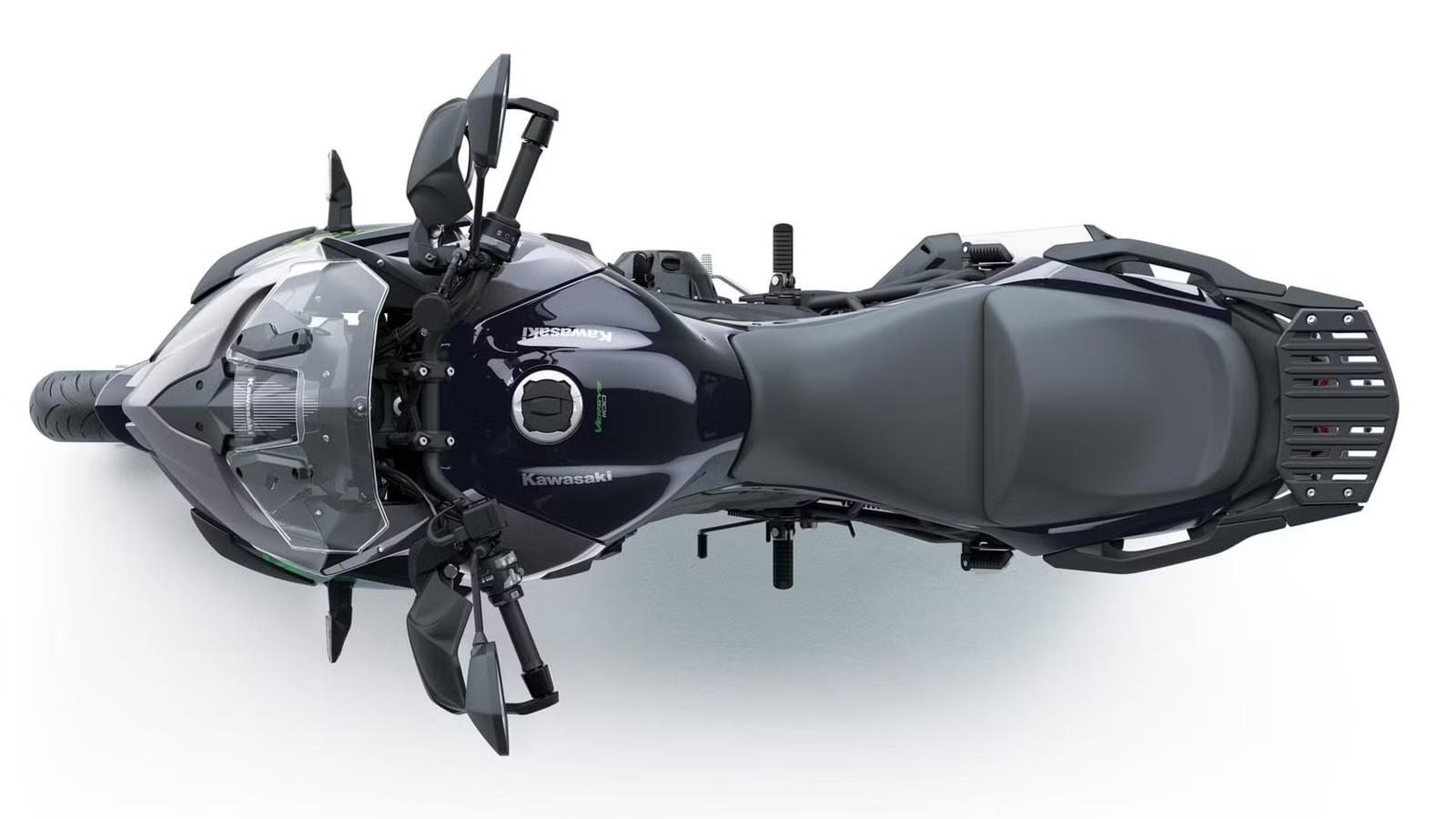
We recently called this the most value-for-money inline-four touring bike for 500-mile days, and we stand by that. The Versys 1100 SE LT checks all necessary boxes for your touring duties, be it hard saddlebags, electronic suspension, or massive saddles for utmost comfort. What gives it a further edge is its uber-easy-going engine. Unlike the XR and GX, this isn’t a sports bike-derived powerhouse retuned for touring duties. Instead, this is a tailor-made engine for Kawasaki’s touring platform.

That means it should run cooler, less stressed, and more efficient than its rivals. The efficiency figures back that up: Kawasaki claims 42 MPG, while Suzuki and BMW claim 37 MPG. Plus, this has an extra 0.5 gallons of capacity over the Suzuki. So the total tank range should be around 230 miles here compared to the GX’s 185 miles. To make matters sweeter, the Versys doesn’t cut corners anywhere like the XR. All the electronic nannies are present as standard, in addition to creature comforts like cruise control, heated grips, adjustable windscreen, and a two-way quickshifter. Even the paint is self-healing!
Kawasaki Ninja H2 SX SE
Price: $29,999

The Ninja H2 SX SE is a proper sport-tourer like the GT and Ninja 1100. But at $29,999, it is way pricier than anything else on the list. Why? Because of the ‘H2’ in its name. That means the 999cc inline-four powerhouse has a supercharger attached to it, helping produce an insane 207 horsepower and 101 pound-feet. The output doesn’t kick in at soaring RPMs, either; the torque peaks at just 8,500 RPM (just 900 RPM later than the Versys, while being a few thousand RPMs sooner than the GX and XR). That means this right here is the fastest way to wrap up your 500-mile journeys.

Serious output aside, comfort remains a priority. The riding triangle is said to be comfortable, thanks to mid-set footpegs, a thick seat with a ride height of 32.9 inches, and tall clip-on handlebars. Once aboard, you’ll also appreciate the plethora of safety aids and creature comforts. The list is longer than anything else here and comprises:
- Bosch radar front and rear
- Blind spot detection
- Adaptive cruise control
- Collision detection
- Hill hold assist
- Heated grips
- Cornering ABS
- Two-way quickshifter
- Wheelie control
- Traction control
- Power modes
- Ride modes
- Engine brake control
- Tire pressure monitoring
- LED lights with auto high-beam
- Keyless ignition
Honda CB1000GT
Price: TBA

The CB1000GT is Honda’s answer to the Versys 1100 and GSX-S1000GX+ overseas. And considering the bikes it shares the platform with (CB1000 Hornet and CB1000F) are both here, the GT’s chances of an American launch are pretty strong. You can also expect an aggressive MSRP, since this is priced closer to a Yamaha Tracer 9 GT overseas rather than the liter-class rivals. Despite that, the package is likable enough to disrupt the liter-class crossover-type touring bike space. All of it starts with the inline-four engine, derived from the 2017 CBR1000RR.

A retune brings peak power down to 147 horsepower and 75 pound-feet, concentrating much of the oomph under 10,000 RPM. That means easy tractability, low internal stresses, and respectable efficiency (~40 MPG). Then, there’s the touring-friendly package. Saddlebags are standard inclusions, and so are big seats, cruise control, six-axis IMU-aided rider aids, and a five-step adjustable windscreen. Topping things off is Showa’s EERA suspension. So the forks and monoshock can both be adjusted on the fly or left in an automatic setting to manage the best riding experience automatically.
Source: Various Manufacturers

Related posts
Latest Post


No Comments