The SUV That Feels Like A Tech Upgrade, Not A Compromise
10 minutes reading
Monday, 21 Sep 2026 15:00 0 6 autotech
Few vehicles have earned their dominance as convincingly as the SUV in the American market. Over the past several years, the segment has grown to capture a substantial share of all new passenger vehicle registrations — and it shows no signs of slowing. That growth is driven by buyers who want elevated ride height, cargo flexibility, and fuel efficiency without sacrificing everyday usability. structural shift away from traditional sedans Demographically, the segment’s most noteworthy consumer base is defined by urban buyers drawn to its affordability and maneuverability. As the 2026 car market unfolds, the relevance of the compact SUV cannot be overstated These models hold a steady share of the total new-vehicle sales mix, serving as the primary battleground for automotive innovation.
Toyota’s strategy in the U.S. for 2026 continues to center on a diverse approach. The Japanese brand prioritizes a broad lineup of crossovers and SUVs that caters to varying consumer needs rather than pivoting exclusively to battery-electric vehicles. This strategy has proven exceptionally successful. As of the first quarter of 2026, the brand’s hybrid vehicles accounted for over 50 percent of total sales volume — a milestone that reinforces their market dominance. Sales of their most popular compact and midsize utility models remain at historic highs. Specific off-road-focused entries saw year-on-year surges as high as 84 percent for ICE variants and even more dramatic triple-digit growth for their hybridized counterparts as new generations reached dealerships. Toyota treats hybridization as a core powertrain pillar, often making it the standard or exclusive offering for high-volume models to normalize the technology. By integrating planetary gear-based power split devices and high-capacity lithium-ion batteries across its lineup, the brand delivers a seamless driving experience that requires no change in consumer behavior. Toyota’s choice to standardize hybridization effectively captures 37 percent of buyers who prioritize long-term resale value and low maintenance costs over the early adoption of fully electric platforms.
How The RAV4 Turns That Strategy Into A Smarter Cabin
2027 Toyota RAV4 front 3/4 shot parkedTopSpeed | Michael Frank
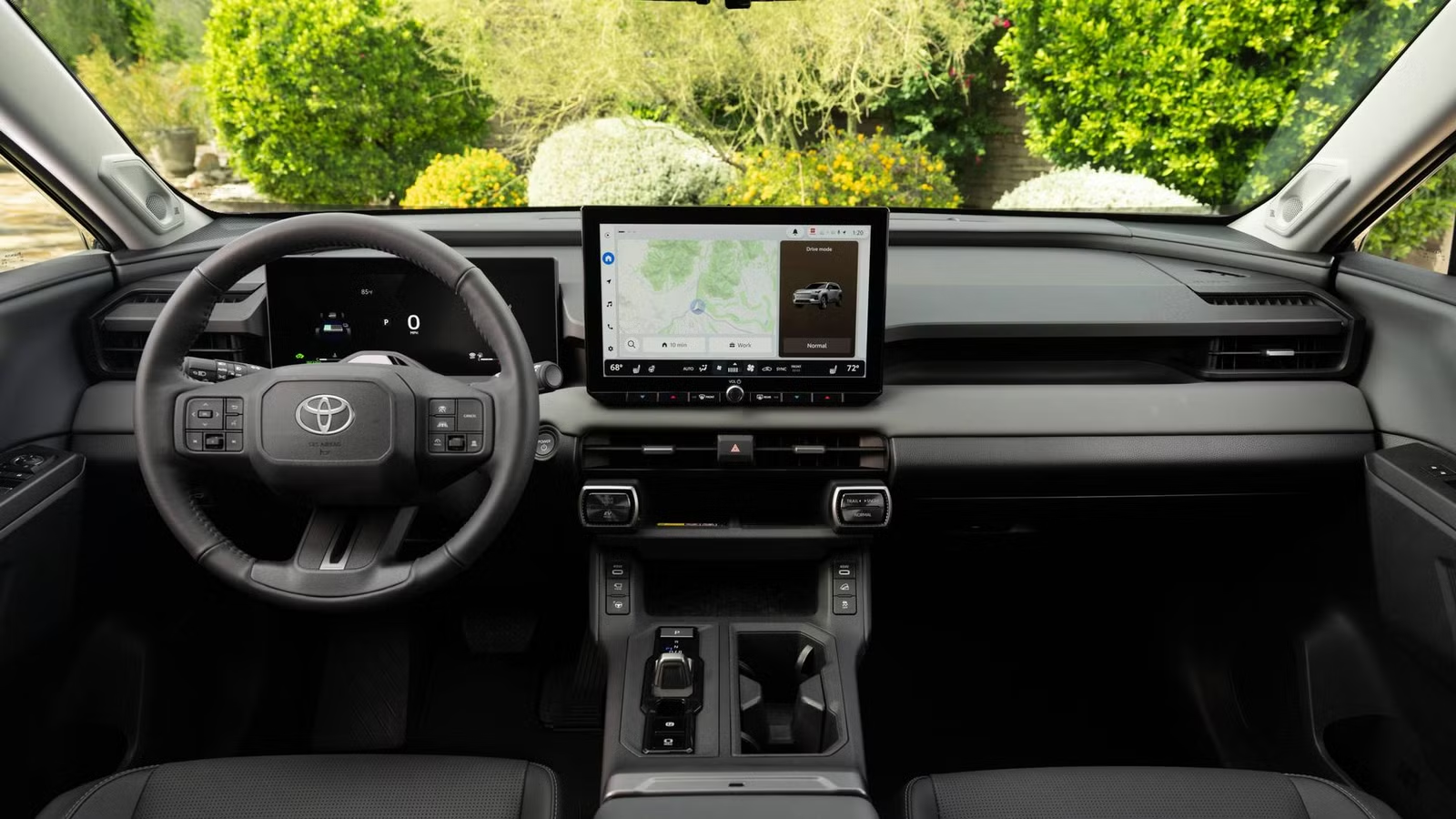
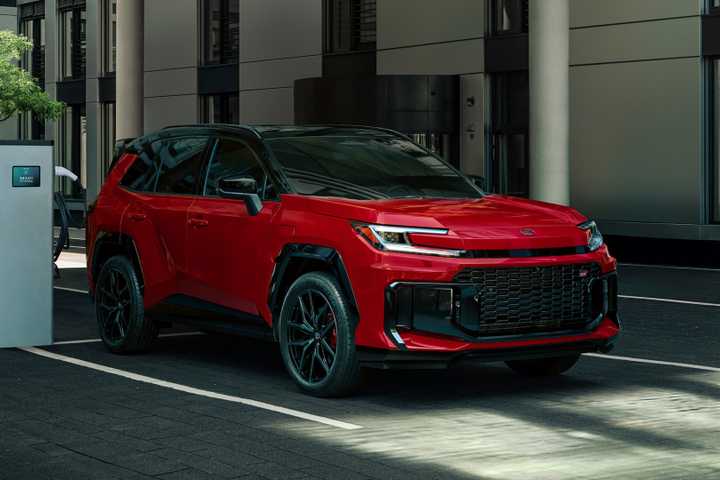
The LE sets a high baseline for the brand’s digital smart suite, featuring a standard 12.3-inch digital instrument cluster and a 10.5-inch Toyota Audio Multimedia touchscreen equipped with wireless Apple CarPlay and Android Auto. Toyota adds comfort to the LE by including dual-zone automatic climate control and a six-speaker audio system. Stepping up to the SE adds a sportier edge with 18-inch black sport alloy wheels and blue interior stitching, while standardizing heated front seats and a power-adjustable driver’s seat.
Interior of a 2026 Toyota RAV4 LimitedIsaac Atienza | TopSpeed
The Woodland Edition, designed for outdoor enthusiasts, builds on this with a rugged exterior and interior design theme, featuring a 0.5-inch lift, all-terrain tires on 18-inch matte gray wheels, and unique 120-volt/1,500-watt household-style power outlets in the cargo area — a handy touch for camping trips. It also includes Woodland-branded all-weather mats and raised roof rails with crossbars.
Why Higher Trims Make The Tech Feel Less Basic
Interior shot of a 2026 Toyota RAV4 XSE showing the cockpit layoutToyota
For buyers who want more refinement, the XLE Premium swaps fabric for SofTex-trimmed seating and adds a height-adjustable power liftgate along with a wireless smartphone charging dock. The XSE upgrades the center display to a larger 12.9-inch touchscreen, and pairs it with ventilated front seats, a power-adjustable passenger seat, memory settings for the driver, synthetic suede Brin-Naub upholstery, and a standard surround-view camera for easier maneuvering. At the top of the range sits the Limited trim, which adds a standard nine-speaker JBL Premium Audio system, a panoramic glass roof, and heated rear seats. Convenience is rounded out by a digital rearview mirror and a hands-free kick-sensor power liftgate.
How Hybrid Power Makes The RAV4 More Than Just Practical
2026 Toyota RAV4 front-end shotToyota
The 2026 Toyota RAV4 is only available with hybrid powertrains. The HEV lineup introduces Toyota’s fifth-generation hybrid system, which features an improved transaxle, battery, and power control components to refine performance. The all-wheel-drive model produces a combined 236 horsepower, while the front-wheel-drive model produces 226 horsepower. Toyota also improves the towing capacity of select all-wheel-drive models — including the XLE, Woodland, SE, XSE, and Limited grades — to 3,500 pounds. All front-wheel-drive and LE all-wheel-drive models can tow up to 1,750 pounds.
The PHEV features the company’s new plug-in hybrid system, pairing a naturally aspirated 2.5-liter four-cylinder engine with a high-capacity battery and charger compatible with Toyota’s sixth-generation hybrid technology. This system produces a combined 324 horsepower, reflecting a 22-horsepower increase over the previous generation — a meaningful step forward for a vehicle in this class.
Why That Hybrid Power Still Keeps Fuel Costs In Check
Front 3/4 action shot of 2026 Toyota RAV4 Woodland driving on roadToyota
According to the EPA, the front-wheel-drive model is the most efficient, achieving 49/42/45 MPG on the city/highway/combined cycle. Opting for all-wheel drive brings this to 46/39/42 MPG — not much of a sacrifice. The Woodland’s larger tires and all-wheel-drive-only configuration yield 41/35/38 MPG, while the XSE’s sportier wheel setup shifts consumption to 43/37/41 MPG.
How Long-Term Ownership Strengthens The RAV4’s Case
2027 Toyota RAV4 front 3/4 shotTopSpeed | Michael Frank
J.D. Power’s latest valuation of the RAV4 results in a reasonably positive 79/100 overall score, supported by a 78/100 for driving experience, 82/100 for resale, and 77/100 for the dealership experience. iSeeCars backs this with an 8.7/10 reliability score, projecting a 13.8-year lifespan and 169,545 miles of trouble-free use, along with a 29.1 percent probability of reaching 200,000 miles. According to CarEdge, the Toyota RAV4 will cost $6,005 for maintenance and repairs during its first 10 years of service — a figure consistent with its strong brand reputation, high consumer demand, and proven long-term reliability. According to Edmunds, you can expect to spend $36,219 over five years and 60,000 miles on the base Toyota RAV4 LE, with $4,427 going toward maintenance, $601 toward repairs, $11,554 toward depreciation, and $7,831 toward fuel.
What Toyota Charges For This Practical Advantage
Rear 3/4 shot of a 2026 Toyota RAV4 HEV XLE Premium Ruby Flare PearlToyota
Toyota has built a reputation for producing durable vehicles with low maintenance costs, which translates to higher resale values. The RAV4 benefits from Toyota’s strong presence in the hybrid market, where it is recognized as a leader due to its early adoption of hybrid technology and consistent refinement of its models.
Toyota kicks the 2026 RAV4 range off with the LE, starting at $31,900. Following this are the $34,700 SE, all-wheel-drive-only $39,900 Woodland, $36,100 XLE Premium, and the $41,300 XSE and $43,400 Limited, both of which are also all-wheel drive only. The PHEV range consists of the SE and XSE, priced at $44,815 and $48,685, respectively. Opting for all-wheel drive adds $1,400 to all applicable models.
Where Its Price Places It In The Current Compact Hybrid SUV Landscape
Compared to its closest rivals, the RAV4 manages to grab the advantage in terms of price and value for money. The 2026 Honda CR-V Sport Hybrid starts at $35,630, while the 2026 Hyundai Tucson Hybrid and Mazda CX-50 Hybrid start at $32,450 and $34,750, respectively. For those itching for adventure, the 2026 Subaru Forester Hybrid is available with standard Symmetrical AWD and a 2.5-liter four-cylinder Boxer engine assisted by Toyota hybrid tech, starting at $34,730. While the 2026 RAV4 undercuts all these rivals on sticker price, buyers may find it difficult to actually get their hands on one, as production for the new-gen models has yet to catch up to demand. This has led to dealer markups on available units that could put the aforementioned rivals back in contention if out-the-door prices stray too far from MSRP. Regardless, once production catches up and prices normalize, the RAV4 will likely reclaim the top spot for the majority of compact hybrid SUV shoppers — as it has for the past decade.
How Toyota Backs Up The Price With Serious Safety Tech
2026 Toyota RAV4Chris Chin | TopSpeed
The 2026 Toyota RAV4 Hybrid debuts TSS 4.0, which marks a major evolution in Toyota’s active safety suite by leveraging enhanced sensor hardware and the new Arene software platform. A standout addition is the emergency driving stop system, which can bring the vehicle to a controlled stop if the driver becomes unresponsive while lane tracing assist is active. The pre-collision system now features expanded intersection support, detecting motorcycles and oncoming vehicles during turns, while Toyota’s Proactive Driving Assist provides gentle braking or steering inputs to maintain distance from obstacles such as parked cars or cyclists. Additionally, the full-speed range dynamic radar cruise control features curve speed management and offset passing logic, which subtly shifts the RAV4 Hybrid within its lane when passing large trucks.
Dynamic shot of a 2026 Toyota RAV4 Hybrid LimitedToyota
Beyond the TSS 4.0 suite, the RAV4 is equipped with an array of active and passive protections. Standard across all trims is the blind spot monitor with rear cross-traffic alert and a backup camera with dynamic guidelines. Higher trims or optional packages introduce front cross-traffic alert, a panoramic view monitor with a 360-degree overhead view, and Advanced Park, which automates steering for tight spots. On the passive side, the vehicle is built on the TNGA platform, featuring reinforced frame joints to optimize crash energy absorption. It comes standard with an eight-airbag system, including a driver’s knee airbag and front passenger seat-cushion airbag. Toyota’s Star Safety System is also standard, integrating traction control, electronic brake-force distribution, and smart stop technology.
Why The RAV4 Becomes The SUV That Fits Almost Everyone
2026 Toyota RAV4 GR front seatsToyota
2027 Toyota RAV4 rear cargo spaceTopSpeed | Michael Frank
The RAV4 features a tech-focused cabin that delivers entertainment and information in an intuitive way while making every drive safer and more comfortable. It’s powered by a hybrid powertrain producing 236 horsepower that doesn’t demand expensive upkeep over the long haul. On paper, that’s not unusual — plenty of SUVs offer roughly the same. What sets the RAV4 apart is how it packages that cabin and performance within a genuinely compact footprint. 2026 Toyota RAV4 Interior Dimensions
Headroom (front/rear)
36.7 / 39.5 inches
Legroom (front/rear)
41 / 37.8 inches
Shoulder Room (front/rear)
57 / 56.4 inches
Stepping inside reveals a modern yet utilitarian interior that’s built to get the job done rather than dazzle. It still seats five, with up to 37.8 cubic feet of maximum cargo space — enough to swallow a few suitcases with the rear seats up. Compared to rivals like the Honda CR-V Hybrid and Hyundai Tucson Hybrid, the 2026 RAV4’s cabin dimensions are actually slightly smaller. The RAV4 compensates with a lower starting price, undercutting both the Tucson Hybrid and CR-V Hybrid. Compared to the 2026 Mazda CX-50 Hybrid, the RAV4 comes out ahead on cabin specs, leading in headroom, shoulder room, and cargo space by nearly 10 cubic feet. The cabin also offers generous storage throughout, and most trims feature cloth or faux leather upholstery that complements its practical, tech-forward character.
Front 3/4 shot of 2026 Toyota RAV4 PHEV Woodland parked off-roadToyota
As a result, the RAV4 becomes a versatile SUV that can do everything and fit any lifestyle — family hauler, road-trip companion, weekend adventurer, or daily commuter. It’s the reason the RAV4 is the most popular SUV in the country, moving over 680,000 units in 2025 alone. Starting around $32,000, the RAV4 is a complete package, delivering a balance of technology, efficient performance, and versatility that few rivals can match at the price.
Base Trim Engine
2.5L Inline 4 Hybrid
Base Trim Transmission
CVT
Base Trim Drivetrain
Front-Wheel Drive
Base Trim Horsepower
183 HP @6000 RPM
Base Trim Torque
163 lb.-ft. @ 3600 RPM
Make
Toyota
Model
RAV4
Segment
Compact SUV
Sources: Toyota, J.D. Power, iSeeCars, CarEdge, and Edmunds.










No Comments