
The Motorcycle That Quietly Defines Kawasaki Better Than The Ninja
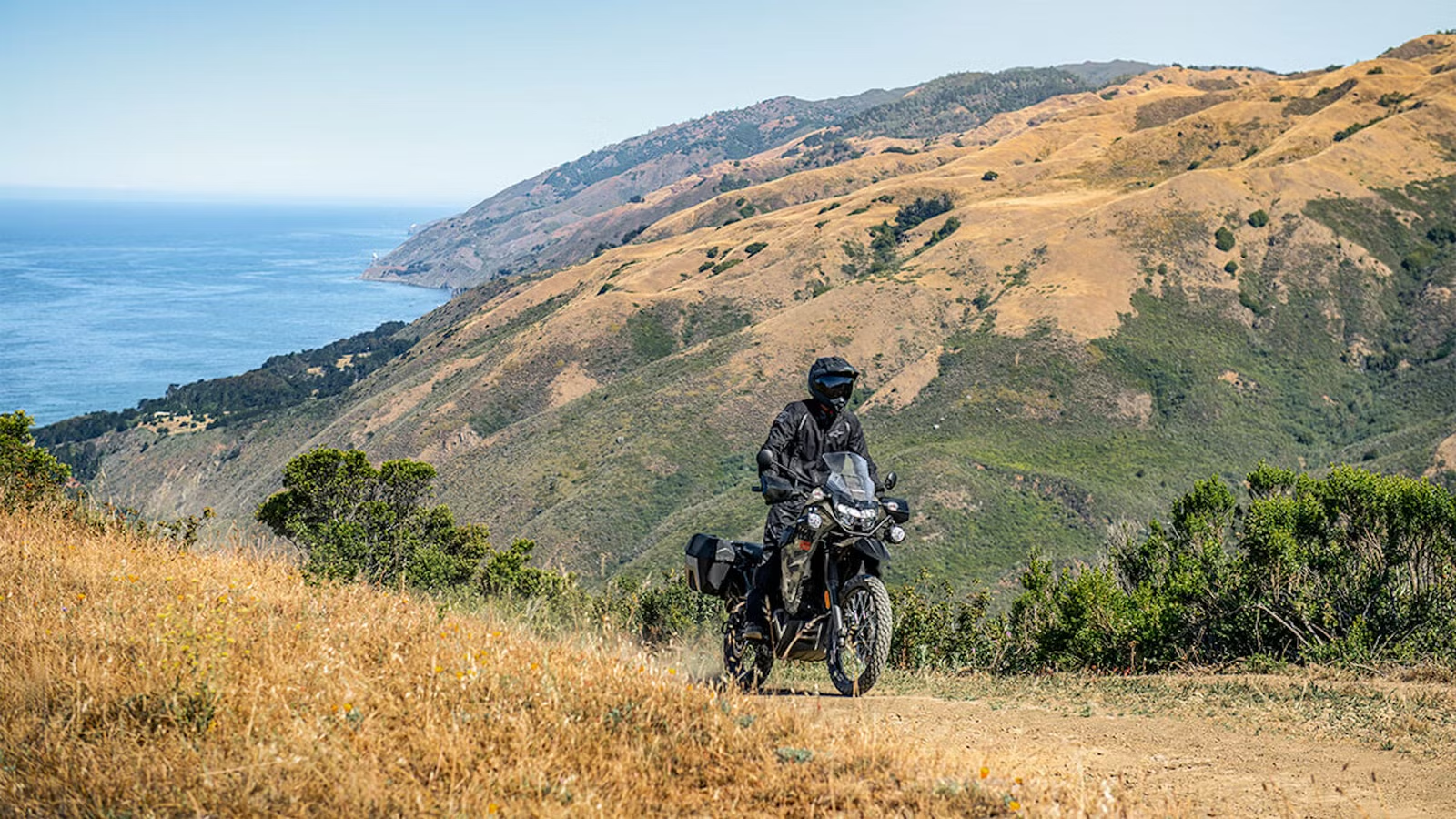
Kawasaki built its modern reputation on high-RPM violence and competition silverware. The Ninja badge is the sharp end of that identity, proving its mettle across wildly different disciplines. Jonathan Rea used the ZX-10RR to put the WorldSBK field in a headlock for six straight titles. Meanwhile, on the dragstrip, Rickey Gadson took generations of green superbikes, from the ZX-9R and ZX-12R through to the ZX-14, and turned factory drag racing into an 11-time championship clinic. Between all that, however, the brand has whipped up some stellar underrated machines. And one of these is a dual-sport-type adventure bike that we’re going to talk about.
Kawasaki’s Real Prowess Might Not Be Its Tech-Laden Ninjas

The Ninjas’ obsession with digital wizardry eventually infected the broader motorcycle industry. Modern showroom floors are packed with six-axis IMUs and endless electronic rider aids. Kawasaki can play the spec-sheet game better than most, but it also maintains an entirely different school of thought. Parked far away from its track-honed flagship models sits a secondary tier of machinery that ignores transient electronics in favor of bulletproof mechanical basics.

These bikes include the likes of the KLX230, W800, and Vulcan 900. They trade marketing hype for real-world reliability, delivering straightforward ownership to riders who care far more about mechanical durability than software updates. True engineering pedigree is not only about hunting fast lap times; it can also be about building a machine that simply refuses to break when conditions turn sour. Much like a shark or a crocodile, a mechanically resolved platform will find an evolutionary sweet spot early on and will have little reason to change.

For four decades, Kawasaki has maintained an unassuming dual-sport-type adventure bike powered by a thumper that embodies that exact mechanical stubbornness right alongside those world-beating Ninjas. It runs relaxed tolerances, an under-stressed single-cylinder engine, and dead-simple componentry that shrugs off low-grade fuel and outright neglect. When complex bikes trigger dash warnings in the middle of nowhere, this platform can be kept running with a spool of string and prayers – or basic tools, whichever is handy.

The Kawasaki KLR650 Is Built To Outlast Ninjas

The Kawasaki KLR650 is the direct antidote to the Ninjas’ high-tech arms race. Where the Ninja family chases lap times, quarter-mile passes, and magazine covers, the KLR has defined reliability for generations. It might not be fast, or loaded with tech, but it will get you where you want to go and back many times over without complaint. It is the unpretentious workhorse that proves simple, honest engineering outlasts spec-sheet vanity every single time, and quietly defines Kawasaki better than the Ninja.
$6,999 Base Price Is Accessible, But The Top Variant Is Pricey

The KLR is a legacy brand, and as such, it does not compete at the high end of the middleweight segment, choosing instead to remain at the lower end. The base KLR 650 retails at $6,999, but if you equip it with the dual-channel ABS, it goes up to $7,299. These are also the prices for the KLR 650 S, the variant with the lower seat height and reduced suspension travel. Finally, there is the KLR 650 Adventure ABS that retails for $8,199. This is a pretty high price for something that is essentially a few decades old, but it gives the KLR a couple of adventure-touring-ready accessories.
A 652cc Under-Stressed Thumper Prioritizes Low-End Tractor Torque

The KLR 650’s single-cylinder engine has been essentially the same since its introduction and is one big reason for making this motorcycle legendary for reliability. What has remained the same during the decades is the liquid cooling and the four valves with the double overhead camshaft. What has changed is the addition of a second counterbalancer to reduce vibration in 2008, and fuel injection was another introduction in 2022.

There is nothing fancy about this engine. It has a simple cable throttle, a five-speed gearbox, and a final chain drive. It displaces 652 cc, has a compression ratio of 9.8:1, and generates 38.5 horsepower at 6,000 RPM and 39.1 pound-feet at 4,500 RPM. The fact that you do not have to rev it out to get maximum torque works in its favor, especially off-road, and the low compression ratio means that it is a very unstressed engine. Its reliability is legendary, but on long highway stretches the vibrations will get uncomfortable.
Conventional Long-Travel Suspension Absorbs Abuse But Exposes Budget Brakes

The KLR’s chassis matches the engine’s intent in that it is a simple, rugged piece of technology whose main aim is to be reliable. It is a steel semi-double cradle frame with 41 mm telescopic forks at the front and a Uni-Trak monoshock at the rear with adjustable preload and rebound damping. The front suspension offers 7.9 inches of travel and the rear a little more at eight inches. brakes seem a little inadequate judging by its size, weight, and more modern bikes, but they were okay for the period in which it was developed. The front has a 300 mm single disc with a two-piston floating caliper, and the rear has a 240 mm disc with a single-piston caliper.

These are mounted to wire-spoke wheels with a 21-inch at the front and a 17-inch at the rear. The tires require tubes, which is OK since this is expected to be more of a dual-sport than an adventure motorcycle. The rough-and-ready nature of the chassis and suspension bits means that it is uber-reliable no matter what you do, but should you want it to be better, the aftermarket has an infinite number of solutions. Better brakes would make a significant difference to the overall ride, but it still manages to outlast rivals from KTM and Yamaha for thousands less.
456-Pound Curb Weight Is A Bit High For Its Dual-Sport Roots
The KLR is pretty much a full-size motorcycle despite its engine, with a length of 89.8 inches, width of 38.2 inches, and a wheelbase of 60.6 inches. The seat height is quite tall at 34.3 inches, but it has genuinely impressive ground clearance at 8.3 inches. The fuel tank is also quite large at 6.1 gallons, and it weighs 456 pounds. The curb weight has steadily increased over the years and now has put it firmly in the realm of an adventure motorcycle rather than a dual-sport like it originally started out as. The tank range is impressive enough that it is perfect for riders who want to escape everything, but the aftermarket can provide you with absolutely enormous fuel tanks that’ll make you give up and take a break before the fuel runs out.
No Fancy Features Make This A Raw Ride

The KLR’s grassroots nature means that if you’re looking at tech and features, you’re in the wrong place. Kawasaki gave in and gave it an all-LCD instrument cluster with the 2022 update, along with fuel injection. The display shows the fuel level, speed, odometer, trip meters, and a clock. The Adventure variant adds a few things that make long-distance rides easier. They include lockable, quick-release hard side cases that open with the ignition key, auxiliary LED lamps, a 12V charging socket, an engine guard and frame sliders, and a tank pad. This also increases the weight to over 480 pounds.
The Himalayan And Ibex Expose The KLR’s Price-To-Feature Deficit

The KLR650 started off as one of the big, highway-capable dual-sport bikes along with the Honda XR650L and the Suzuki DR650S. Along the way, it has evolved into a low-cost, high-reliability, simple ADV. With this filter, there are a few rivals. The Royal Enfield Himalayan 450 retails for as little as $5,999 in base trim. This goes up to $6,799 for the top-spec variant with tubeless rims and the rally seat. It has turned out to be better than anyone expected, and RE has infused some likable tech, such as seamless Google Maps integration with its TFT instrument cluster, switchable ABS, and two ride modes across the range.

A left-field option is the CFMoto Ibex 450 that retails for $5,999 and is proving to be the best budget adventure motorcycle of the year. This has a parallel-twin cylinder engine with a 270-degree firing order, 21/18-inch tubeless spoke wheels, switchable ABS, fully adjustable KYB suspension, a radial front brake caliper, a 5-inch TFT display, traction control, type A and type C USB charging sockets, and LED projector headlamps. Phew. The small dealer network and questions about reliability work against it – even the Royal Enfield requires a lot more time to prove that it can get anywhere near the heights of the KLR’s reliability.
Source: Kawasaki USA

Related posts


Latest Post


No Comments