
The Sports Cars Smart Collectors Are Targeting Today
Some collectors chase cars with the most hype or fame attached to them. Others buy cars they have a personal connection to. However, smart collectors have a pulse on the used car market, value trends, and buyer behavior. They buy cars that are poised to appreciate that everyone else overlooks. And while anyone who claims they can accurately predict exactly which cars will be expensive in the next few years is lying, looking at which cars’ values soared in the past, and the features and characteristics they have in common, is a great place to start.

For this list, we’ve selected five sports cars that most experts and enthusiasts agree are either underpriced or poised to become classics. They may not be rare or expensive today, but all are backed by pure analog construction, strong heritage, enthusiast-friendly driving dynamics, and designs that age like fine wine. The choices we made for this list are further backed up by real-world auction value trends, experts like Hagerty, and values and trends for similar models on the used market that are already out of most buyers’ reach.
5
Mazda NB Miata (incl. MazdaSpeed versions)
Average Used Price: $13,281
While high-performance cars are on many enthusiasts’ radars, savvy collectors also target budget classics with strong value potential, famous reliability, and a proven fan base. Easily the best example that embodies all of these characteristics is the NB-generation Mazda MX-5 Miata. The budget king on Hagerty’s latest bull market list, the second-generation Miata refined the original fully analog naturally aspirated sports car recipe at the turn of the century. Produced from 1999 until 2005, it recently joined the classic-car club, and values are now starting to rise, after the first-gen’s values have already soared in the last decade. This generation brought more modern styling, a stiffer chassis, solid lifters, and more power from the notoriously reliable 1.8-liter four-cylinder engine.

But while the NB Miata is already iconic, enthusiasts in the know are paying the best money for special MazdaSpeed variants – the only turbocharged Miatas ever produced. Produced only in 2004 and 2005 with just 5,428 examples leaving the factory, MazdaSpeed Miatas came equipped with Garrett turbos that pushed their outputs to 178 hp and 166 lb-ft. Along with the extra power and torque comes a stronger clutch and suspension with Bilstein shocks. A limited-slip diff helps the rear wheels put down power. As a result, these launch to 60 mph in well under 7 seconds. And while the average price of an NB Miata is in the low teens, regardless of model year, collectors are now paying well north of $20,000 for clean MazdaSpeed models, such as this one that fetched $26,500 in 2025 – chump change compared to what these rare Miatas could be worth in a few decades.
4
BMW Z4 M Coupe
Average Used Price: $38,842

The Z4 M Coupe may be the best true sports car BMW ever built. Hear us out. Produced only between 2006 and 2008, it’s lighter, smaller, and more nimble than any other M car made in the last 20 years, and it rides on its own dedicated sports car chassis. It’s also the last Z4 ever sold as a coupe, and features the brand’s most legendary naturally aspirated inline-six under the hood: the S54. It makes 333 hp in North America (343 hp for Europe-spec versions), routed to the rear wheels only through a six-speed manual transmission. It’s the same exact powertrain as the beloved BMW M3 E46, but in a stiffer chassis with the driver’s seat much closer to the rear axle for a true sports car feel. And while both cars are capped at 155 mph, the Z4 M Coupe launches to 60 mph in just 4.8 seconds. Needless to say, enthusiasts now seem to be buying these left and right.
According to recent auction data from The Classic Valuer, the Z4 M’s average auction value has been slowly rising year over year, from around $32k in 2020 to roughly $37k today. With early models now breaking into classic car status, it’s reasonable to assume the Z4 M’s prices will only continue to soar. In fact, several examples logged on Classic.com in the last month were listed at over $60,000.
3
Nissan Skyline GT-R R32
Average Used Price: $51,891

We’re not joking: The original Godzilla is still selling for 50 grand, and often much less. It’s the GT-R that started the legend, debuting the RB26DETT in a brand-new chassis and a brand-new design, along with Nissan’s ATTESA E-TS all-wheel-drive system that allowed it to dominate motorsports from the moment it touched asphalt.
When it entered the Japanese Touring Car Group A championship in 1989, it won every single race of the 29 races in the series. It continued to streak win after win, including three consecutive wins in the Australian Touring Car Championship between 1990 and 1992, where it earned its famous nickname. Despite being over three decades old, the R32 GT-R’s spec sheet and the RB26’s tuning potential make it a performance monster. Stock, these are conservatively rated at 276 hp, but can rocket to 60 mph in under 5 seconds. With bolt-ons, these can easily push above 500 hp on stock internals. Compared to later GT-R models, the R32 was significantly lighter and more nimble. There are no electronic nannies, just mechanical grip and turbo rush. The R32 is arguably the purest expression of the Godzilla bloodline.
Fewer than 30,000 R32 GT-Rs were built between 1989 and 1990, and they are all legal for import in America – many already roam the streets. But despite that, and the legend attached to its name, the R32 GT-R remains the absolute cheapest way for enthusiasts to get behind the wheel of an all-wheel-drive GT-R today. The sub-$50k average for earlier examples of the regular R32 GT-R is nearly criminal, and some have even sold for as little as $21,500, although finding one that hasn’t been modified for cheap is an undertaking. Meanwhile, enthusiasts in the know are buying the cleanest and rarest versions – such as Nismo-tuned ones – for over six figures. Hagerty already named the more expensive R33 GT-R on its bull market lists, but between the two, we believe the R32 is the bigger bargain today.
2
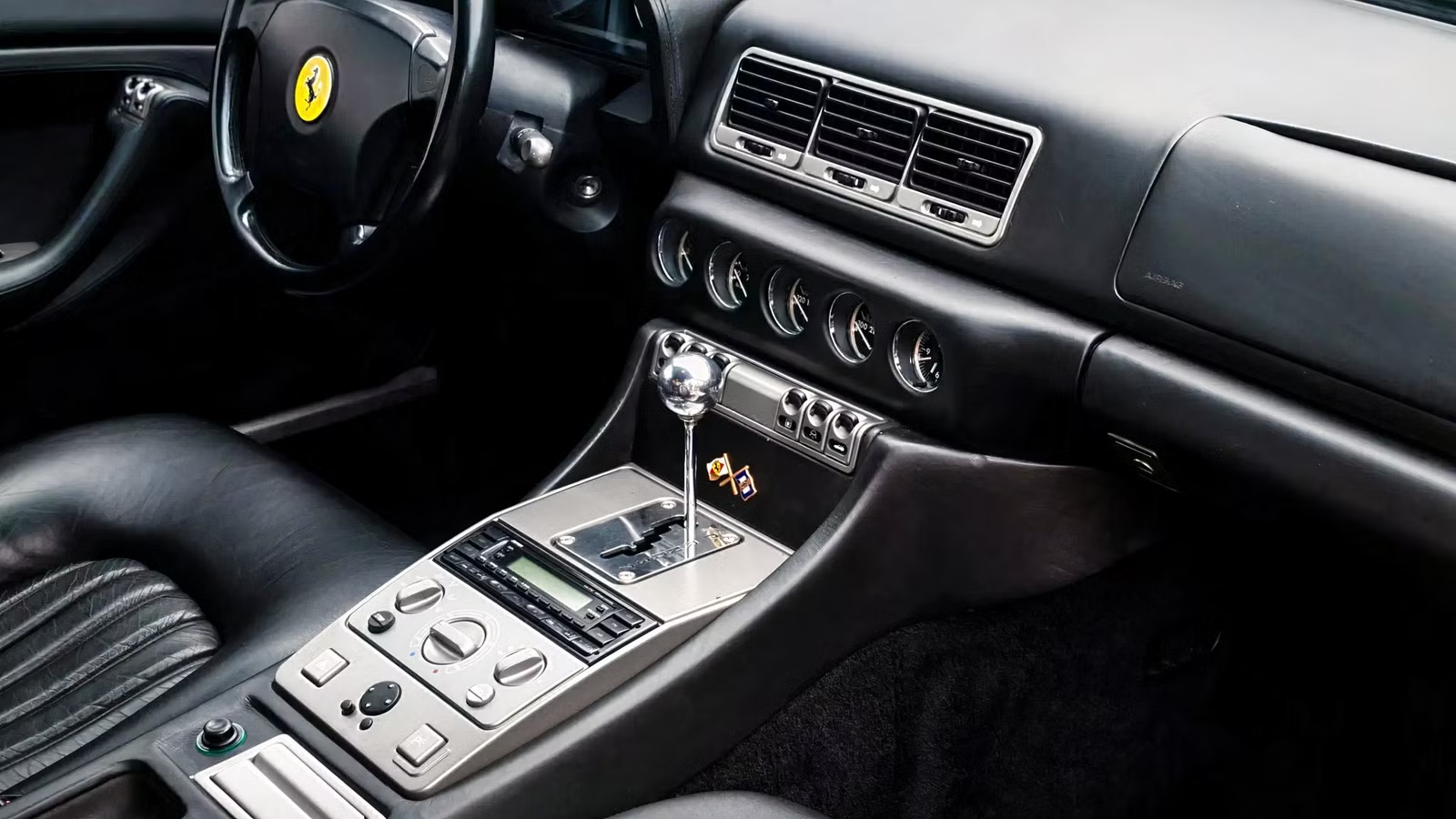
Ferrari 456
Average Used Price: $51,954 – $100,000

The 456M is not the best Ferrari ever made, but it’s easily one of the most overlooked. Consider this: The 456 is a fully-fledged V12 grand tourer produced at the turn of the millennium – relatively modern in its performance and features, but still fully analog. But while Ferraris that fit that description, such as the 550, 575, and even the slightly older 512 TR, all command multiple six figures, this one still trades hands for the price of a used F-150. Why is that? It’s anyone’s guess, but the fact that it’s a comfort-oriented 2+2 grand tourer with steep maintenance bills might have something to do with that – not that other Ferraris are cheap to maintain.
Another thing to keep in mind is that the cheapest 456s (the GTA models) all come with the dreaded 4-speed automatic transmission. Still, for less than 50 grand, it’s something we wouldn’t lose too much sleep over. And despite the used value difference between the automatic and manuals being striking – a gated manual instantly doubles a 456’s value – these manual 456 and newer 456M GT trims are still relative bargains at around $100,000. For reference, the updated 456M models that debuted in 1998 received a sleeker facelift, suspension tweaks, and electronic traction control, but they aren’t generally worth significantly more than their predecessors.
Also, whichever combination of transmission and model year you opt for, we didn’t find any notable difference in performance – all 456s come with a 5.5-liter free-breathing V12 that produces 442 hp along with a glorious soundtrack. They all top out at over 185 mph and launch to 60 in roughly 5 seconds, with exact acceleration times varying between independent tests more than the transmissions.
1
Chevrolet Corvette C7 Z06
Average Used Price: $75,504

Yes, seriously. The last front-engined, manual transmission Z06 is worth less than 80 grand today, on average. In fact, auction databases put the average value of earlier 2015 models at under $70k, which is absolutely insane for a 650-horsepower supercar slayer. With a seven-speed stick equipped, these Z06 models are still some of the quickest manual transmission cars on the planet, with a 3.2-second 0-60 mph run. Opt for the less-coveted automatic, and you’re rewarded with a sub-3-second run. That performance is courtesy of GM’s supercharged LT4 – arguably the last old-school American V8 engine that’s still in production LINK – that also powers the current Cadillac CT5-V Blackwing.
Still, the C7 Z06 may not be a bargain supercar for long. Hagerty notes a striking 11% rise in prices for excellent condition models over the last 12 months, and recent auction price trends back this estimate up. With prices already rocketing, the rarest and most desirable examples – convertibles and 7-speed manuals – are likely going to be the first ones to go out of reach. Hagerty notes the convertibles are worth roughly $2,300 more than the coupes, on average, and estimates a 10% premium on going for a manual transmission example. Of course, the same applies to the C7 Z06’s predecessor, which replaced supercharging with sheer displacement.
Sources: Classic.com, The Classic Valuer, Car and Driver, Hemmings, Hagerty.

Related posts

Latest Post


No Comments