
The Sub-$8,700 Cruiser Delivering Harley Style Without Harley Drama
Cruiser bikes are the backbone of American motorcycling culture, and Harley-Davidson has played a crucial role in their success over the years. Comfort and aesthetics have been vital parts of the formula. However, drama is also an integral part of this packaging.

While some riders embrace Harley’s drama as a way to feel more connected to the bike, others find frequent repairs and service visits stressful. For the latter, there’s an old-school custom-styled Honda cruiser bike that faithfully replicates Harley charm without the drama. In 2026, this reliable and refined metric cruiser is more affordable than any Harley on sale.
Harley-Davidson Cruisers Are The Flag Bearers Of Old-School Charm
The quintessential cruiser bike formula is rather simple—a big V-twin, minimal bodywork, laid-back ergonomics, and lots of chrome. Very little has changed over the years, which is also why cruiser bikes still uphold their old-school charm. Harley-Davidson carries this charisma forward well in its 2026 Softail model lineup.


The latest nostalgia-inducing cruiser bike is the 2026 Super Glide, which revives a 1970s nameplate that single-handedly redefined what a factory-custom cruiser could be. But frankly, if we have to choose one cruiser bike to define influential Harley-Davidson styling, then it’s got to be the now-defunct but not forgotten Iron 883. The Harley-Davidson Iron 883 is special because it is one of the most affordable ways to enjoy a dark, custom-styled Harley. It is also accessible and packs a visceral V-twin with ample aural drama.

Furthermore, the Iron 883 is popular among custom builders, serving as a highly customizable “empty canvas” for dreamy riders. It stands out from the usual crop of Harley V-twin cruisers by flaunting aggressive, minimalist bobber styling with far less chrome. Notable visual features include blacked-out components, chopped fenders, and fork gaiters. With a sub-26-inch seat height and relatively compact dimensions, it is still one of the most accessible air-cooled Harley cruiser bikes.
But It Is Not Without Drama

A Harley-Davidson without mechanical drama can seem surprising. Yes, and it isn’t a bad thing, because riders are accustomed to the mechanical hurdles that Harley cruisers come with. On the flip side, with old-school components that have been in production and use for decades.
Harley riders enjoy easy access to the factory and even third-party components. Furthermore, a thriving culture of working on one’s own Harley also helps one get closer to the machine. Hence, common issues such as oil leaks, clutch spring plate failures, and electrical problems are not red flags but rather challenges to be overcome and lessons learned. However, not everyone is a fan of Harley’s drama.

This is where the newer, thriving bunch of metric cruiser bikes comes into the picture. These were made as solid alternatives to traditional American V-twin cruiser bikes. But Japanese brands like Honda, Yamaha, Kawasaki, and Suzuki also contributed their expertise, making metric cruisers more desirable. These are superior to traditional ones, offering higher mechanical reliability, advanced technology, and greater value, all while retaining a nostalgia-driven visual appeal.
Honda Offers Some Cool Cruiser Bikes That Match Harley’s Aura For Cheaper

Among the big four Japanese manufacturers, Honda stands out for its vibrant cruiser bike lineup. The most versatile and modern is its Rebel series, ranging from the baby Rebel 300 to the do-it-all Rebel 1100. The Rebel 300 is the only cruiser bike under $6,000 with an electronic clutch system. And the Rebel 1100 is the only cruiser bike in the world with a six-speed Dual Clutch Automatic transmission. In between lies the Rebel 500, an underrated entry-level cruiser bike.

Furthermore, Honda is the only 2026 bikemaker to offer a factory chopper with the Fury. It looks wild, cool, and unreal for a mass-produced cruiser bike—the $9,699 Rebel 1100 locks horns with the most affordable Harley-Davidson—the $9,999 Nightster. While there is a real Harley rival to the $11,499 Honda Fury Chopper, the custom-styled $22,999 Breakout comes close but is an expensive affair.

Then there’s the Honda Shadow Phantom, which stands out as the oldest surviving Honda cruiser bike nameplate today. It offers nostalgic charm, custom-inspired visual appeal, and a powertrain that is the epitome of reliability. It costs less to own than any V-Twin Harley-Davidson, new or old.
The Honda Shadow Phantom Delivers Old-School Harley Style Without The Issues
Starting Price: $8,699

Honda can eliminate the “drama” from the Shadow Phantom thanks to its superior reliability and refinement. This is primarily because of its overengineered V-twin engine that sits cocooned in a sturdy yet simple chassis. The hardware setup is straightforward with little to no complex components.
Even technological intervention is basic here, with the only notable feature being a dual-channel ABS. These and other clever hardware choices help make the Shadow Phantom much easier to live with, even when compared to the quite accessible and relatively affordable Harley-Davidson Iron 883.
Custom Styling Makes It Look Exciting Despite The Age

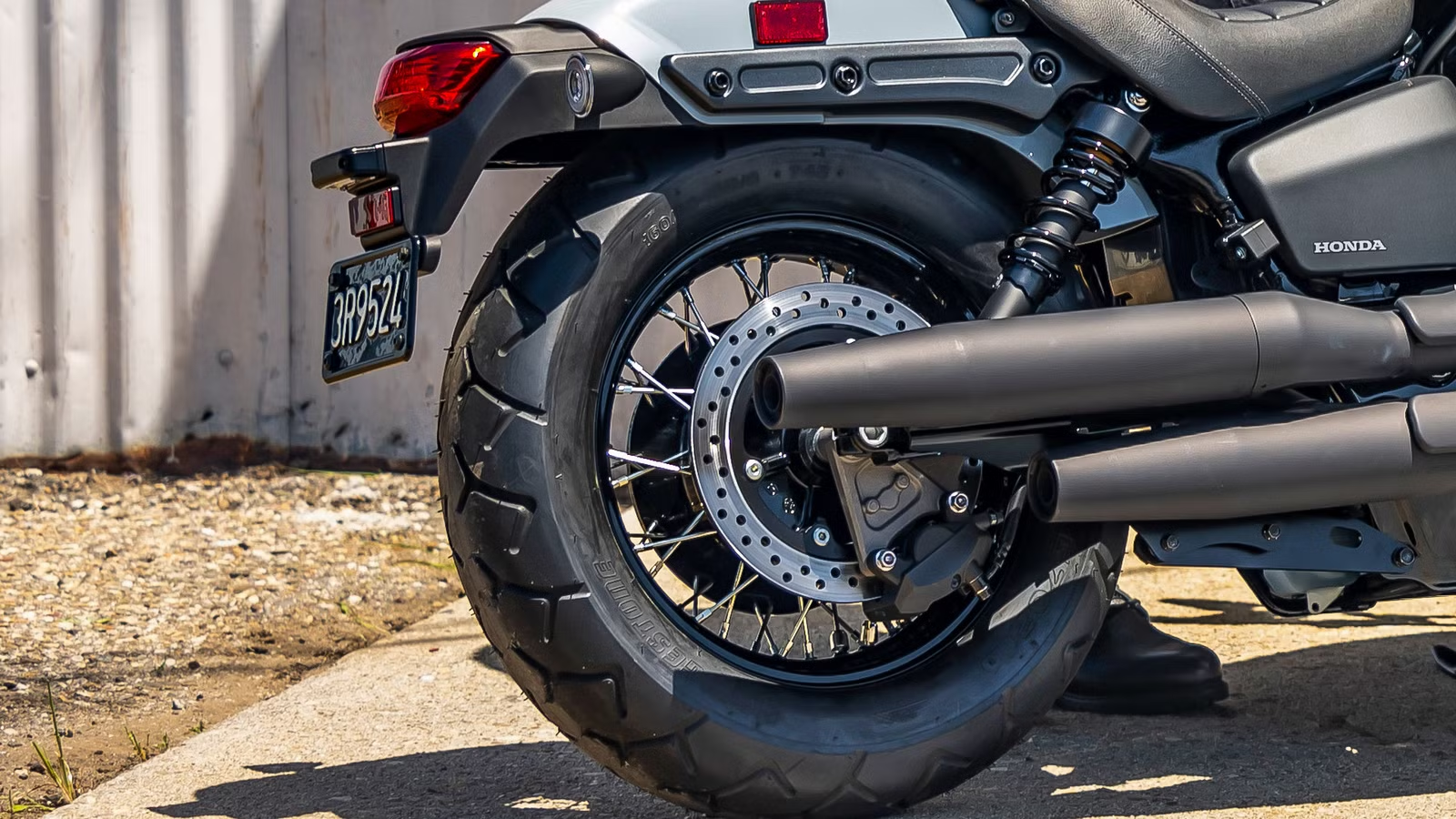
The primary reason why many confuse the Honda Shadow Phantom with a custom Harley or Indian cruiser bike is its faithfully recreated traditional cruiser bike design. This 10-year-old design also exudes a classic, timeless appeal, sprinkled with custom cues. Notable visual features that help the Shadow Phantom stay desirable despite its age include a dual-tone paint job, chopped fenders, and a scooped solo seat. It gets a lot of blacked-out elements, including the engine, wheels, fork covers, and the exhaust system. Offering a beautiful contrast are its laced wheels wrapped with chunky tires and 160-section rubber at the rear.
Here’s How The Honda Shadow Stays Drama-Free And Saves You Thousands Even After Purchase

It has not changed its core formula since 1997, which contributes to the abundant availability of affordable OEM and aftermarket parts. This, when coupled with its proven reliability quotient, helps reduce ownership costs compared to a Harley-Davidson Iron 883. While the Harley Iron 883, even in its last iteration (updated in 2009), relied on an air-cooled 45-degree Evolution V-twin engine, the Honda Shadow family has been powered by a liquid-cooled 45-degree V-twin since its inception in the 1980s.

While we praise Honda for its reliability quotient, it is not immune to problems. There are common issues that plague the Shadow Phantom, like clunky gearboxes, worn-out stators and regulators, and even oil weeping around the cylinder head gasket in high-mileage examples. But compared to the more susceptible Harley-Davidson Iron 883, the Shadow Phantom’s issues are minor and don’t hurt your wallet as much. The Honda Shadow’s more refined V-twin translates to better MPG ratings.
The lower curb weight also helps here. This results in lower yearly fuel expenses compared to the less efficient air-cooled Harley V-twin. The routine yearly maintenance costs for the Honda range from $150 to $350 if taken to a dealership. The Harleys’ average yearly maintenance costs are notably higher, ranging from $600 to $900. The Iron 883 is more expensive due to its shorter scheduled service intervals and the inherent issues of air-cooled V-twins.
Designed And Sized To Be A Relaxing Daily Companion

Compared to the Harley Iron 883, the Honda Shadow Phantom is a more relaxed, daily-rideable motorcycle. It has a lower seat height of 25.6 inches and a much lower curb weight of 553 pounds. While the Iron 883 is more compact, with a wheelbase of 59.5 inches and a length of 85.4 inches, the Shadow Phantom, with a wheelbase of 64.5 inches and a length of 93.0 inches, is more comfortable on city roads thanks to a lower center of gravity. The Harley, while low slung, still has a top-heavy design, which makes it relatively cumbersome to move around.
Complemented With A Cozy V-Twin And Sturdy Yet Simple Underpinnings

The Shadow Phantom’s refined and reliable V-twin is also designed to offer a relaxed character. The 745 cc mill, in the current iteration, has been around since 1997, when it was first introduced on the Shadow VT750C. It produces 44.9 horsepower and 47.9 pound-feet of torque. A lazy compression ratio of 9.6:1 and a linear yet meaty torque curve at the lower end make the Shadow lively yet predictable. Power is sent to the rear wheel via a five-speed manual gearbox and a final shaft-drive system.

It is underpinned by an old-school double-cradle steel frame that cocoons the V-twin. The chassis is suspended on 41 mm telescopic forks with 5.1 inches of travel up front and preload-adjustable twin shocks with 3.5 inches of travel at the rear. Braking duties are courtesy of a 296 mm disc coupled to a two-piston caliper up front. The rear gets a 276 mm disc coupled to a single-piston caliper.
Source: Honda Powersports

Related posts

Latest Post


No Comments