
The Station Wagon That Had Supercar Power In The ’70s
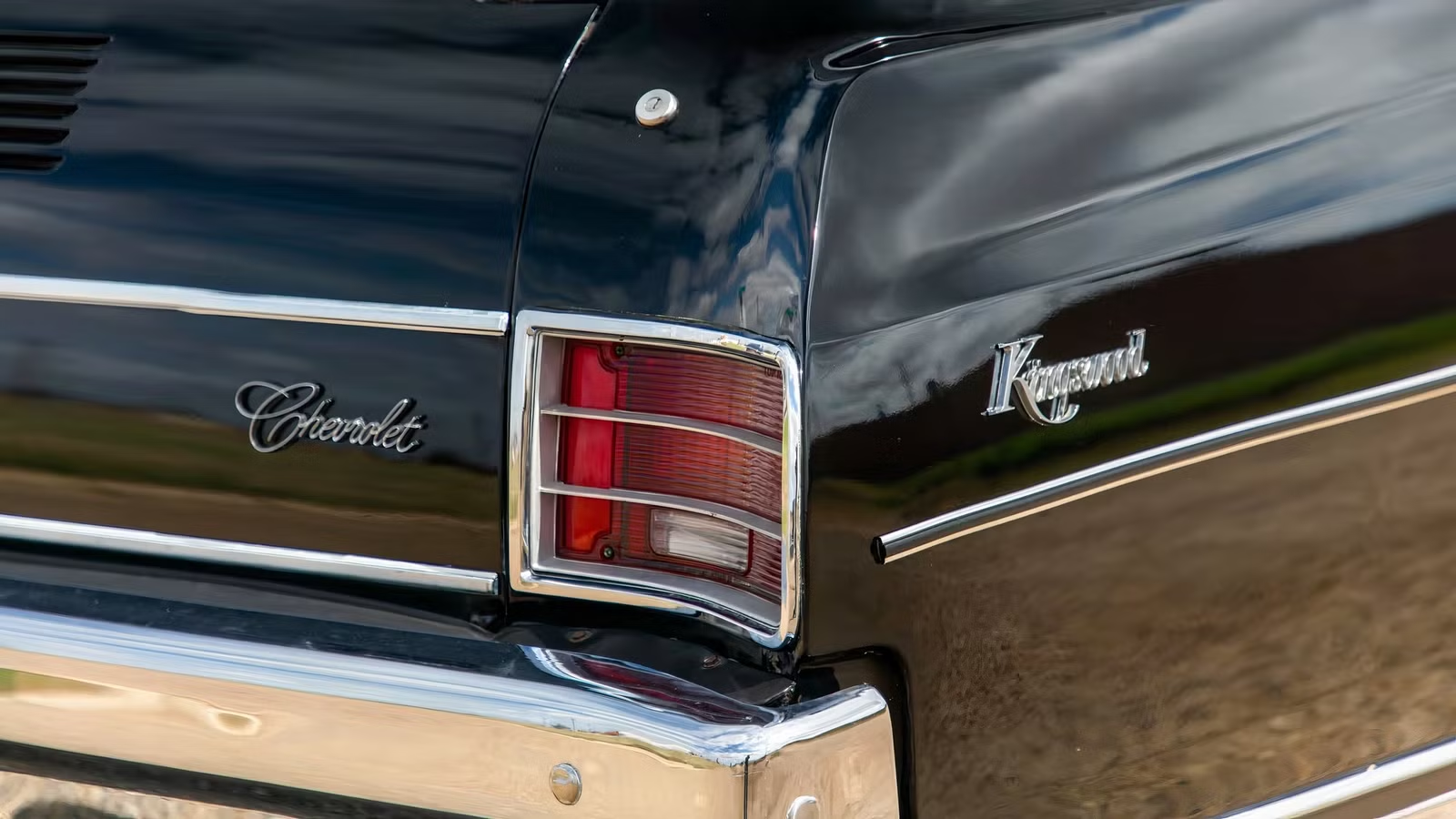
Station wagons have never been the first thing that comes to mind when the conversation turns to American muscle. Yet buried inside one of Detroit’s most unassuming family haulers is a story that still stops gearheads cold: a full-size Chevrolet wagon, ordered straight from the factory, packing the same big-block firepower as the era’s most celebrated performance cars. Before emissions regulations and insurance surcharges shut the party down, the order sheet was the only rulebook that mattered — and someone took full advantage of it. GTOs At the height of the muscle car era, American automakers shared engines freely across body styles. If a platform could physically accept an engine and the driveline could handle the torque, buyers were often allowed to order it. That approach led to some unexpected combinations, including Wagons performance figures to rival those of contemporary sports cars. full-size station wagons with engines powerful enough One particular wagon stands out today not because it was marketed as a performance vehicle, but because it combined family-hauler packaging with hardware normally reserved for Chevrolet’s most powerful full-size cars.
The Chevrolet Kingswood Estate Was Never Supposed To Be A Performance Car

The Chevrolet Kingswood Estate sat near the top of Chevrolet’s station wagon lineup in the early 1970s. It was large, heavy, and unmistakably American. Built on General Motors’ B-body platform, it shared its underlying structure with full-size sedans like the Impala and Caprice. That shared foundation is the key to understanding how this wagon became something far more extreme than its appearance suggested.
GM’s B-body architecture was engineered to handle large engines and serious torque. These cars used body-on-frame construction, rear-wheel-drive layouts, and durable driveline components. The same platform served as the basis for police vehicles, taxis, and high-output sedans. From an engineering standpoint, there was nothing fragile or wagon-specific about it.

Because of that, wagons were not isolated from Chevrolet’s engine catalog. They received many of the same small-block and big-block options as their sedan counterparts. The notion that wagons were mechanically softened is largely a modern assumption — at the time, they were simply another body style mounted on proven hardware. That reality opened the door to some extreme factory combinations, including the formidable 454-cubic-inch Chevy V8.

Fun Fact: The Kingswood Estate sat at the very top of Chevrolet’s station wagon lineup, which meant buyers weren’t locked out of the brand’s most aggressive engine options. If it could be ordered in a full-size Chevy, the Kingswood Estate usually qualified.
Big-Block Power Available In A Family Hauler

In 1970 and 1971, Chevrolet’s engine lineup reached its most aggressive point. This was the brief window before emissions regulations, insurance pressures, and fuel-economy concerns reshaped the American car market. During that period, buyers could order full-size Chevrolets with some of the most powerful engines the company ever produced.
At the top of Chevrolet’s full-size engine lineup sat the 454-cubic-inch LS5 V8. Not to be confused with the specially tuned LS6 454 that pushed 450 hp in the Chevelle and El Camino, the LS5 was rated at 360 horsepower and stood as the most powerful engine officially available in full-size Chevrolets during the peak muscle-car years. Ordering one in a station wagon, however, was another matter entirely.
Enter The 1971 Chevrolet Kingswood Estate SS 454

Period ordering practices allowed buyers to specify large-displacement engines across most full-size body styles, including station wagons. While documented examples are rare, Chevrolet’s own option structure confirms that 454 V8-equipped wagons were mechanically supported within the full-size lineup.
More than five decades later, rare examples of 454 LS5 V8-optioned Kingswood Estate SS models still surface in the used market — survivors America’s craziest sleeper wagons of the golden era.
The platform could accept the massive V8, the driveline could handle the torque, and Chevrolet was still operating in an era where customer choice took priority over strict model separation. If a buyer prioritized extreme power over convention, the full-size ordering structure did not explicitly prevent it.
The 1971 Kingswood Estate SS 454’s Performance Came Close To Supercars Of The Era

Describing a station wagon as having supercar-level performance sounds like exaggeration until period testing data enters the picture. Full-size Chevrolets equipped with the 454 were capable of mid- to low 14-second quarter-mile times in stock form, with well-optioned examples dipping into the high 13s under ideal conditions. That level of straight-line performance placed them uncomfortably close — at least from a standing start — to cars now celebrated as early supercars, including the Ferrari Daytona and Lamborghini Miura P400S. Not equal, not comparable at speed, but close enough that the overlap looks genuinely absurd on paper.

It is easy to assume that the added weight of a wagon body would erase that advantage. In reality, the V8’s massive torque output helped offset curb weight more effectively than peak horsepower figures alone suggest. These engines delivered immense low-end and midrange pull, which mattered more in real-world acceleration than top-end speed.
Gear ratios and rear-wheel-drive layouts further contributed to the effect. Full-size Chevrolets were typically geared to maximize torque delivery rather than optimize fuel economy. The result was startling acceleration for a vehicle designed to carry an entire family.

|
Vehicle |
Engine Output |
0–60 MPH |
Quarter Mile |
|---|---|---|---|
|
Chevrolet Full-Size Wagon (454) |
360 HP (gross) |
6.5–7.0 sec |
Low–Mid 14s |
|
Ferrari 365 GTB/4 Daytona |
352 HP |
5.4 sec |
Mid-13s |
|
Lamborghini Miura P400S |
370 HP |
5.6 sec |
Low-13s |
|
Porsche 911S (1970) |
180 HP |
6.5 sec |
High-14s |
The fact that a wagon like this belonged in the same performance conversation at all is wild.
Fun Fact: Even when fitted with big-block power, most Kingswood Estates left the factory with bench seats, column shifters, and woodgrain trim. On the outside and inside, it still looked like a car built for school runs, not stoplight battles.
Rarity And Why These Wagons Were Overlooked

Despite the mechanical possibility, LS5-equipped wagons were never common. Most buyers selecting full-size wagons prioritized passenger capacity, towing ability, or comfort — performance was rarely the main objective. As a result, very few wagons were ordered with the most extreme engine combinations. Documentation for these cars is also thinner than for traditional muscle coupes. Enthusiasts closely tracked Chevelles, Camaros, and Corvettes, while wagons received far less attention. Build sheets were discarded, dealer records were lost, and many cars lived hard lives before being scrapped.
That lack of visibility kept values low for decades. Collectors focused on headline-grabbing muscle cars, while performance wagons remained obscure. Even today, V8 wagons are debated precisely because so few examples survived with complete paperwork. Ironically, that rarity and neglect are exactly what make them compelling now.
Why This Kind Of Wagon Would Never Exist Again

The conditions that allowed a car like this to exist disappeared almost immediately. By 1972, emissions standards forced dramatic reductions in compression ratios and power output. Gross horsepower ratings were replaced by net figures, revealing just how much performance had been lost. Insurance companies began penalizing high-horsepower vehicles, fuel prices rose, and consumer priorities shifted. Station wagons became firmly associated with family duty, while performance was increasingly confined to clearly defined trims and marketing strategies.

Modern performance wagons do exist, but they are engineered intentionally and marketed as such — refined, safe, and technologically complex. What made the Kingswood Estate special was that it was never designed to be outrageous. It became outrageous simply because the order sheet allowed it.
Fun Fact: Because so few performance wagons were saved early on, originality matters more than shine today. A documented, correctly optioned Kingswood Estate often draws more attention from collectors than a fully restored example with an uncertain history.
Big-Block Wagon Values And Market Context

|
Year / Model |
Location / Venue |
Sale Result |
|---|---|---|
|
1971 Chevrolet Kingswood Estate SS 454 |
Mecum |
$33,000 |
|
1970 Chevrolet Kingswood Wagon |
Mecum |
$27,500 |
|
1971 Chevrolet Kingswood Wagon |
Bring a Trailer |
$26,400 |
|
1972 Chevrolet Kingswood Estate Wagon |
Bring a Trailer |
$17,525 |
One 1971 model-year 454 SS Kingswood wagon traded hands at Mecum Dallas in 2022, bringing $33,000 despite its solid condition and the 360-hp LS5 under the hood. Since then, big-block wagons that once struggled to attract attention have been drawing serious interest whenever documentation is present. Pricing data remains limited due to rarity, but collector enthusiasm for muscle-era wagons has grown steadily.
The idea of a station wagon with supercar-level power sounds like a myth until the facts are laid out. Chevrolet did not build this vehicle as a statement. It happened because the company had not yet learned to restrict itself.
That makes the Kingswood Estate one of the most honest performance vehicles of its era. It existed because American manufacturing freedom made it possible — and that is what makes the story so much better. Today, that freedom reads as excess. In the early 1970s, it was simply another option on the order form.
Sources: GM, Chevrolet, Hagerty, Bring a Trailer, Hemmings

Related posts


Latest Post



No Comments