
This Luxury SUV Has More Power Than A Bugatti Veyron
The Bugatti Veyron made four-figure power sound almost ridiculous in a road car. Its 16-cylinder engine pushed past the 1,000-hp mark at a time when many serious sports cars made less than half that. Now picture the usual luxury three-row SUV: kids in the back, luggage behind them, soft seats, road-trip range, and enough cupholders to supply a small diner. Hypercar horsepower does not belong in that picture. At least, it did not. A new electric SUV has quietly crossed the old Veyron line while keeping three rows and genuine family-car practicality.
1,000 Horsepower Used To Be Hypercar Territory

When the original Bugatti Veyron 16.4 reached production in 2005, its power figure became almost as famous as the car itself. Bugatti’s 8.0-liter W16 used four turbochargers to produce 1,001 PS (987 SAE hp), or 736 kW. That number mattered because it sounded outrageous even before anyone started talking about the Veyron’s 250-plus-mph capability. Bugatti had packed 16 cylinders, four turbos, all-wheel drive, a seven-speed dual-clutch transmission, and an enormous cooling system into a road car that owners could theoretically drive to dinner.
Electric powertrains have since scrambled that old rulebook. Huge output no longer requires 16 cylinders, a forest of plumbing, and enough turbochargers for a small group project. Multiple electric motors can send enormous torque to the wheels almost instantly, while software manages traction with a level of precision combustion drivetrains could never easily match. That change has produced four-figure-power sedans, pickups, and SUVs. The latest example makes the contrast especially strange: three rows of seats, a luxury-focused cabin, room for a family and its gear, and more than 1,000 horsepower. Somehow, the school-run vehicle has wandered into territory once reserved for the world’s most exotic machinery.
The Numbers Sound Wrong For Something With Three Rows


Start with the figure that looks like a typo: 1,070 horsepower. Then add a manufacturer-claimed 3.1-second run from 0 to 60 mph. Those numbers would make sense on the spec sheet of an electric supercar with two seats, tires the width of garden rollers, and approximately enough luggage room for a toothbrush. Instead, they belong to a vehicle designed to seat up to seven adults. The horsepower alone exceeds the original Veyron’s output, and the acceleration puts this machine deep into territory that once required a purpose-built performance car.
The rest of the numbers make the combination even harder to process. The manufacturer projects 373 miles of range for this version, although an official EPA rating has not yet replaced that estimate. Under the right conditions, it can also add as much as 200 miles of indicated range in 14 minutes on a sufficiently powerful DC fast charger. That charging claim requires a 400-kW charger, and actual speed varies with the battery, charger, temperature, and vehicle configuration. Still, the basic idea matters: the vehicle can deliver extreme acceleration and still cover the kind of distance that makes interstate travel practical.
Even more impressively, it remains a full luxury SUV, with flexible seating and cargo space meant for ordinary life. That is what makes the 3.1-second claim so entertaining – a performance car can organize its entire existence around going fast, but a three-row SUV has more jobs. It needs to carry people comfortably, swallow bags, deal with parking lots, cruise quietly, survive road trips, and occasionally transport something sticky that a six-year-old swore was sealed. Asking the same vehicle to launch like a serious sports car creates an engineering problem far more interesting than simply adding motors and printing a huge number in the brochure.
The 2027 Lucid Gravity GT-S Is America’s Most Powerful Three-Row Model

The mystery SUV is the 2027 Lucid Gravity GT-S, the new performance flagship of Lucid’s Gravity range. Lucid revealed it in August 2026 as a sharper, more powerful version of its luxury electric SUV, with inspiration drawn from the Air Sapphire performance sedan. The highlight figure is 1,070 horsepower, and Lucid calls the GT-S America’s most powerful three-row SUV. That output sits well above the regular Gravity lineup while leaving the vehicle’s core mission intact: carry up to seven adults, provide useful cargo capacity, and operate as a luxury family vehicle rather than a weekend-only toy. Orders opened with the announcement, and Lucid says availability starts in late 2026.
To bring the Bugatti comparison into focus: The original Veyron 16.4 produced 1,001 PS and 736 kW from its quad-turbo W16. Because 1,001 PS converts to about 987 SAE horsepower, the Lucid’s 1,070-hp rating actually clears it by roughly 83 SAE horsepower when both figures use comparable units. The two vehicles reach those numbers through completely different routes. Bugatti built an 8.0-liter, 16-cylinder mechanical monument dedicated to extraordinary speed. Lucid uses electric propulsion inside a three-row SUV that can carry seven people. Nobody should expect the third-row passengers to appreciate a full-power launch, of course. There are easier ways to make children drop their snacks.

Lucid claims the GT-S can hit 60 mph in 3.1 seconds and continue to a 155-mph top speed. Those figures also show why horsepower alone cannot turn the Gravity into a modern Veyron equivalent. The original Bugatti reached roughly 253 mph in production form, and its entire aerodynamic and mechanical package revolved around surviving speeds beyond 400 km/h. The Lucid’s mission ends far earlier. What makes the GT-S impressive is how much acceleration it offers without abandoning the dimensions and duties of an SUV. A three-second launch in a low hypercar feels dramatic. The same launch in a vehicle with a third row brings considerably more furniture along for the ride.
The GT-S also shows how aggressively Lucid has stretched one model range. The 2027 Gravity Touring makes 560 hp, while the Grand Touring produces 828 hp. The GT-S jumps to 1,070 hp, nearly twice the Touring’s output. It starts at $125,900, before the $1,850 destination charge and other fees. That hardly qualifies as cheap transportation, but the context remains wild – Bugatti’s Veyron originally occupied the million-dollar stratosphere, while the Lucid delivers an even larger horsepower number for the price of a high-end luxury SUV. Buyers pay plenty for the GT-S, but they do not need hypercar money to put four-figure output in the garage anymore.
Lucid Had To Make 1,070 HP Usable, Not Just Impressive

Power is obviously the magic trick here. But chassis control determines whether that number means anything beyond the first straight road. Lucid therefore makes its Dynamic Handling Package standard on the GT-S – the system includes independent rear-wheel steering and an adaptive three-chamber air suspension. Rear steering can help a long vehicle turn more eagerly at lower speeds while improving stability when speeds rise. The air suspension can adjust its behavior and lower the Gravity at speed, which helps the SUV manage body movement and aerodynamic demands. Lucid says the complete package targets agility, stability, handling, and ride comfort.
The hardware attacks the central problem created by the GT-S’s power-to-practicality mix. Electric motors can make adding output look deceptively easy on a spec sheet, but 1,070 hp still has to push a large vehicle through real corners, bumps, highway lane changes, and emergency maneuvers. Rear-wheel steering effectively gives engineers another tool for controlling how the vehicle rotates, while adaptive air springs let them vary the chassis response instead of accepting one fixed compromise.

The Gravity’s electrical platform plays a role in its broader dual-purpose character too – Lucid built the Gravity family around a 926-volt architecture, and its charging system can use the rear drive unit to help accommodate lower-voltage 500-volt chargers. That sort of engineering rarely gets the same attention as a 0–60 time, but it makes a high-performance EV easier to live with after the launch-control fun ends.
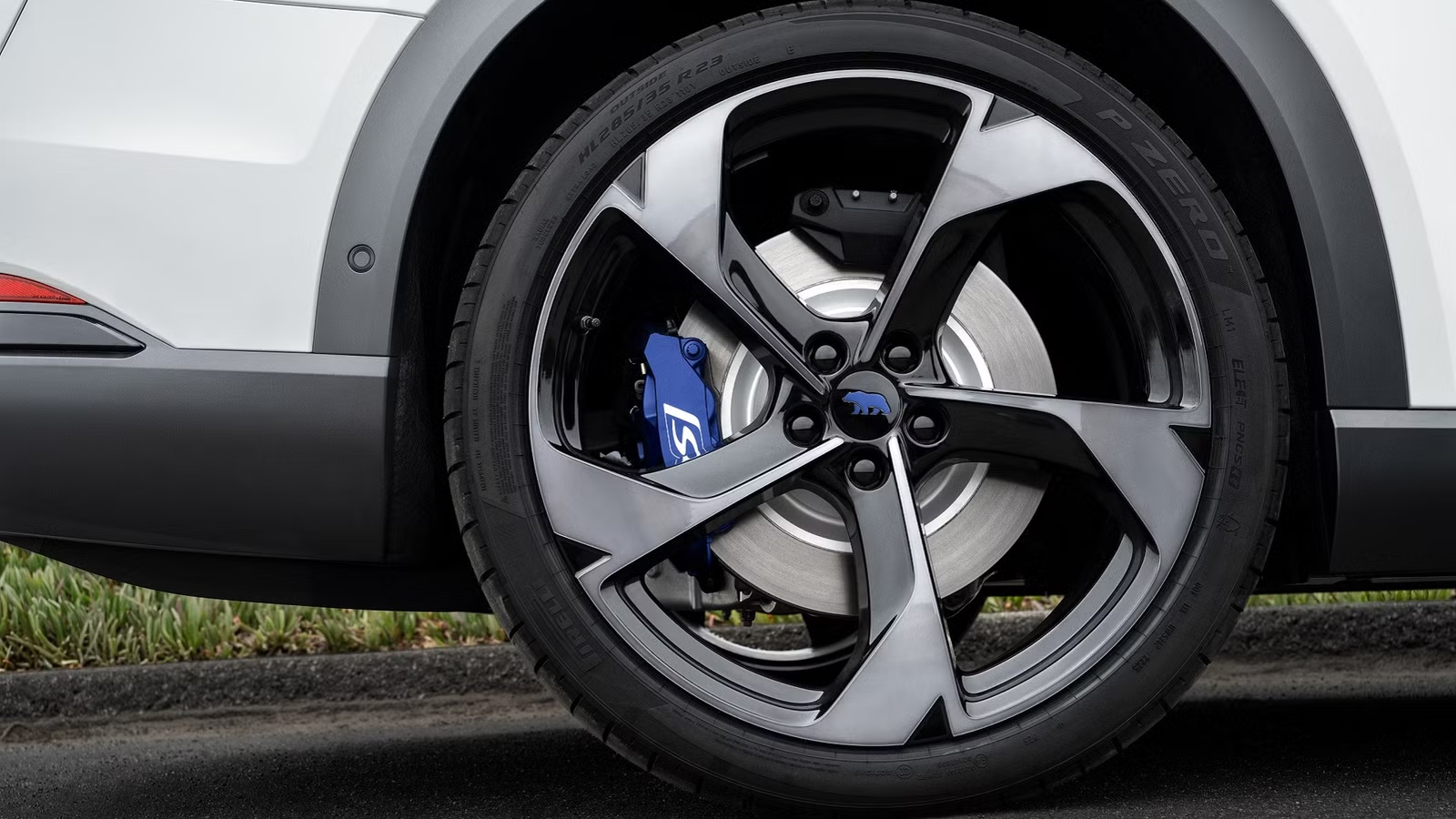
Lucid also gives the GT-S some visual clues from the Air Sapphire without turning the SUV into a rolling billboard. Blue-painted brake calipers and blue exterior accents identify the performance model. Inside, blue stitching and piping run through the first and second rows, with more blue on the seatbelts, steering wheel, armrests, and steering-wheel marker. Lucid Bear logos appear on the front headrests, another nod to the Sapphire family.
The Gravity GT-S Shows How Much The Performance World Has Changed

The original Veyron remains the cleaner way to see how far the benchmark has moved. Bugatti needed an 8.0-liter W16, four turbochargers, four-wheel drive, advanced aerodynamics, specialized tires, enormous cooling capacity, and extraordinary engineering effort to make its 1,001-PS target work. The car’s reason for existing centered on pushing road-car performance into a region that had seemed almost impossible. Its 400-km/h-plus capability demanded solutions that went far beyond producing engine power. The Veyron became legendary because Bugatti managed the heat, traction, braking, stability, and durability that came with the number.
Roughly two decades later, four-figure output can sit inside a quiet electric SUV with three rows. That does not make the Gravity GT-S a better Veyron, a faster Veyron, or an electric replacement for the Veyron, but that has never been the model’s intent. The Bugatti can reach speeds the Lucid does not attempt, and its W16 delivers the sound, mechanical complexity, and sense of occasion that an electric drivetrain cannot reproduce in the same way. The Gravity has another assignment entirely – it needs to make huge power compatible with carrying a family, luggage, and several hundred miles of travel between charges.

The real story is that the benchmark has moved. In the Veyron’s era, passing 1,000 PS helped define one of the most extreme production cars on Earth. In 2026, a buyer can order a 2027 three-row luxury SUV with 1,070 hp, a 3.1-second manufacturer-claimed sprint to 60 mph, a projected 373-mile range, rear-wheel steering, adaptive air suspension, and seats for seven. The achievement does not erase the Veyron’s place in history, but it shows how much the meaning of an outrageous horsepower number has changed. Hypercar power can now share a vehicle with road-trip range and a third row.
Source: Lucid, Bugatti

Related posts





Latest Post


No Comments