
The Mercury Sedan That Hid A Mustang Mach 1 V8 Under Debadged Bodywork
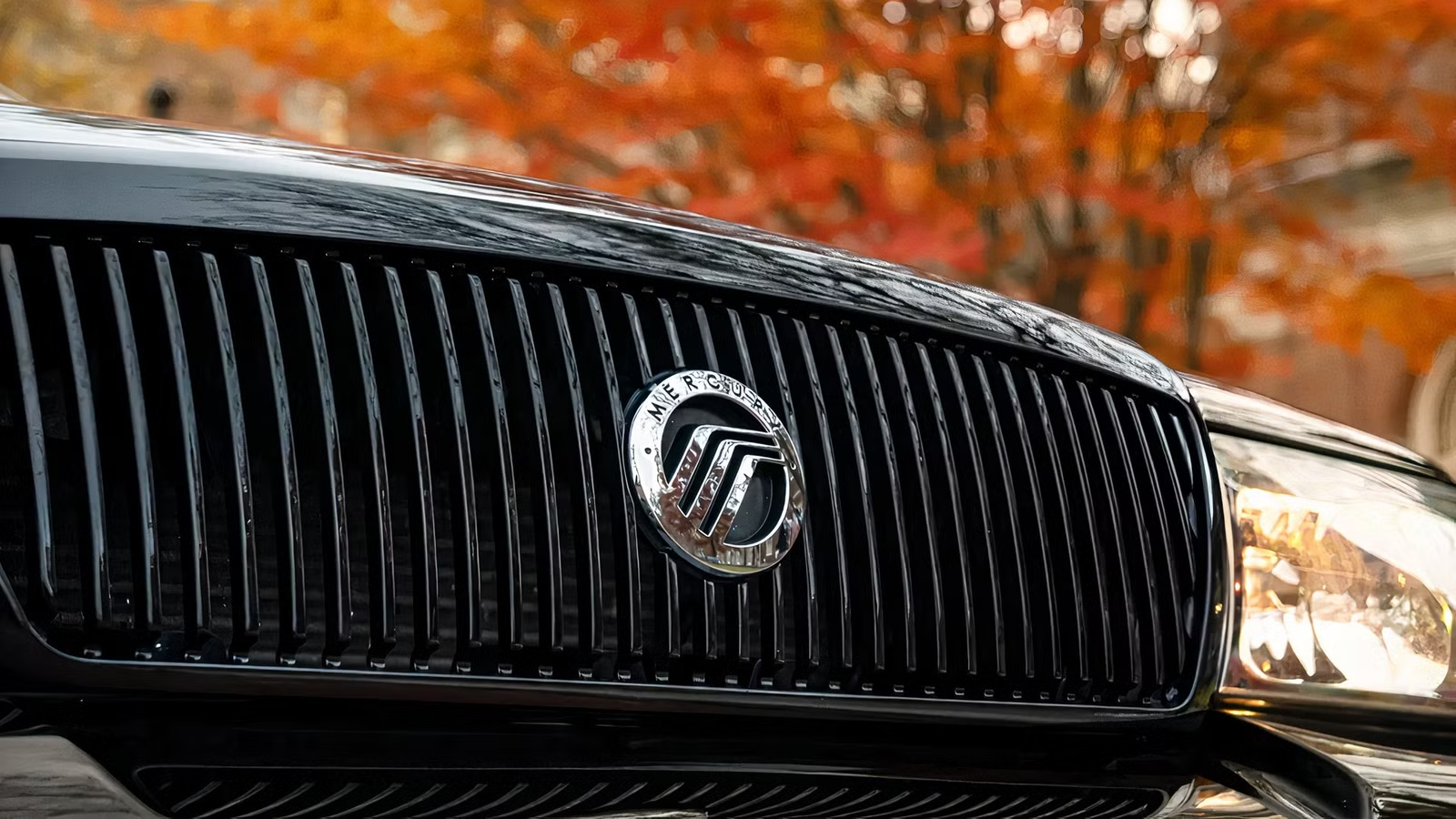
The 2000s were a pretty weird time for Mercury, primarily for one particular reason. On one side, its customer base wanted docile, comfortable cruisers that floated down interstates. On the other? You had the next generation of American muscle car fans and some of the last of the old-school hot rodders vying for something “more,” something better, and something faster. Making those two paradigms meet in the middle seems like a hopeless idea. But that doesn’t account for Mercury’s solution to said problem.
The Panther Platform: Sports Car Material? Apparently So

Anyone familiar with the Ford Panther platform will tell you it’s got about as much grace as a tuna sandwich, but at least it’ll get you from place to place with a floaty suspension and a V8 up front. First introduced in the late 1970s to carry the legacy of the LTD-based heavyweights from the 60s, the Panther platform offered luxury like its ancestors with more favorable dimensions. In truth, smaller proportions were as much a result of CAFE standards as a general, merciful end to the Malaise era.
Far from a quantum leap into the future, the Panther platform did the bare minimum of what it had to in order to adhere to these new regulations. This showed in the powertrains they used, old-fashioned hits like the five-liter small-block V8 and the Windsor-based 351 V8. Emissions-choked and low-strung, these were usurped by the 4.6-liter modular two-valve V8 in 1991. In every possible metric, the Modular V8 was the polar opposite of a sports car.
If it could’ve run on carburetors, no ECUs, and leaded gasoline, it would’ve done so happily. At least, that was the spirit of its application, as well as the sentiment among its buyers. The new Modular powerplant debuted under the hood of a 1991 Lincoln Town Car before winding up in its most famous application, the Crown Victoria and its Grand Marquis counterpart. With its live rear axle and body-on-frame construction, these Gen-II Panther Fords were as caveman as an old-timer could buy in the early ‘90s.

Turning a Grandpa Car Into a Gentleman’s Sports Sedan With Mustang DNA

There was nothing whatsoever to indicate a Panther could be sporty. At least, there wasn’t any evidence until the third-generation Panther platform made its debut in 2003. By then, the Crown Victoria in particular had gained a reputation for effectively being bulletproof. So much so, that retired P71 Crown Vic Police Interceptors often menaced the very streets they served, sold off to spotty teenagers. So maybe if the high-end power wasn’t there yet, the dependable, low-end V8 grunt certainly was.
Besides, it’s not like Ford’s rivals at GM weren’t turning land ships sporty with the Impala SS just a few years prior. According to Steve Babcock, Project Manager for the initiative to make the Grand Marquis sporty, the inspiration from cross-town rivals was absolutely present. “Initially, I planned it as a Ford, but I wanted to use the [redacted] name from Mercury’s history,” Babcock once said in an interview with Hagerty years later. “Chevy created that market with the Impala SS. We were aiming for the same customer.” Babcock and his team worked closely with the race-minded people at Roush Performance to breathe new life into the humdrum single-cam Modular motor, but they had their work cut out for them with something this archaic.
To start, they took the heavy cast-iron block and deleted it, opting for a lighter aluminum block with four valves per cylinder and high-flow heads. Then, they gave it a true dual-pipe exhaust system to make it breathe out as well as it breathes in. To help that floppy white bread chassis underneath, the performance variant used SVT-inspired Tokico monotube shocks with chunky sway bars front and rear, plus a Watt’s linkage to help that live rear axle stay compliant in corners. In effect, Mercury’s new sports sedan was an SN95-series Mustang Mach 1 with four doors. Certainly, the drivetrain components were all there, as were the fancy suspension components, all wrapped in a leather smoking jacket. Now all it needed was a name, and boy did they have a good one.
The Mercury Muscle Car Enthusiasts Quietly Chase
Mercury built fewer than 520 of its rarest muscle car. It was made to race, not to sell. Collectors are finally paying attention.
The Marauder: Bad Ass Name, Grunt to Back it Up

With 302 hp and 318 lb-ft of torque, the Mercury Marauder did its namesake proud. Derived from a lineage that stretches back to 1963, the Marauder was likely best known prior as the 7-liter V8-sporting personal luxury barge of the very late 1960s; these older cars also shared their platform with the equivalent Marquis of that time period. In those years, the Marauder/Marquis used the Ford Galaxie’s full-size platform. This means, of course, that the new Gen-III matched its ancestors about as well as you could in the early 2000s.
Mercury Marauder Engine Specs
|
Displacement |
Horsepower |
Torque |
|
4.6 Liters |
302 HP |
318 LB-Ft |
To differentiate itself from the Grand Marquis, the Marauder was given a partially blacked-out monochrome paint job with five-spoke alloy wheels, not the steelies with white wall tires other Panther cars often used. In terms of styling changes, it’s fair to say they were mostly subtle. Even in the interior, the biggest change was a console-mounted shifter, and that was about it. Black leather was the most popular interior color, or “Dark Charcoal” as FoMoCo called it, but a lighter slate-gray color called “Light Flint” was a rarer option.
75 percent of all Marauders were black on the outside, but a scant few also came in Silver Birch Metallic, Dark Pearl Blue, and Dark Toreador Red Metallic. Compared to the fairly forgettable rest of the Mercury lineup of the era, the Marauder was a rare highlight, proving the brand still had a reason to remain in business in the early 2000s. Sentiments soon soured on that idea, as we all know in hindsight. But just looking at the Gen-III Marauder in a vacuum, you couldn’t tell Merc was in such dire straits whatsoever. So then, was it successful? Well, that depends on the definition, if we’re honest.
The Lincoln V8 Coupe Real Sleeper Fans Quietly Worship Today
This forgotten luxury coupe packs serious V8 muscle borrowed from Ford’s performance division.
The Limelight Stolen by the Competition, Namely, Dodge and Chrysler

By itself, the nearly $35,000 Marauder was an expensive little firecracker. Excitement was high after its debut in concept form at the 2002 Chicago Auto Show. Debuting as a convertible in Chi-Town, hopes were high that Mercury might bring a drop-top variant to production if it sold well enough. But remember, 2003 was almost a quarter-century ago. Accounting for inflation, the Marauder’s true MSRP is closer to $63,500 in modern money.
For a luxury sports sedan riding on the same chassis as a taxi cab, paying what amounted to Jaguar or Audi money was a big ask indeed. It became an even bigger ask when, in 2004, Chrysler unveiled the LX-bodied 300C. Sporting a 5.7-liter HEMI V8 that made 340 hp and 390 lb-ft of torque, it made the Marauder look slow by comparison. Suddenly, in the automotive equivalent of a blink of an eye, the Mercury Marauder was completely and utterly irrelevant.
An Ultra-Rare, Surprisingly-Valuable Sports Sedan

With the 300C and its Dodge Charger cohort leaving it in the dust, and the Panther platform’s performance chops thoroughly maxed out, the last Marauder left Ford’s St. Thomas Assembly plant in Canada on June 25th, 2004. Never again would the brand field even a remotely sporty car. By the start of the following decade, Ford was on the brink of total collapse, and Mercury was sunset as a result.
Now, Gen-III Marauders are collector’s items. Exactly 11,052 were sold, and examples in good condition can sell from anywhere between $25,000, to as high as the upper $50,000s. For a car of its origin with a fancy engine, that’s quite impressive.
Source: Classic.com, Hagerty

Related posts

Latest Post


No Comments