
The Scooter Company That Stuffed A Ferrari V6 Into A Gorgeous GT And Got Crushed By Politics
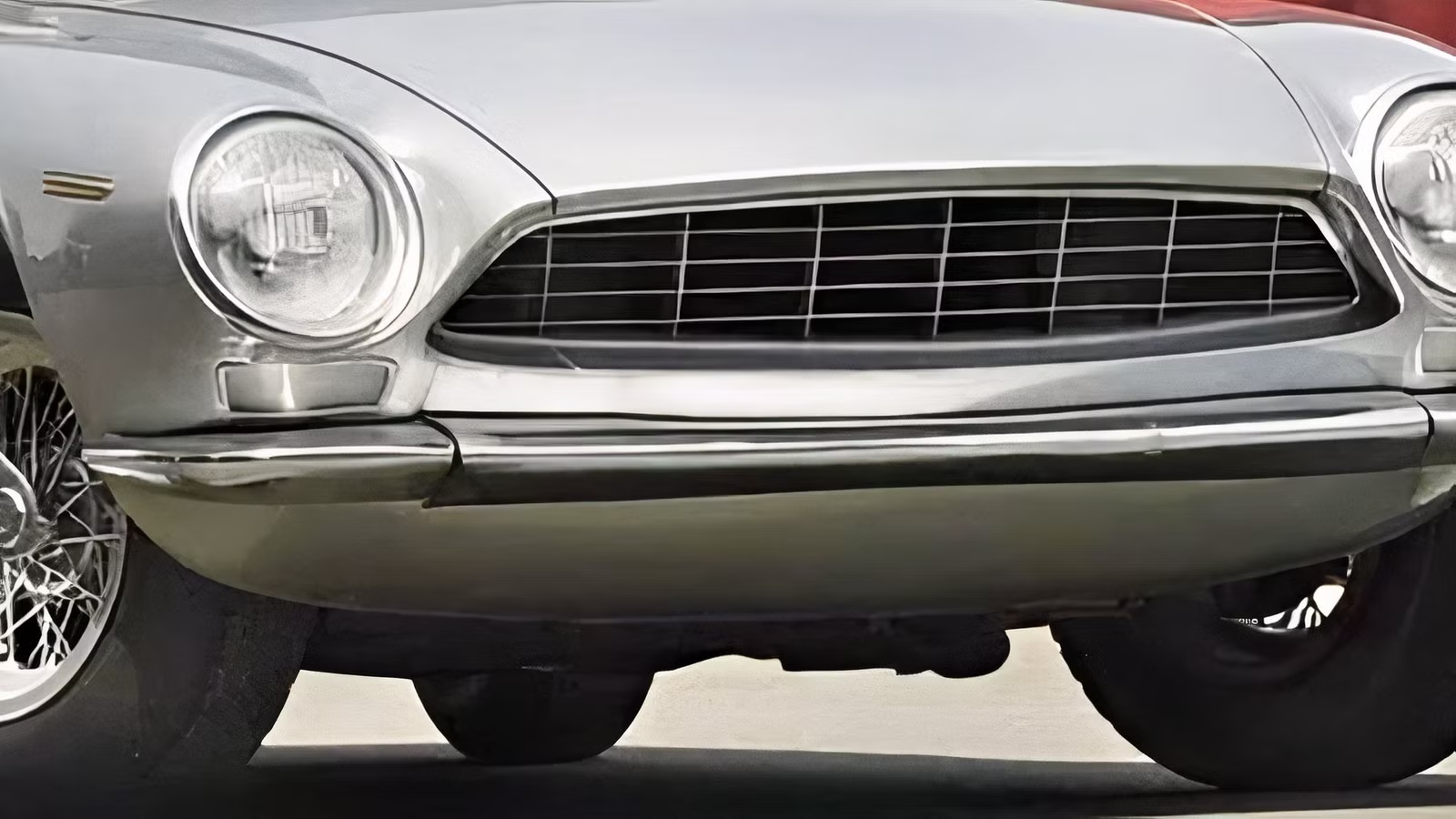
Enzo Ferrari was a man famous all over the world not just for building Italy’s best high-end sports cars, but also for a personality that was considered eccentric even by the standards of his home country. If Enzo Ferrari didn’t like you, he made it known in a suave, aggressive, and borderline outlandish manner that nearly bordered on parody. Don’t believe it? Just ask anyone at Ford who tried to buy Ferrari outright in the early ’60s. Suffice it to say, it didn’t go well for Ford. Still, that didn’t mean Old Man Enzo’s heart was black as coal. In fact, depending on the person, it was quite the opposite. Given the right set of circumstances, Enzo Ferrari was all too happy to collaborate. Back in 1963, this resulted in something amazing.
Collabing With Ferrari: Like Helping the Pope Deliver Mass, But With More Horsepower

So, what kind of person, or more to the point, what kind of company would Enzo Ferrari entrust to build a car carrying one of his powertrains? Perhaps some eccentric, low-volume race car manufacturer in the same vein as Ferrari’s own Scuderia team, or maybe a boutique, coach-built grand tourer maker with an MSRP like some country’s national debts. Well, no, not even close. The answer was the titanic Italian scooter manufacturer, Innocenti. Based in Milan but exporting scooters all over the world, the firm was most well known for its ubiquitous Lambretta motor scooter.
Outside of scooters, Innocenti made modest earnings building cars from other manufacturers, under license, in their own factories. Among them, some highlights included the Austin-Healey Sprite, dubbed the Innocenti 950 Spider. They also licensed-built cars from BMC, Morris Oxford, and even Mini over the years, proving Innocenti had the skills and the labor needed to mass produce cars at scale if they chose to. The only thing Innocenti lacked was some kind of true flagship vehicle, something they could advertise the world over as a signifier of automotive greatness. Knowing this, Innocenti must have known there was only one person in all of Italy who could help them make that ambition a reality.
When Innocenti presented Enzo Ferrari with a proposal to build a halo car, one would think he’d take a slow drag of his pipe, unleash a torrent of colorful Italian insults, and then go on a lunch break while they sulked in the chairs in front of his desk. But no, in fact, the exact opposite happened. Ferrari was downright enthusiastic to help Innocenti, and the reason why came down to his interest in building smaller, accessible sports cars without the prancing horse badge on the front. Ferrari would famously fail at this endeavor with his ill-fated Dino brand, but without the power of hindsight, Old Man Enzo had nothing but hope in his heart when Innocenti paid him a visit.

Ferrari Engine, Innocenti Body, Pure Italian Perfection

Ask a gearhead to conjure a non-Ferrari sports car with a Ferrari engine, and they’ll immediately think of the Lancia Stratos. But a full decade before the Stratos, Ferrari gave his blessing to not just supply Innocenti with an engine, but to design one from scratch for his new business partners at Innocenti. The result was something that basically amounted to roughly one half to three-quarters of a typical Colombo V12. At just 1.8 liters in size, the 60-degree V6 Ferrari came up with was peppy, happy to rev, and a genuine marvel of early ‘60s engineering. The bare block as well as the cylinder heads were made of aluminum, the crankshaft was made of forged steel, and a single chain-driven overhead camshaft per bank gave the engine a character like one far newer. Fed by dual twin-choke Weber carburetors, the Ferrari-Innocenti V6 produced a scarcely believable 156 horsepower at the crank. In an era where 1.8-liter engines seldom made more than 70 or 80 horsepower, that was nothing short of witchcraft.
With a redline somewhere around 7,000 rpm, the Innocenti-Ferrari engine was an absolute screamer by the standards of the period. Better still, it was mounted inside a body every bit as impressive as the internals beneath the skin. Adding to the ensemble cast of great Italian designers, Innocenti contracted Carrozzeria Bertone, and their hotshot designer Giorgetto Giugiaro to build a sleek body of steel and aluminum that’d be the envy of the sports car world. In the end, what they came up with was, predictably, utterly brilliant.
Innocenti 186 GT: Amazing, Capable, But At The Wrong Place And Time

The Innocenti 186 GT was nothing short of a transformative car for the Italian auto industry. At least, it should’ve been, given the kind of hardware it was working with. Its sleek 2+2 fastback bodywork was somewhat reminiscent of an Alfa Romeo or a Fiat GT, but with a bit more “razzle dazzle” owing to the Bertone-penned styling. Its 1.8-liter engine was paired to a four-on-the-floor manual gearbox with overdrive, and the interior was appointed with softer vinyl than other sports cars of its type, featuring artisan-crafted switchgear, gauges, dials, and a wood-trimmed steering wheel that molded to the hands like a natural extension of the human body.
Underneath, the suspension setup was contemporary and very effective, consisting of double wishbones with coil springs and an anti-roll bar up front, and a live rear axle with semi-elliptic leaf springs in the back. Paired to disc brakes at all four corners, the 186 GT was as capable in the corners as it was at singing proudly with its Ferrari engine. An entire production facility in Milan was constructed for the express purpose of tooling the 186 GT for mass production. Had production scaled to full capacity, it’s thought that Innocenti could produce the 186 GT on a scale similar to equivalent Alfas, such as the Giulia Sprint GT.
By all accounts, everything was in place for Innocenti to completely knock it out of the park with its first sports car. The design was gorgeous, the engine was fantastic, the buyer base was certainly there, and the production facility was state of the art. And yet, almost nobody today, save for a handful of dedicated enthusiasts, has ever so much as heard of the thing. The reason is simple—right as production was slated to get underway, the whole floor fell out from beneath the firm, all for reasons entirely out of its control.
The Beginning of the End, Before It Even Started

Historians like to tout the economic revival experienced by Italy after the Second World War as nothing short of a miracle. By most standards, that’s absolutely true, and Enzo Ferrari certainly played a role in making it happen. But make no mistake, things were not entirely smooth sailing, particularly in the early-to-mid 1960s. At that time, Italy’s fledgling post-war industrial sector found itself in hard times. The very industries tasked with supplying Innocenti with steel, aluminum, wood, and leather suffered severe financial strain on the back of labor disputes, rising material costs, and an overarching economic slowdown across most of Europe. The British Motor Corporation, Innocenti’s primary licensing partner, began exerting great pressure on the firm to trim the fat wherever possible. In the end, that was all it took for the 186 GT program to be scrapped.
A mere two prototypes were built before the project came to an abrupt end. By then, the company had reverted to focusing solely on low-risk operations like license-built foreign cars and motor scooters full-time. Of the two prototypes built, one was scrapped, and the sole survivor languished at an Innocenti storage facility until the late 1990s, when it was transferred to the Museo Ferrari in Maranello, where today, it shares real estate with the best and brightest the prancing horse ever developed.
Source: Museo Ferrari Maranello

Related posts

Latest Post



No Comments