
The 1970 Hemi Super Bee Killed By Dodge’s Own Order Sheet
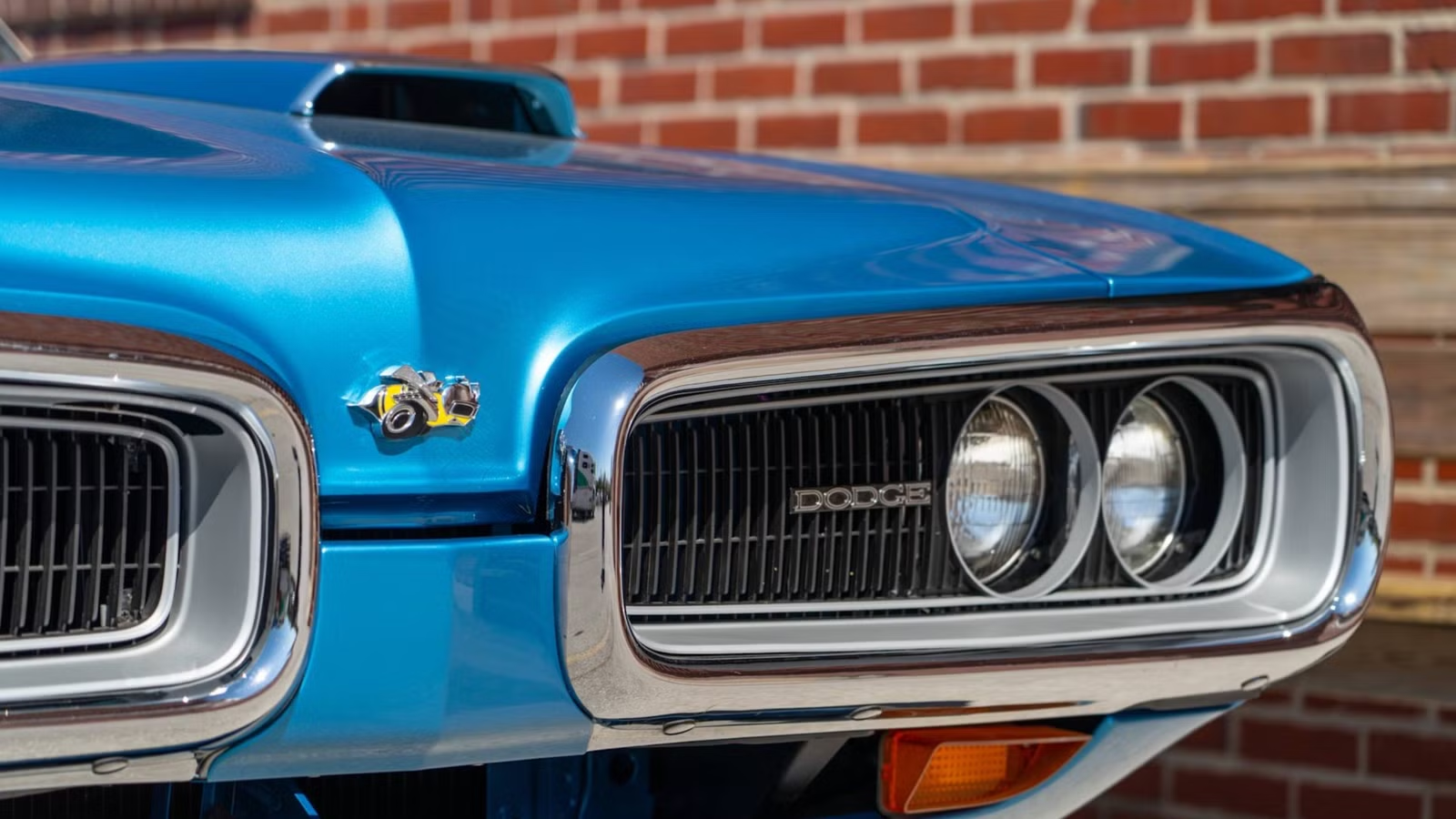
The 1970 Dodge Hemi Super Bee was one of the most formidable street machines of the day, and it was arguably one of the coolest-looking Golden Age muscle cars. It was also one of the rarest 426 Mopars, but not because it was a limited special edition or even that people didn’t like it, but rather due to the fact that Dodge kind of made it out of reach for most folks. Raid and Black Flag are efficient bug killers, but nobody did the Bee in better than Dodge, which took the once-affordable no-frills budget bruiser and turned it into an elite luxury ride that was outside of most muscle car enthusiasts’ price range. There are other factors that explain the scarcity of the ’70 Hemi Super Bee, but it was mostly the Dodge order sheet that kept the numbers low.
Last Of The Coronet-Base Dodge Super Bees

The bare-bones burner Plymouth Road Runner was introduced in 1968 and was such a smash hit that Dodge demanded their own version, which hit dealerships mid-model year. Based on the Dodge Coronet, the Super Bee was an anti-luxury, pro-performance ride that came standard with massive power and not much else. By 1970, the styleless B-Body got some sexy Coke bottle curves, a wicked “bumblebee wings” split front grille, and an optional twin-scoop hood, making for one of the baddest-looking sets of wheels of the entire classic age. Unfortunately, this marvel of engineering and design would only last one year, as both the Coronet R/T and Super Bee were discontinued. The Super Bee did survive for one year as trim for the third-gen Charger, but after that the Malaise era of detuned engines set in and kicking ass was no longer cool, clipping the Bee’s wings.
Rare 1970 Hemi Mopar Unicorn

Because the 426 Street Hemi is so revered and was the defining big-block of the Golden Age, many people think it is more prevalent than it really was. With just 9,761 Hemis produced for passenger vehicles from 1964-1971, across 13 different Dodge and Plymouth models, it is actually quite rare. The Road Runner is the most frequent car to get a Hemi with 2014 units, while the GTX got 1,477 and the Charger with 1,473. The biggest single year was the 1968 Road Runner which was Hemified 1,019 times and the only model year to break into the four-digits. On the flip side of that, only 36 Super Bees were equipped with a 426 Street Hemi, which is second to the ’70 Coronet R/T that eked out just 14. Since the Super Bee and Coronet R/T have the same sheet metal, combining their Hemi totals makes 50, which still qualifies as one of the rarest Mopars, trailing the 22 for the ’71 Charger Super Bee and 30 of the ’71 GTX.
Street Stinger Super Bee Assassin

The 426 Hemi V8 engine rocked 425 horsepower and 490 lb-ft of torque, making it the most dominant big-block on the streets for the entire Golden Age of American Muscle. In 1970, GM lifted its insipid big-engine ban and the Chevy Chevelle got a 455 LS6 V8 that produced 450 hp and 500 lb-ft of torque, but for whatever reason it still wasn’t a Hemi-killer. A possible explanation for this, and we’ll get into it in more depth later, is because the Chevelle engine was probably accurately rated, while the Hemi was almost certainly underrated. In any case, a 1970 Hemi Super Bee could rocket from 0-60 in 5.5 seconds, scorch a quarter-mile in 13.5 seconds, and hit a top speed of 125 MPH, which was hard, if not impossible, to beat that year. With a little bit of tweaking, this was a 12-second car that literally terrified Chevy and Ford owners.

Why The ’70 Hemi Super Bee Is So Rare

Dodge never put a cap on 1970 Hemi Super Bee production, and if 100,000 buyers wanted one that year, they would have gladly obliged. That, however, didn’t happen and, as we mentioned, only 36 left the factory, so why did so few people buy one of the greatest classic era muscle cars ever? Well, the answer is kind of nuanced, but basically it comes down to the dealers. They are the ones that generally order cars, with buyers sometimes doing a special order thing, and the dealerships didn’t have a lot of confidence that they were going to move ’70 Hemi Super Bees. Most car shoppers pick up something on the lot, and in 1970 there weren’t a lot of Hemi Super Bees. Had the dealers been more aggressive in ordering the Hemi cars, it’s certain more would have sold, but that’s just the way things played out.
Hemi Upgrade Was Steep

Another factor in the rarity of the 1970 Hemi Super Bee, and the reason why dealers had no faith in it, was the price. A base Super Bee with a 335 hp 383 Magnum V8 was $3,074, which is $26,455 adjusted for inflation and not a bad price for an underrated Mopar big-block. Upgrading to the Hemi put another $848 on the price, which is $7,298 in today’s bucks. Given the rarity and value of Hemi-equipped Mopars, we don’t look at that added expense as being excessive, but people were a little more frugal back then, and it really was a ton of cash. Also, for just $375, buyers could upgrade to the 390 hp 440 Six-Pack that delivered Hemi-like performance for a fraction of the cost. In fact, there were 1,268 Super Bee Six-Packs sold in 1970, which is substantially more than the Hemi output that year.
Insurance Premiums Came at a Premium

Long before Jake from State Farm could help you save money by bundling home and auto, getting a muscle car insured was no easy task, especially if it was a super-powered 426 Hemi. That’s why most automakers severely underrated their big blocks, with the most egregious example being the 1970 Buick GS 455 at 360 hp that had a 13.34-second ET. The 426 Hemi was most certainly underrated at 425 hp, with most speculating it exceeded 500 hp, but its official rating was still extreme. Back in the day, the insurance premium for a Hemi car was more than double that of, say, a base model 383, and that was if you could find coverage at all. For young drivers, who were primarily the muscle car nuts, the rates were even higher, and there weren’t a lot of companies that would even write a policy for a 19-year-old driving a ’70 Hemi Super Bee. Insurance concerns were another major factor in the low production of this otherwise amazing Mopar.
’70 Hemi Super Bee Is A Forgotten Mopar Classic

There are certainly many super-rare Golden Age muscle cars, but generally they are sought-after collectibles, with a huge presence. It seems like every single Mustang Boss 429 has crossed the auction block at least once and the same is true for the ’70 Chevelle SS 454 LS6s. Even the Holy Grail 1971 Plymouth Hemi ‘Cuda convertible, of which possibly only 11 were built, has had three different cars listed for auction. Only two different ’70 Hemi Super Bees have ever been put up for auction, out of 36 cars produced. That Bright Blue Metallic Bee pictured above and the Burnt Orange car from the previous section are the only two we could find ever having been listed at auction. They are also less-than-cool versions with white vinyl hard tops and weenie wheels, which are two things we don’t dig about classic Mopars, so we’re still looking for a coupe with some Cragar SS mags.
Prices and Values for the Hemi Super Bee

Given the elusiveness and magnetism of the ’70 Hemi Super Bee, it should be a half-million-dollar collectible, but it is sadly nowhere near that. Hagerty sets the fair condition value for a running Bee that needs some sprucing up at just $43,400 and the tip-top show car Concours condition at $196,333. That’s certainly a ton of cash, but for something that was made in such limited numbers and which only two are confirmed to still exist, it’s an insult. J.D. Power, which bases their prices on real world sales, of which there are only two, says the high-retail for a ’70 Hemi Super Bee is $162,800 and the average is only $93,400. To put that into perspective, a 1969 Dodge Daytona Hemi, of which 70 were built and most still exist, has a Concours condition value of $954,000 and a top sale of $3.3 million.
Auction Action on the Bee

As we told you, only two different 1970 Hemi Super Bees have ever sold at auction, and they didn’t exactly break the bank or even radically exceed their posted values. The Burnt Orange one we told you about earlier was in perfect shape, having undergone an extensive restoration, plus it was a numbers-matching car with an original broadcast sheet, but it only sold for $159,500 at Mecum Kissimmee 2019. The Bright Blue Metallic Hemi Super Bee was bid up to $199,000 on Bring a Trailer in 2023 but didn’t hit the reserve and failed to sell. It then showed up at Mecum Indy 2023 where it sold for considerably less, bringing the gavel down at $187,000. Neither of these sales reached the Hagerty top-condition value, and both of them are tragic low-balls that undermine the rarity and greatness of the ’70 Hemi Super Bee.
’70 Super Bee’s Honey-Sweet Legacy

The Hemi Super Bee was far too impressive to fade away with a lackluster 1970 run and a limited trim package on the ’71 Charger. When the Modern Muscle Car Era was amping up, Dodge paid tribute to it with the 2004 Ram 1500 Rumble Bee pickup featuring a 5.7-liter Hemi and fierce mechanized bumblebee decals. Then, in 2007 on the rebooted Charger there was the 425-horsepower 6.1-liter Hemi SRT8 Super Bee, the 2012 470-horsepower 392 Hemi Super Bee, and the 485-hp 2023 Last Call Super Bee. Getting even cooler, in 2027 there will be a Ram 1500 Rumble Bee SRT with a 777 hp 6.2-liter supercharged Hemi Hellcat V8. The Super Bee is also coming back on the current-gen Charger, though it will feature a twin-turbo I-6 and not a Hemi, but it’s putting out 550 hp, so that doesn’t entirely suck. The Super Bee is such an icon of Mopar Muscle that it simply can’t be ignored and will continue to wow enthusiasts as long as people still want to light up their tires and flout traffic laws.
Sources: Bring a Trailer, Hagerty, J.D. Power, Mecum, Dodge

Related posts
Latest Post


No Comments