
The Rogue Homologation Special That Beat Europe’s Sports Cars At Their Own Game
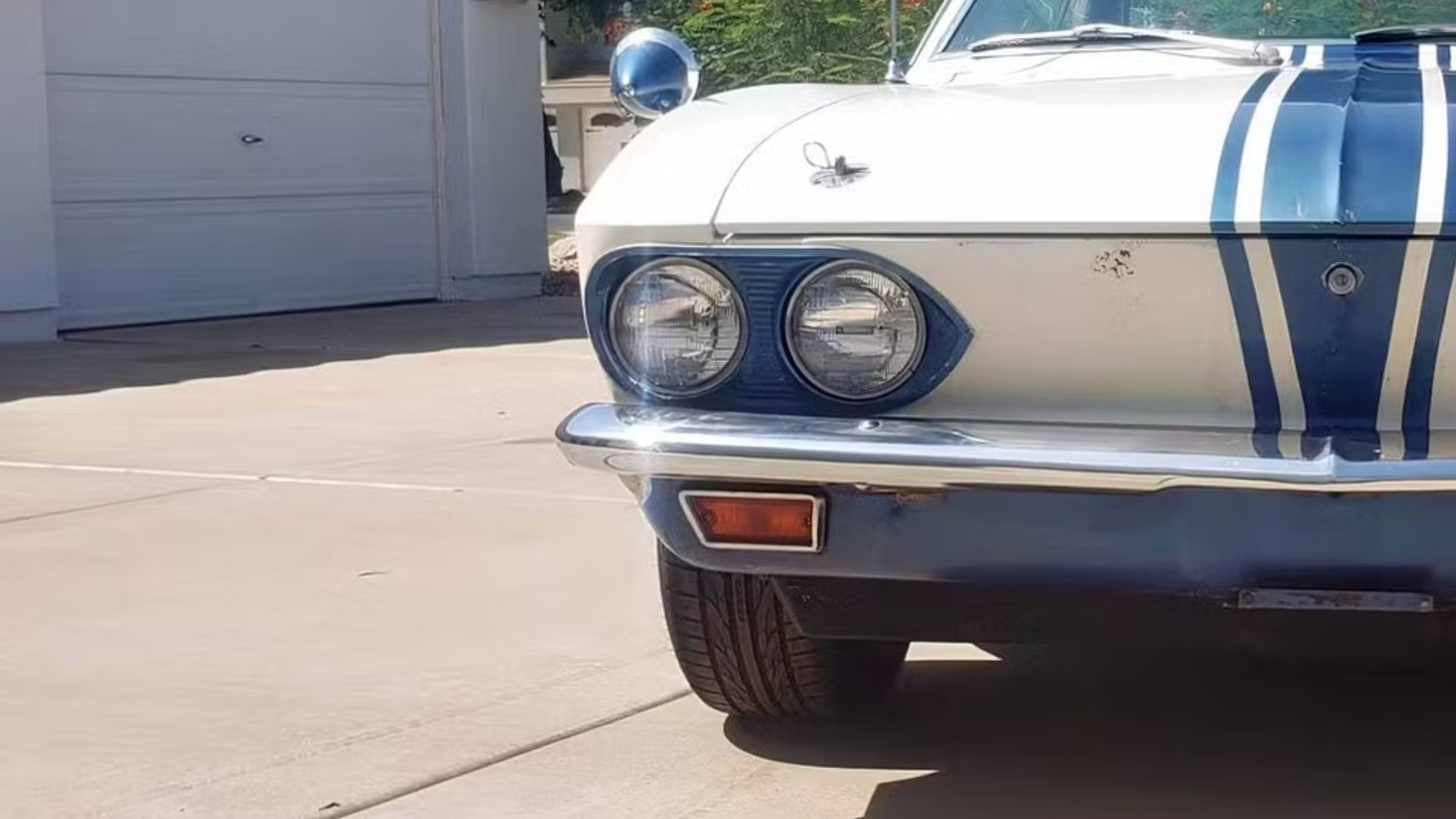
How many times in automotive history has the dealership side of the operation done more for the performance car side of things than the OEMs themselves? At least in the United States, it’s happened on more than one occasion. Even then, most dealer-side field modifications of normal cars into bona fide racers tended to stick to a formula. You know, rear-drive, front-engine, typical muscle car fare. Well, someone should have told that to a Pennsylvania man named Don Yenko. Why? Because at least once, he ignored that formula entirely.
Don Yenko: Not Just a Man, But a Performance Car Force of Nature

What can you say about Donald Frank Yenko that hasn’t already been said a thousand times before? As an ambassador for racing homologation, Yenko arguably did the job better than anyone else in America. Born in Western Pennsylvania in 1927, Yenko served in the Air Force before literally switching gears into the discipline of motor racing after college. Through the 1950s, ‘60s, and ‘70s, Yenko gained a fearsome reputation as an endurance racer.
A multi-time entrant in the 24 Hours of Le Mans, racing with Corvettes, Yenko amassed four Sports Car Club of America national driving titles during his racing career. All the while, Yenko established one of Pennsylvania’s only Chevy-based performance shops, right next to his family’s dealership just outside Pittsburgh. It was here, at this unassuming Chevy dealership, that some of the most famous dealer-modified muscle cars of the era were sold.
Most famously, Yenko took the Chevy Camaro of the period, ripped its engine out, installed the 427-cubic-inch big block out of a flagship Corvette, and sold it as a workaround for GM’s factory drag car ban. Other models like the Nova and Chevelle also got the Yenko treatment at some point in the mid-to-late 1960s, proving the shop wasn’t just a one-trick pony. To that end, Yenko even gave oddball Chevrolets you would have never expected to be sporty their chance to shine. In fact, it came well before the Camaros and Novas that made Yenko a household name later on.
The Corvair: Ready for the Yenko Treatment? Evidently, Yes!

Oh, the Corvair—that little nugget of rear-engined curiosity that may or may not be “Unsafe at Any Speed,” depending on if you believe what Ralph Nader wrote in his book on the matter. Rear-engine layout and oversteer-prone suspension aside, the Corvair managed to catch the attention of Don Yenko for every reason but safety. Instead, Yenko fancied the Corvair as America’s answer to the Porsche 911 and other lightweight European sports cars with similar layouts.
With this in mind, Yenko had his work cut out of him in 1966. Turning a Corvair into a bona fide homologation special, compliant with SCCA rules, was far less straightforward than doing so with a car of a more traditional layout. To start, Yenko acquired no fewer than 100 Corvairs for himself, leveraging his family dealership business and the Central Office Production Order (COPO) to make the sale. Then, he stripped out the rear bench seat for every single one. In doing so, Yenko kept in compliance with SCCA rules banning rear seats.
With that done, Yenko had to optimize the Corvair to compete in the same SCCA D-Production class that Porsche, Alfa Romeo, and TVR, among others, competed in. This involved replacing the metal engine hatch with a fiberglass decklid, adding functional air scoops, and fitting a seven-quart oil pan, plus a heavy-duty belt tensioner, stiffer springs, quick-ratio steering, and a Cadillac brake master cylinder to compensate for some of the stock Corvair’s shortcomings. By the time the project finished, the results were nothing short of stunning.
Yenko Stinger: World-Class Performance and Power in Four Unique Stages

|
Engine |
Displacement |
Weight |
Base Price |
|
2.7-Liter Flat-Six |
240 HP |
2,100 lbs |
$5,000Base Price |
Like many great COPO creations of the ‘60s, there was more than one layer of options and performance packages available for Don Yenko’s first flagship homologation car. A base 1966 Corvair Monza with a 2.7-liter air-cooled flat-six engine made as little as 95 horsepower without options. Of course, OEM setups with quad single-throat carburetors, and even early turbocharging, were available as well, but weren’t suitable for the kind of intense racing Don Yenko intended on competing in.
His Stage I Yenko Stinger homologation special bumped power to 160 hp. Using high-flow intakes, carburetor tweaking, and basic tuning, the initial-stage Yenko Stinger was already a potent street beast. Stage II added to that by bumping compression up to 10.0:1, fitting more durable valve springs, and adding heavy-duty notched pistons. This made the 190-hp Stage II Stinger far more suitable for weekend track days, not just casual sporty driving. Still, there were still two more stages to go.
Stage III spiked engine compression to 10.5:1, no small feat in the pre-ECU, purely mechanical muscle car era, and added forged pistons and a racing distributor for semi-professional racing events across North America. With 220 hp on tap, that was a remarkable amount of power relative to what the chassis was. For context, a 1966 Porsche 911S only managed 160 hp. At the very top, reserved for SCCA sanctioned competition alone, the Stage IV Stinger added full race internals, the maximum compression ratio permissible, and race-tuned everything down to the bare block.
Less a Corvair, More a Force of Nature

So, how did the Stinger fare in SCCA D-Production racing? If your first answer was domination, congratulations, your foresight is impeccable. The potent rear-engine, high-horsepower racer was every bit the match for Triumph TR4s, Porsche 911s, Lotus Elans, and TVR Granturas sent to compete from Europe. On the home front, the Corvair held its own against domestic fare like small block Corvettes and Shelby GT350s.
By splitting the difference between small, nimble European creations and big, burly American muscle, the Corvair successfully competed against both camps with spectacular results. With D-Production veteran Jerry Thompson at the wheel, a Yenko Stinger managed to win the SCCA Central Region Championship in 1966. With lightning-quick performances at demanding circuits like Mid-Ohio and Watkins Glen, the Stinger was a legitimate force to be reckoned with on the track. The following year, in 1967, a Stinger outright won the SCCA D-Production National Championship, once again with Thompson at the wheel. After ‘67, the Corvair-based Stinger was forced to the sidelines, bowing out while icons like the Yenko Camaro 427 brought a more traditional approach to SCCA competition.
A Race Car Unlike Any Before or Since

From there, the Yenko Stinger embarked on a prolific barnstorming career in the hands of dozens of local drivers across America. Still technically SCCA-compliant as long as Yenko kept sending “YS” serial plates to its owners, Stinger Corvairs continued to race until the SCCA scrapped certain homologation rules in 1986.
With its racing career now finished, the estimated 70 to 75 surviving Stingers verified as SCCA veterans began lives as classic racing royalty. Today, auction prices for surviving examples reflect the sheer heritage and racing pedigree attached to the name. When one pops up in good condition, expect to pay no less than $50,000 for the privilege. If a Stage IV racer ever pops up, don’t be surprised if it sells for far more than you might think.
Source: Mecum

Related posts



Latest Post


No Comments