
7 Forgotten JDM Coupes That Practically Last Forever
Every JDM gearhead has heard the reliability claims a thousand times. Supra, Skyline, RX-7 — those names get repeated until they stop meaning anything. But with six-figure auction prices turning those legendary icons into unobtainable museum pieces, actually owning one has become a pipe dream for most enthusiasts.

Every car on this list shares an engine with something Americans already drove and trusted for years. Same block, same maintenance history, in a different body, nobody recognizes. These are seven JDM coupes, oldest to newest, where the engine’s reputation does the talking instead of the badge.
1991–1995 Toyota Corolla Levin GT-APEX (AE101)
This was the last twin-cam Levin before Toyota retired the bloodline for good, and it’s still running on an engine three other platforms have already vouched for. The A-series architecture is about as simple as Toyota engineering gets — basic suspension, light electronics, nothing fancy to break. With regular oil changes and basic upkeep, these cars routinely cross 200,000 miles without drama.


The engine doing the work is the 4A-GE 20v “Silvertop,” a 1.6-liter four making 160 hp at 7,400 rpm through a five-valve-per-cylinder head. It’s the same engine swap enthusiasts chase for their AE86 builds, and they’re not doing it for the looks. The 4A-GE family also powered the U.S.-market AE86 Corolla and the MR2, so this isn’t a one-car reputation.
The one sensor worth checking before you buy is the vane-type airflow meter — it’s the one fragile part on an otherwise bulletproof engine. Keep the timing belt on schedule, and there’s no reason this car shouldn’t outlive its owner.
10 Legendary ’90s Japanese Cars That Still Crush Modern Sports Cars
Now bona fide classics, these Japanese cars remain faster than most modern sports cars.
1991–2000 Toyota Soarer 2.5GT (Z30)

The Soarer shares its body shell, suspension, and platform with the export-market Lexus SC300 and SC400, but JDM buyers got the better end of the deal. Japan-only buyers got the 1JZ-GTE twin-turbo and 2.5GT-T trims, along with tech that never made it across the Pacific. It’s the same luxury GT formula America got, just with the engine everyone actually wants.

Owners on Carsurvey.org describe running the Soarer fault-free on nothing more than scheduled oil changes, and they point to the factory-grade stainless exhaust and zinc-plated body panels as part of why it holds up. The 1JZ-GTE and 1JZ-GE engines aren’t just a Soarer thing either — the same family runs in the Chaser, Mark II, Crown, and Cresta. That’s four other cars backing up the same reputation.
Current marketplace data puts prices averaging around $14,000. If you’re shopping, the factory manual transmission is rare and worth prioritizing. Just make sure the EMV touchscreen and climate control modules still work before you sign anything.
1991–1999 Toyota MR2 SW20 GT (3S-GE, Naturally Aspirated)

Let’s address the elephant in the engine bay first. The 3S-GE has a reputation in some corners for oil seepage and cooling gremlins, but that reputation needs context before you write the car off. Specialists describe the engine itself as well-built and refined, delivering strong performance and economy with very few issues as long as it’s been serviced on schedule.
The seepage people complain about almost always traces back to the cam cover, distributor o-rings, or head gasket — aging rubber and gaskets, not a flaw in the block. Every 30-year-old engine needs its seals replaced eventually, and this one is no exception. The cooling-system complaints you’ll find online are mostly about the turbocharged 3S-GTE; the naturally aspirated GT runs simpler, runs cooler, and doesn’t carry the same baggage.

It also helps that the design is non-interference, so even a snapped timing belt — due every 60,000 miles — won’t take the engine down with it. KBB owners rate it 4.9 out of 5.0 for reliability, with 93% saying they’d recommend it. While US buyers only got a tamer, lower-revving economy engine in their naturally aspirated MR2s and Celicas, this JDM-spec 3S-GE features a Yamaha-designed cylinder head that combines high-revving performance with Toyota’s legendary block durability.
Average sale price sits at $17,551, with a range from $5,625 to $27,750. If you’re buying one, look for a Rev3 model or later — built from November 1993 onward — for corrected suspension geometry and the most mature version of this engine’s seals and cooling setup.
1991–1993 Nissan Silvia Q’s (S13, SR20DE)

Everyone knows the S13, but the problem is, most people know the wrong one. The S13 chassis actually produced three different cars: the Japan-only Silvia notchback, the JDM and European 180SX hatchback, and the USDM 240SX, and the engine swap matters more than people realize.
The SR20DE and SR20DET never made it into the American 240SX, which got the weaker KA24 instead. Carsurvey.org owners are consistent on this point, calling the SR20DE the durable choice and steering buyers away from the earlier CA18 entirely. That same SR20DE also powered the Sentra SE-R and the NX2000, both sold new in US showrooms, so its reliability case doesn’t rest on Silvia owners alone.

What nobody talks about is that the drift culture put all its attention on the turbo SR20DET found in the high-tier K’s trim and the 180SX hatchback. The naturally aspirated Silvia Q’s coupe, built for daily cruising instead of sliding sideways, got skipped over completely. If you’re shopping for one, the Q’s is the sweet spot — this car’s whole case for longevity rests on that simpler, naturally aspirated engine, not its high-stress turbocharged sibling.
10 JDM Legends That Can Handle Over 1,000 HP Without Breaking A Sweat
Just a couple of upgrades can turn these JDM classics into diabolical machines.
1994–2000 Mitsubishi FTO GPX

The FTO won Japan’s Car of the Year for 1994–95, and it earned that title without leaning on a turbocharger to get there. The 6A12 V6 is naturally aspirated, which sounds like a downgrade until you realize that’s exactly why these cars hold up. Carsurvey.org owners document plenty of FTOs surpassing 150,000 miles with minimal issues, and skipping the turbo plumbing is a big reason why.

In GPX and GP Version R trim, Mitsubishi’s MIVEC variable valve timing pushes the 2.0-liter V6 to 200 PS at 7,500 rpm, with a redline that climbs past 8,000 rpm. That’s serious output for a naturally aspirated engine from the mid-90s, and it never needed a turbo to get there. Mitsubishi never federalized the FTO for the US, missing period side-impact and bumper regulations and never bothering to engineer a US-spec version — so every one of these in America today came over as an import.
Today’s market runs $7,000 to $28,000, with a median around $14,500. The one thing to avoid is the INVECS-II automatic, which is the documented weak link in an otherwise dependable car. Find a five-speed manual GPX, and you’re looking at one of the most underrated V6 coupes Japan ever built.
1991–1997 Mazda MX-6 J-Spec (KL-ZE)

The J-spec MX-6 is generally forgotten, and once you know what’s under the hood, that feels like a mistake. The Japanese market got the KL-ZE V6, built with a redesigned intake manifold, larger intake runners, and a 10:1 compression ratio. That’s a meaningfully stronger engine than the KL-DE that American buyers got in their version of the same car.

The KL-ZE’s reputation is strong enough that it’s become a popular swap into U.S.-market MX-3s and Probes, which tells you everything about how it’s regarded. KBB data spanning 105 owner reviews backs that up, with multiple owners reporting well past 200,000 miles, including one driver still going strong at 236,000. Owners consistently describe the MX-6 as undervalued and underrated, and when problems do show up, they trace back to the rear disc brakes or the distributor — not the engine itself.
Average sale price lands around $7,300, with a range from about $2,100 for a rougher example up to $10,000 or more for something clean. Stick to the manual transmission here. The automatic is the one part of this car with a real reputation for trouble, and it’s not the part you want anyway.
These 2001 JDM Legends Are About To Become Legal In America
New year, new import loophole: a fresh wave of 2001 JDM icons just hit the 25-year mark. Here’s what to chase and what to avoid.
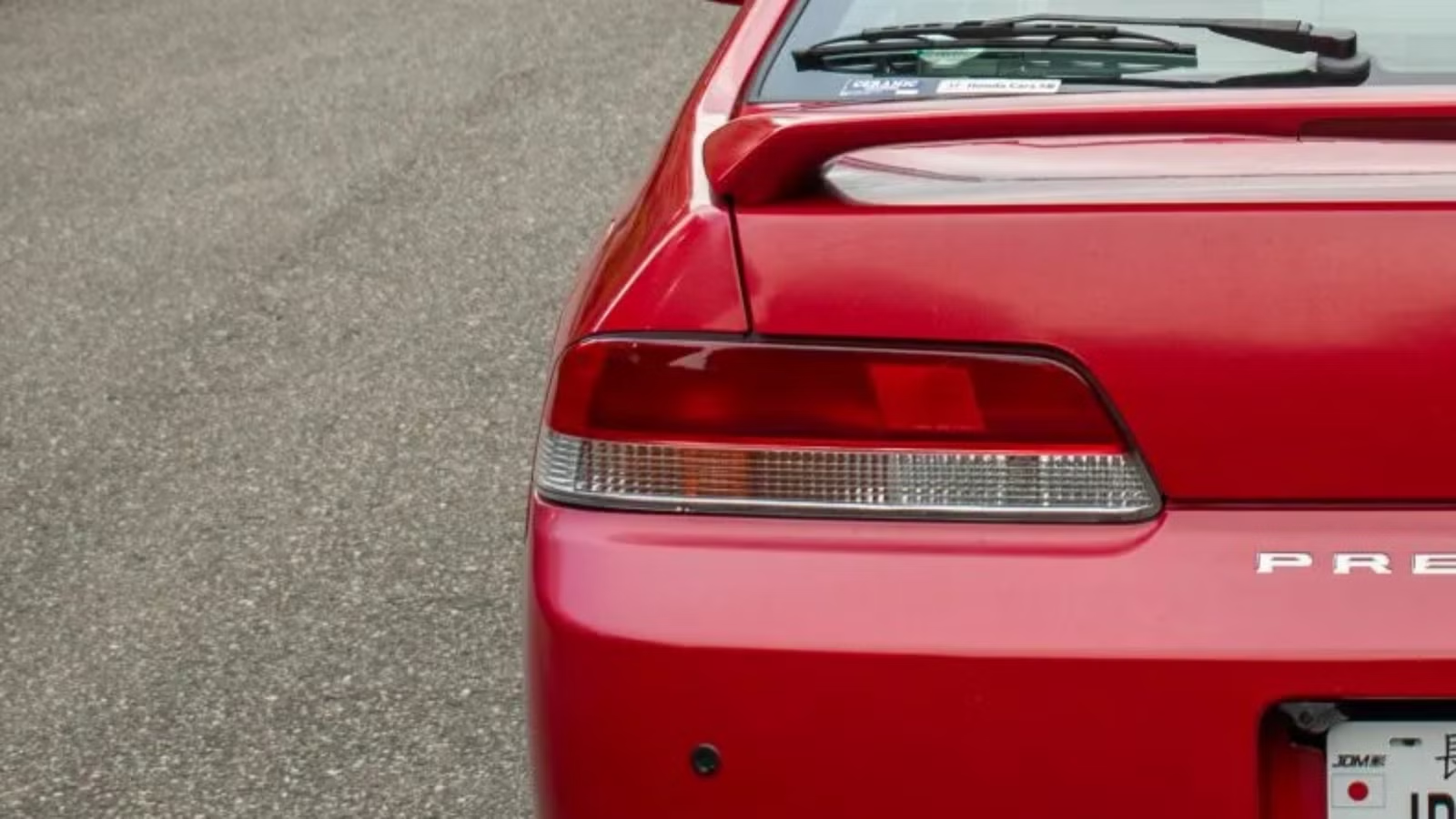
1997–2001 Honda Prelude Type S (BB6, JDM)

Honda owners have a saying about the Prelude, and it’s about as blunt as car advice gets: just do regular maintenance, and they will last well past 200,000 miles. That’s not a marketing line. It’s the consistent message across owner forums and review sites, and it holds up because of what’s under the hood.

The H22A VTEC engine in the Type S is paired with Honda’s Active Torque Transfer System (ATTS), a brilliant piece of handling tech that was only ever offered on Japan’s Type S and the US-market Prelude Type SH. ATTS redistributes torque to the outboard front wheel mid-corner, giving this front-wheel-drive coupe handling that punches well above its layout. When Preludes do run into trouble, it almost always traces back to skipped timing belts or neglected valve cover gaskets — maintenance issues, not flaws in the H22A itself.
KBB gives this generation a 4.8 out of 5.0 consumer reliability score, and the H22A’s reputation doesn’t rest on the Prelude alone. The same engine also runs in the JDM Accord SiR, backing up the case with a second platform’s worth of owners. If you’re shopping for one, look for the 5-speed manual specifically — the automatic is the documented weak point on an otherwise rock-solid car.
Sources: Bring A Trailer, KBB, Collecting Cars

Related posts


Latest Post


No Comments