
10 Adventure Bikes That Can Handle Almost Anything You Throw At Them
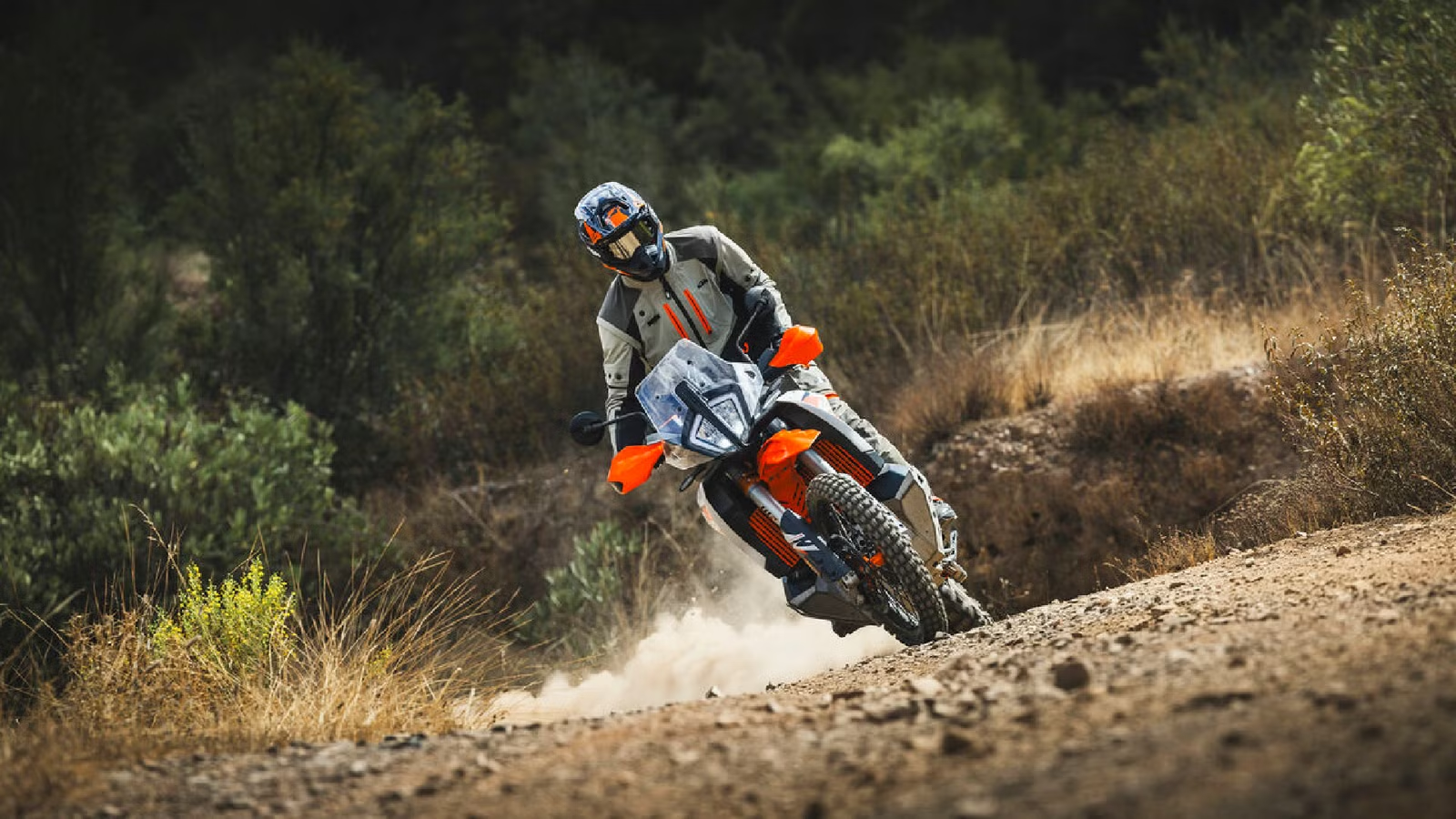
At times, people modify their bikes for adventure activities. They take stock naked bikes and fit them with tall windscreens, chunky tires, saddle stays, bags, and top boxes, and expect them to perform similarly. While something like that can be used almost anywhere, true adventure bikes are much more than just these minor changes. They get taller suspension, more comfortable ergonomics, higher ground clearance, a durable chassis, and engines that are tuned for a wide variety of roads from smooth tarmac to off-road trails. Here are 10 such examples.
Aprilia Tuareg 660 Rally
Price: $12,499

The Aprilia Tuareg 660 Rally takes a good approach to the adventure formula. It doesn’t rely on a huge engine and instead focuses heavily on reduced weight and improved off-road behavior. The bike is powered by a 659cc parallel-twin engine that produces 80 horsepower and 51.63 pound-feet of torque. The Rally version of the bike gets some changes over the standard version, like fully adjustable KYB suspension that is tuned for performance, tube-type spoked wheels, and race-ready ergonomics.

Now, at 439 pounds, the Rally is considerably lighter than most other bikes on this list, which makes it much easier to handle off-road terrain. It also gets a sophisticated electronics package, including riding modes, traction control, engine-brake control, cruise control, and switchable ABS. Now, thanks to the firmer suspension and stiffer seat, the Rally is extremely off-road performance-oriented. So if you think you will be doing more days on tarmac than on bad roads, the standard version might be a better option.
Yamaha Ténéré 700 World Raid
Price: $12,999


The original came from Yamaha’s involvement in the Paris-Dakar era, when long-distance desert racing helped establish the idea of a motorcycle capable of crossing enormous distances away from conventional roads. The Ténéré brought that idea to the middleweight class using Yamaha’s 689cc CP2 parallel-twin that produces 72 horsepower and about 50 pound-feet of torque.

The World Raid essentially takes the idea of long-distance travel a little more seriously than the standard Ténéré 700. 46 mm KYB front fork, 9.1 inches and 8.7 inches of suspension travel front and rear, a 6.1-gallon fuel tank, and a curb weight of 485 pounds, the Ténéré 700 World Raid is one of those bikes that requires you to only set up luggage, and you’re good to go just about anywhere there is a semblance of roads.
BMW F 900 GS
Price: $14,395

The F 900 GS is arguably one of the most purpose-built motorcycles in BMW’s modern adventure range. It is also for riders who suspect they will be spending more time on bad roads and dirt trails rather than smooth asphalt. Its 895 cc parallel-twin produces 105 horsepower and 68.6 pound-feet of torque. It’s got a curb weight of 482 pounds and fully adjustable suspension with 9 inches and 8.4 inches of travel, front and back, respectively.

The F 900 GS is appealing here because it establishes itself in the space between light trail-oriented ADVs and bigger, heavier adventure bikes that dominate the upper end of the category. It cruises comfortably on the highway but doesn’t feel as imposing as the big boxer-powered GS. It also gets a decent electronics package like ABS Pro, Dynamic Traction Control, and heated grips.
Honda Africa Twin
Price: $15,199

The Africa Twin is another motorcycle with roots stretching back to Honda’s Paris-Dakar racing program. The first Africa Twin showed up in the late 1980s and quickly became associated with long-distance exploration. It is powered by a 1,084cc liquid-cooled parallel-twin that produces 100 horsepower and 82 pound-feet of twisting force. 21-inch and 18-inch tires preserve that off-road geometry expected from a serious ADV and a mild 510-pound fully-fueled weight.

The Africa Twin is particularly versatile thanks to the way Honda has managed to blend long-distance road manners with genuine off-road equipment. There is enough torque for loaded highway travel, but the suspension, wheels, and riding position allow the Twin to seamlessly transform into a machine that is more than capable of taking on loose gravel, dirt roads, and even less predictable routes with more challenging terrain.
KTM 890 Adventure R
Price: $16,299

The KTM 890 Adventure R is one of those bikes that makes the term “adventure bike” feel less vague. This 889cc powerhouse of an engine produces 103 horsepower and 73 pound-feet of torque. This makes it fairly usable on the pavement, but there is plenty of grunt for moving around in the dirt as well. There is 9.4 inches of travel on both WP suspension components and a ground clearance of 10.3 inches. Even the wheel size choice is made for the dirt, with 21-inch front and 18-inch rear tubeless spoked rims.

The 890 Adventure R is designed around how a rider actually moves an adventure motorcycle off the pavement. The bike is tall with a seat height of 34 inches, but the seat itself is almost flat in a way that mimics rally bikes. This, along with the compact dimensions, allows you to move around more freely when tackling bad roads and trails. Then you have KTM’s electronics, including riding modes and configurable traction control that allow you to tailor the bike to your preference when doing highway days.
Ducati DesertX V2
Price: $16,995

The Ducati DesertX is one of the clearest examples of a manufacturer deliberately stepping outside its traditional comfort zone. The company’s history is dominated by performance motorcycles, but this was developed around the needs of riders who wanted that Italian performance in the dirt. The latest version has an 890cc V2 engine producing 110 horsepower and 67.8 pound-feet of torque, tuned with shorter first and second gears for low-speed control.

Now, the DesertX doesn’t abandon the Ducati character completely. The V2 engine still gives the motorcycle a distinct personality, but its torque delivery and gearing make it particularly useful when traction is low. Ducati’s sophisticated electronics also allow riders to tailor its behavior for different surfaces.
BMW R 1300 GS
Price: $20,395

The BMW R 1300 GS represents the latest chapter in one of motorcycling’s longest-running adventure stories. The GS lineage dates back to the early 1980s when the R 80 G/S established the idea of a large motorcycle that could combine road touring with off-road exploration. Almost 4.5 decades since then, the GS remains a benchmark for ADVs. Today, it is powered by a 1,300cc boxer twin engine that produces 145 horsepower and 110 pound-feet of torque.

This is not the lightest or the most dirt-focused bike here, but its ability to handle almost anything comes from sheer breadth rather than specialization. It can cover enormous distances on pavement, carry luggage comfortably, and still tackle gravel roads, trails, and rough terrain when the route demands it. The boxer engine also gives the bike a lower center of gravity, allowing for better maneuverability, and BMW’s electronics system allows the rider to adjust the bike’s behavior in different terrains.
KTM 1390 Super Adventure R
Price: $21,649

The KTM 1390 Super Adventure R is proof that a motorcycle doesn’t have to be small to be seriously capable away from the pavement. The enormous 1,350cc 7-degree V-twin produces 170 horsepower and 106 pound-feet of torque. These numbers put it firmly in high-performance territory, but KTM has surrounded the engine with hardware designed for difficult terrain. The 48mm WP XPLOR suspension with 9.4 inches of travel on both sides, a 21/18-inch front/rear tire combo, and a six-gallon fuel tank that gives it substantially more range for long-distance exploration.

It is an outrageous machine when you think about pointing those 170 horses toward a rocky trail, but the Super Adventure R is not just an oversized ADV. Its suspension, chassis, and wheel sizes give it legitimate off-road capability, and the V-twin allows the bike to cruise long distances on highways without panting. The challenge is usually managing its 547-pound curb weight.
Triumph Tiger 1200 Rally Pro
Price: $23,195

The Triumph Tiger 1200 Rally Pro approaches adventure touring from the perspective of a long-distance traveler. The 1,160cc inline-triple produces 148 horsepower and 95 pound-feet of torque, giving the motorcycle plenty of muscle to carry a rider, a passenger, and luggage across long stretches of highway. At the same time, you have a 21-inch front wheel and 18-inch rear wheel, tubeless spoked wheels, and suspension designed for off-road use.

This combination gives the Tiger the fundamental hardware to deal with rough surfaces so it isn’t helpless in the dirt. The inline triple gives it a different blend of smoothness, midrange torque, and top-end performance, giving the Tiger a broader spectrum of capability. The shaft drive is another feature that solidifies its long-distance credentials, as chain maintenance and lubrication go straight out the door. This is particularly useful for riders who plan to spend weeks on the road rather than just weekends.
Ducati Multistrada V4 Rally
Price: $32,495

Like the Super Adventure, the Ducati Multistrada V4 Rally is another monster of a motorcycle. At its heart is a 1,158cc Granturismo V4 engine with power measuring 170 horsepower and peak torque measuring 91 pound-feet. But the Multistrada is built around the idea that adventure does not necessarily arrive right outside your door. Sometimes, you have to travel hundreds of miles before the road turns to dirt.

The Rally receives 7.8 inches of suspension travel with Ducati’s Skyhook semi-active suspension and uses a 19/17-inch wheel combination. This makes it prioritize asphalt a little more than the other bikes on this list. But Ducati has engineered the suspension, electronics, and chassis to be more than capable of dealing with poor surfaces. The Multi is usually best viewed as an all-terrain traveler rather than a dedicated dirt bike. It can deal with gravel, broken roads, and off-road terrain, but its real talent is connecting those places with extraordinary speed and comfort.
Sources: Aprilia, Yamaha Motorsports, BMW Motorrad USA, Honda Powersports, KTM USA, Ducati USA, Triumph USA

Related posts
Latest Post


No Comments