
The Rarest Yamaha Off-Road Bike Was Built By Norton In England
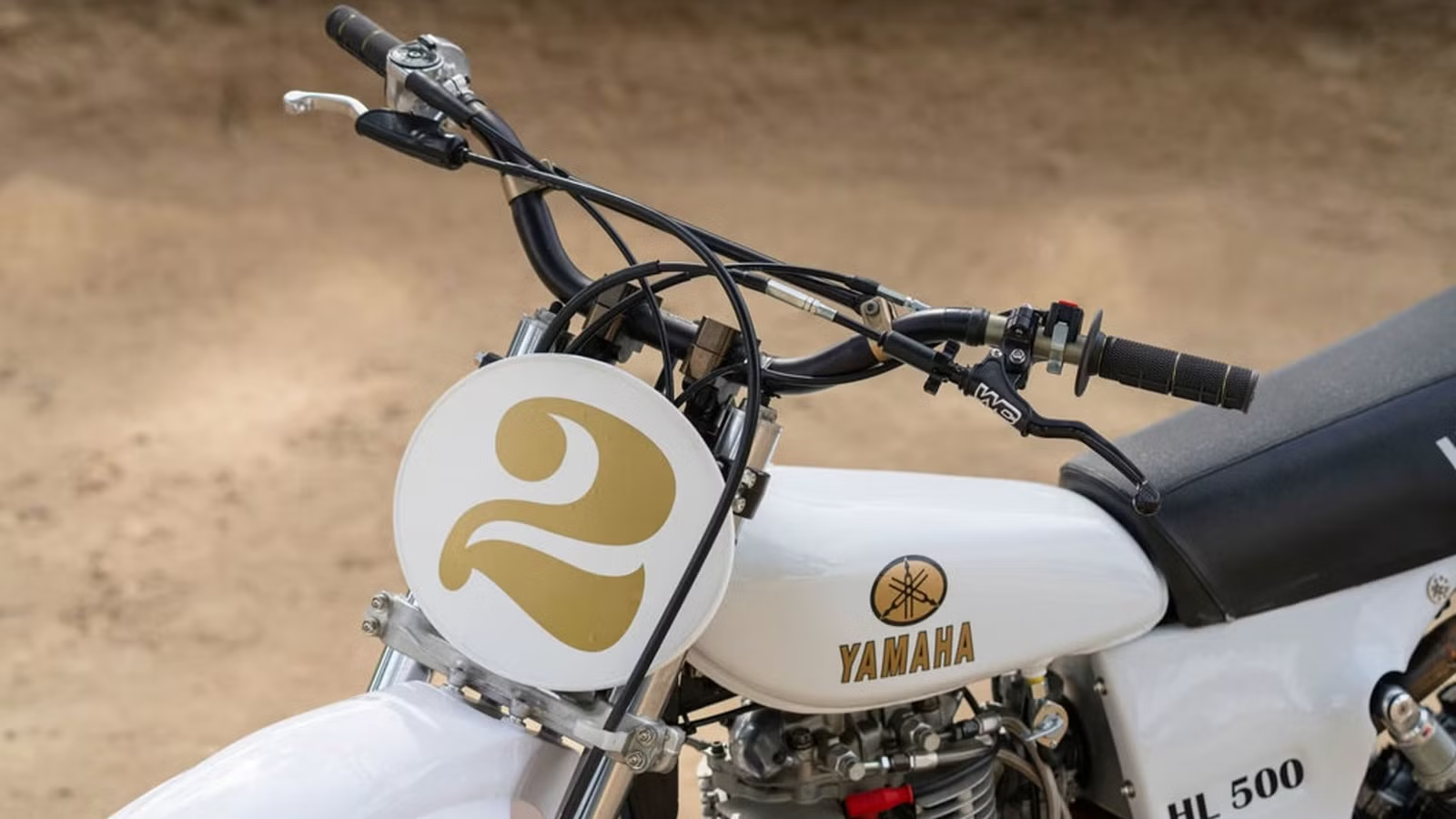
A race-winning prototype proved that a big Yamaha four-stroke could run with the best motocross bikes of its day. Riders wanted one, but what they got was heavier, slower, and far less exotic—and, oddly enough, built in England. The story gets stranger in America, where buyers had to assemble their own version. Each step away from the prototype changed the formula that made the original so special.
The Factory Racer That Created Demand No Production Bike Could Match

That prototype was the Yamaha HL500, and it started because Torsten Hallman and Sten Lundin saw racing potential in a motorcycle that Yamaha itself viewed very differently. Yamaha’s big 499cc single powered the TT500 and closely related XT500, machines aimed far more at trails and endurance riding than Grand Prix motocross. The original bike carried well over 300 pounds and produced modest power. Hallman, a four-time 250cc motocross world champion, and Lundin, a two-time 500cc champion, cared less about what Yamaha had intended. They wanted the motor, and after Yamaha declined to supply a machine in Sweden, the project eventually gained a used example, and the pair began removing nearly everything that made it a pleasant trail bike.
Their first experiments involved a modified Husqvarna motocross chassis. Then ProFab in the United States produced a lightweight chromoly frame to Lundin’s specifications. The finished package used a special aluminum swingarm, Fox AirShox, and Simons forks. It weighed about 247 pounds and offered close to 11 inches of wheel travel at both ends. Those figures explain much of the magic – a large four-stroke single delivers useful traction and a broad spread of torque, but excess mass punishes a motocross bike every time it accelerates, brakes, changes direction, lands, or gets hauled upright after a crash.
The proof came in 1977. Hallman persuaded Yamaha to let two-time 500cc world champion Bengt Åberg race the HL in the 500cc Motocross World Championship, even though Yamaha’s racing operation had shown little interest in backing the four-stroke project. Åberg scored points against the era’s increasingly sophisticated two-strokes, finished ninth in the championship, and won the opening moto of the Luxembourg Grand Prix. The oddball four-stroke had become competitive at the highest level just when conventional wisdom said such bikes belonged to yesterday.

The Yamaha HL500 Was Built By Norton—But Lost What Made The Prototype Special

Demand pushed Yamaha Europe toward an unusual solution. Rather than tool up a Japanese production line for a few hundred specialist motocross bikes, Yamaha’s European operation commissioned the former Norton facility at Shenstone, England, to assemble the HL500. Roughly 200 motorcycles followed for 1978, with another batch of about 200 in 1979. That makes the HL500 one of the strangest Yamahas of the period: Japanese engine, Swedish concept, American-developed frame ancestry, and British assembly. A family tree like that could make a customs officer reach for aspirin.
Norton had access to skilled engineers and fabricators, but series production imposed rules that the original workshop-built racers did not face. The factory could not duplicate every special component, every tuning trick, and every expensive piece of racing hardware at a sensible price. The 1978 production HL therefore mixed its special chassis with much more ordinary Yamaha equipment. Sources identify YZ-derived parts in the front end, while the engine remained much closer to the standard big Yamaha single than Åberg’s heavily developed racing motor. Öhlins rear shocks gave the machine serious suspension hardware, but the complete motorcycle no longer represented the same no-compromise exercise that Hallman and Lundin had created. It looked like Åberg’s weapon. Mechanically, it had started edging back toward the parts bin.

Weight exposed the difference quickly. The works HL had come in around 247 pounds. Period-focused histories put the production machine near 260 pounds, while surviving specifications for later bikes quote figures in the same general neighborhood. Thirteen pounds may not sound catastrophic until those pounds spend an afternoon bouncing through braking bumps and trying to change direction between deep ruts.
The engine made the contrast sharper. The standard 499cc Yamaha single produced roughly 30 horsepower before serious tuning, while racing versions could reach dramatically higher outputs. That gap helps explain why the HL500 remains misunderstood – it often appears in modern descriptions as a factory race replica, which is technically fair but emotionally misleading. A true works replica suggests that the customer gets something close to the machine seen attacking Grand Prix tracks. The 1978 HL instead represented a limited-production interpretation of that machine.
The 1979 Mark II Became The Version Collectors Really Wanted

Yamaha Europe and the Shenstone team clearly understood the problem, because the 1979 Mark II attacked several of the first model’s weaknesses. The easiest identifier is its distinctive dropped, or “banana,” aluminum swingarm. The shape created more clearance and helped increase rear suspension travel. Updated motocross-spec forks improved the front end as well. The visual effect also mattered – a 1979 HL looks more purposeful because the unusual swingarm immediately separates it from the earlier version.
The engine received the changes that the 1978 motorcycle had needed most. A revised camshaft gave the single more aggressive breathing. Yamaha replaced the earlier ignition arrangement with CDI, fitted a larger 38mm Mikuni carburetor, and redesigned the exhaust with a reverse-cone layout. Contemporary specification material credited the later package with about 38 horsepower at 7,000 rpm. That still did not turn the production HL into Åberg’s works engine, but an increase of roughly eight horsepower over the commonly cited early-bike figure represented a major gain on a motorcycle that weighed around 250 pounds.
The Mark II also came closer to the reason the HL concept worked in the first place. Its advantage lay in controllable drive – strong torque could hook the rear tire to hard ground and give a skilled rider useful thrust without demanding constant clutch work. Better breathing and ignition allowed the 1979 HL to exploit that trait instead of merely making noise while the two-strokes escaped. Reports from the period still found limitations in the chassis geometry, starting behavior, and overall performance, and the works machines continued to evolve beyond the customer version. The production HL was improving, but Grand Prix development had already moved the finish line again.

That explains why the 1979 Mark II has become the production version that enthusiasts generally want most. It combines the rarity and British-built oddity of the original batch with useful engineering changes that made the motorcycle faster and more capable. It also captures a brief moment before four-stroke motocross went back into hibernation. Hallman reportedly pushed Yamaha to develop a lighter purpose-built four-stroke engine for the HL program, but the company chose another direction as two-strokes dominated top-level racing. Yamaha would not seriously return to the idea of a modern competition four-stroke until roughly two decades later, when its YZM/YZ400F program helped change motocross all over again. Seen from that angle, the Mark II feels less like an evolutionary dead end and more like a message Yamaha left unopened for 20 years.
The U.S. Profab Kit Offered A Different Path To The Original Formula
American riders got an even stranger version of the HL story because they generally could not walk into a Yamaha dealer and buy the Norton-built European motorcycle. Torsten Hallman Racing instead turned to ProFab, the same American specialist closely tied to the development of the competition chassis. ProFab produced about 100 frame kits sold as the Hallman “TT500 Åberg Replica.” The package cost around $1,000 in 1978 and supplied the frame, swingarm, and related hardware. That was only the beginning of the shopping list – a builder still needed a TT500 donor or suitable engine, suspension, bodywork, wheels, and the dozens of small parts that magically turn a promising pile on a garage floor into something that actually moves under its own power.
A proper build could reach roughly $3,000, serious money for an off-road motorcycle in 1978. Yet the kit carried an advantage that the complete European HL did not: freedom. Builders could use Simons or YZ forks, Fox or Öhlins shocks, YZ or TT wheels, and suitable Yamaha motocross bodywork. Engine tuning depended on the owner’s ambition and budget. That variability makes surviving American HLs difficult to classify today, but it also made the kit concept much closer to Hallman and Lundin’s original thinking.
As a result, a carefully built ProFab machine could get closer to the spirit of Åberg’s racer than a genuine Norton-built HL500. That creates the deliciously awkward part of the collector story. The more “factory” European bike carries greater significance as a numbered, limited-production Yamaha, yet an American kit bike could offer the more authentic riding concept. Later ProFab-framed HLs also remained active in American four-stroke competition, and specialist histories record riders including future stars Rick Johnson and Ron Lechien racing versions in the early 1980s. The design had enough potential to survive after Yamaha’s short production program disappeared.
Using the most commonly cited figures, Norton assembled around 400 complete HL500s across 1978 and 1979, while ProFab supplied roughly 100 Hallman Racing frame kits in the United States. The exact history gets cloudy because racers changed engines, suspension, frames, tanks, and bodywork, while later companies built convincing replicas. That uncertainty only adds to the fascination – a genuine Shenstone HL is exceptionally scarce, and the Mark II sits at the top of the production-bike hierarchy, yet the machine that started the whole frenzy was rarer still: a 247-pound workshop special built to prove that an unfashionable Yamaha four-stroke could fight the world’s best two-strokes. The production bikes never fully captured it, but the U.S. kits let determined owners get closer.
Source: Yamaha, CycleWorld

Related posts

Latest Post



No Comments