
The Rarest Jeep Ever Produced
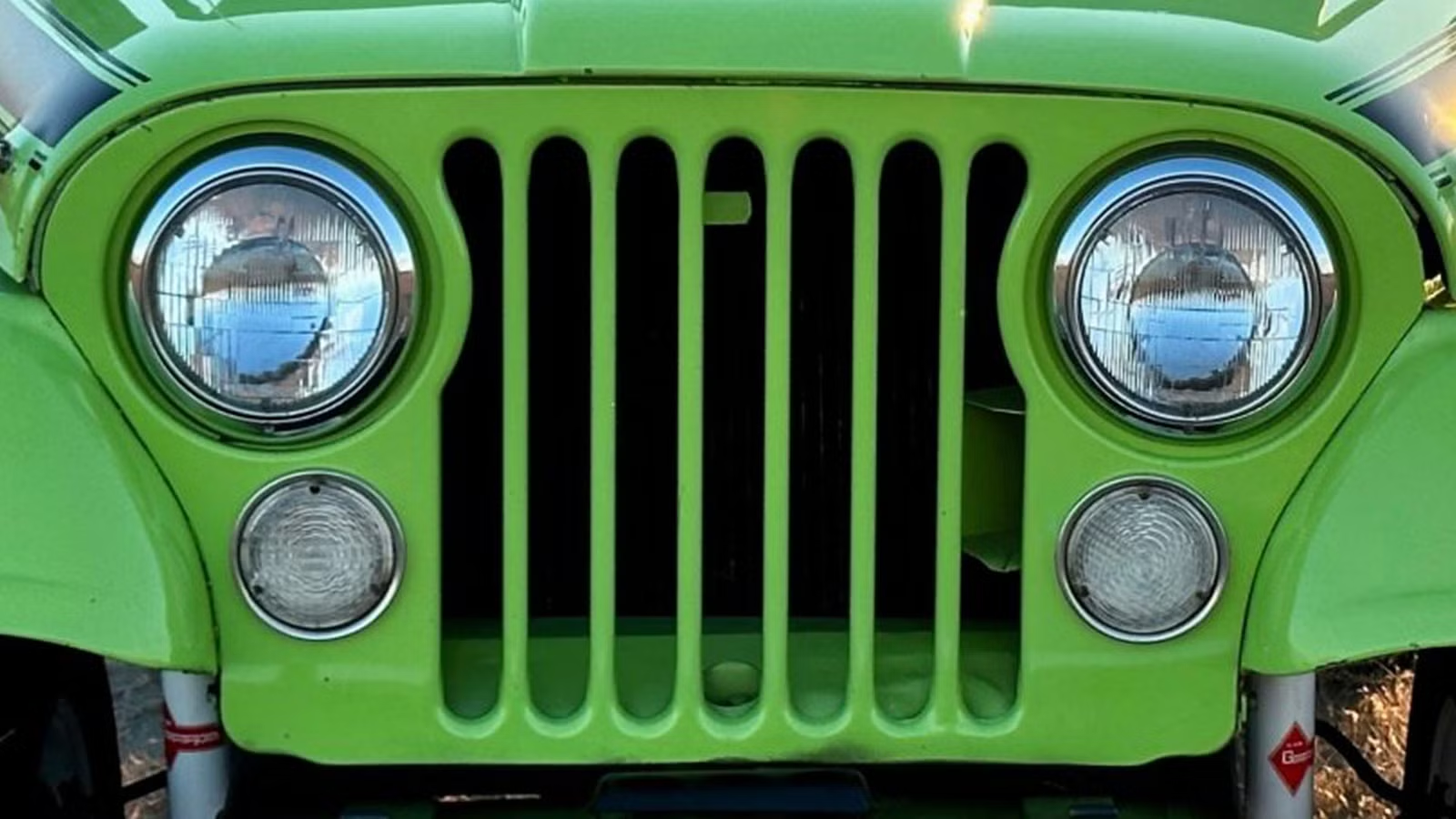
Few automotive names carry as much weight as Jeep. For more than eight decades, the brand has stood for go-anywhere capability, and its most coveted models have earned cult status among collectors who know exactly what to look for. The Willys MB began its life in 1941, serving the U.S. military’s objectives during World War II — and from that rugged foundation, an entire lineage of iconic 4x4s was born.

While the origins of the name “Jeep” are hotly debated, the most plausible and widely accepted explanation traces back to the American army. The Willys was labeled a General Purpose vehicle — “GP” — and it’s widely rumored that soldiers slurred “GP” into “Jeep.”
From the original Willys to the modern Wrangler, Jeep has produced a remarkable number of models over the decades. Among them, a handful stand out as true rarities — special editions with unique features and strictly limited production runs that have since developed a devoted following. We dug deep into Jeep’s storied past to find the rarest series-production model of them all.
The 1969 CJ-5 462 Is The Rarest Production Jeep Ever
1969 Jeep CJ-5 462 Rarity
- Jeep only manufactured around 300 examples of the CJ-5 462, making them extremely rare
- The 462 was a special edition model and does not denote engine displacement
- The CJ-5 462 was only manufactured for one single model year–1969

With around 300 units ever built, the special edition 1969 CJ-5 462 is the rarest Jeep model ever made. While Jeep may have produced one-off concept models, the CJ-5 462 is the rarest series-production model that was sold to the public.
The special edition CJ-5 462 features a 225 cu-in V6 engine, compared to the standard CJ-5 models that offered four-cylinder engines. The “462” badges were the key differentiator for the model; unique paint colors such as metallic blue further set it apart from the standard CJ-5.
Jeep included an upgraded suspension package with the 462 model, which better equipped it to handle rugged terrain and improve its off-road capabilities. The interior was also available with unique touches and custom upholstery that added subtle, distinctive character to the cabin.
The CJ-5 was marketed toward off-road enthusiasts and buyers seeking a more powerful, performance-oriented Jeep. The standard CJ-5 was built in large numbers over several decades, but only a handful of the approximately 300 CJ-5 462 examples produced in 1969 are said to survive in road-worthy condition today. That scarcity drives both their collectible status and their value.
The 1969 CJ-5 462 Used The Dauntless V6 Engine
1969 Jeep CJ-5 462 Engine Specs
|
Manufacturer |
Kaiser-Jeep |
|
Years of Production |
1969 |
|
Displacement |
225 cubic-inch (3.7-liter) |
|
Configuration |
V6 |
|
Power |
160 hp |
|
Torque |
235 lb-ft |
|
Transmission |
3-Speed Manual |
|
Fuel Type |
Gasoline |
(Source: Jeep)
Highlights Of The Buick-Derived Dauntless V6
- The 462 name does not refer to the engine capacity of the CJ-5
- The 225 cu-in Dauntless V6 is derived from the Buick 225 engine with a heavier flywheel
- The Dauntless V6 was dropped in favor of inline-6 engines when AMC acquired the Jeep brand
The “462” designation for this special edition does not mean Jeep dropped a massive big-block V8 under the hood. The 1969 CJ-5 462 used the Dauntless V6 engine with a 225 cu-in (3.7-liter) displacement. This V6 produced 160 hp at 4,200 RPM and 235 lb-ft of torque at 2,400 RPM, mated to a 3-speed manual transmission.
The engine runs a relatively high 9.0:1 compression ratio, which contributes to stronger power delivery. A single-barrel carburetor was used — standard practice for engines of this size at the time. Tuned for off-road use, the Dauntless delivered its peak torque low in the rev range, exactly where trail driving demands it. The engine was also compact and lightweight, helping preserve the CJ-5’s balance and agility relative to the four-cylinder versions. Despite its larger displacement, the Dauntless was reasonably efficient for a V6 of the era.
The Dauntless V6 was originally designed and developed by Buick, then revised and updated by Kaiser-Jeep after 1965. The most significant change Kaiser-Jeep made was fitting a much heavier flywheel to dampen the vibrations inherent in the engine’s firing pattern.
Buick developed the 225 V6 in 1962, and it became one of the first American V6 engines to enter mass production. Kaiser acquired the rights to use it in the Jeep, making the CJ-5 one of the earliest examples of an American compact SUV powered by a V6.
The Dauntless V6 earned a reputation for durability. When American Motors Corporation (AMC) acquired Jeep, however, the engine was discontinued in the early 1970s in favor of AMC’s own inline-6 units. During its run, the Dauntless V6 in the CJ-5 462 set new performance benchmarks for compact 4×4 vehicles — and it remains a central part of what makes the 462 so special and desirable among off-road enthusiasts.
What Is The 1969 Jeep CJ-5 Worth Today?

1969 Jeep CJ-5 Current Values
|
Condition |
Values |
|
Concours Condition |
$31,000 |
|
Excellent Condition |
$21,500 |
|
Good Condition |
$15,900 |
|
Fair Condition |
$11,400 |
(Source: Hagerty)
Jeep CJ-5 Values Today
- On average, Jeep CJ-5 models are worth around $15,900
- Well-maintained examples can be worth up to $31,000
- Special edition CJ-5 462 models are rare and will demand a premium
Generally, most Jeep CJ-5 models command similar values on the collector market. According to Hagerty, the 1969 CJ-5 in fair condition fetches around $11,400, while a good-condition example averages around $15,900. Excellent-condition 1969 CJ-5s are valued at approximately $21,500, and concours-ready examples can reach up to $31,000.
The 1969 CJ-5 462 was a special edition produced in only a few hundred units. Specific valuation data for the 462 variant is scarce, but its rarity makes it considerably more desirable — and more valuable — than a standard CJ-5. Its uniqueness and its place in Jeep’s evolution have cemented the CJ-5 462 as a legend, a tangible reminder of Jeep’s transformation from a tough utility vehicle into a lifestyle icon adored by collectors and enthusiasts the world over.
Sources: Stellantis, Jeep, Bring a Trailer, Hagerty

Related posts


Latest Post


No Comments