
The Rarest Engine Ever In A Ford Production Car
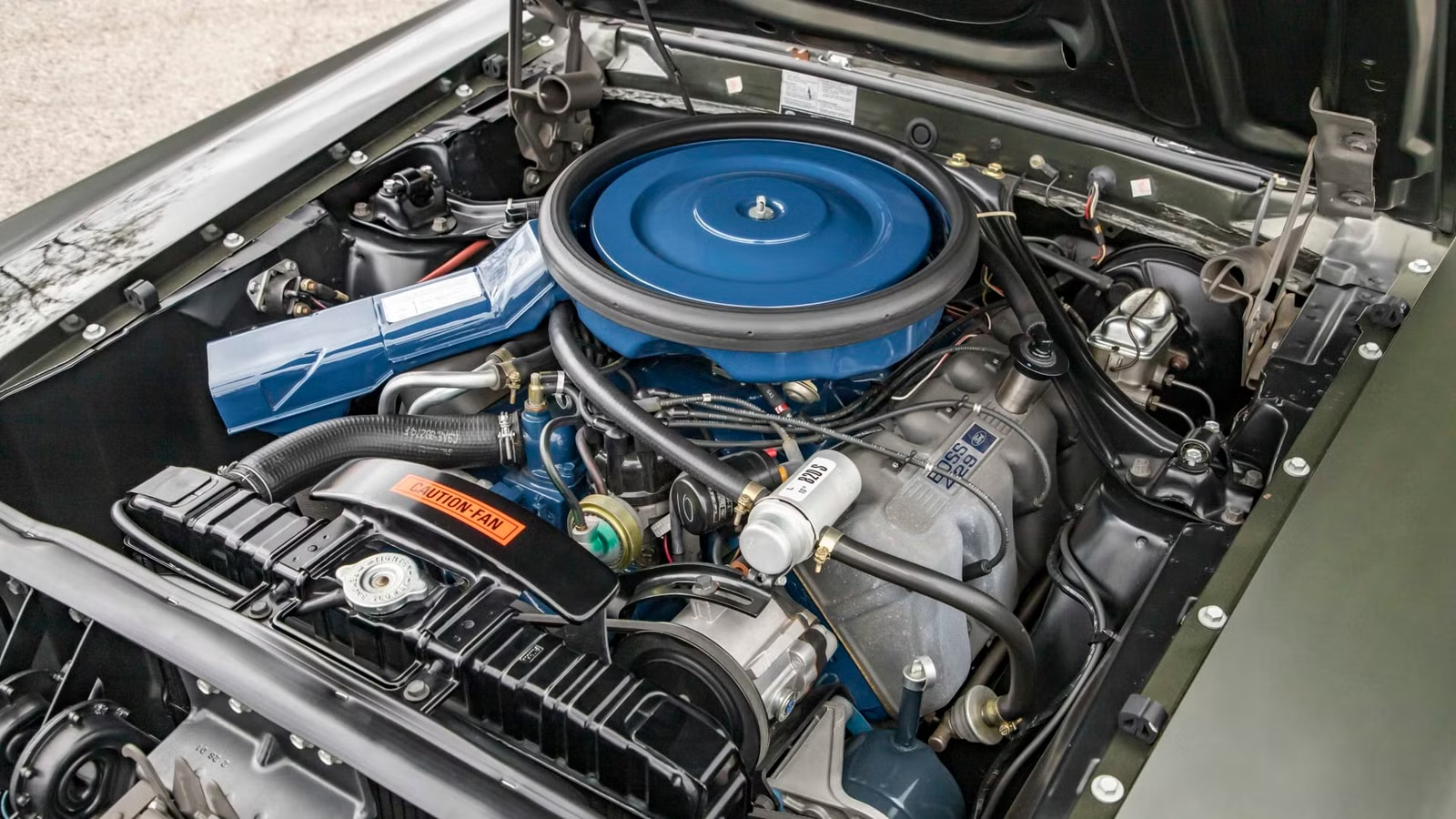
Ford’s engine lineage reads like a hall of fame. The 5.0-liter Coyote V8 still rules the Mustang and F-150, carrying a torch lit decades ago by the beloved pushrod 5.0, the Cologne and Essex V6s, and the thunderous big blocks of the muscle car era — including the Cobra Jet. But buried within that storied catalog is one engine that stands apart from everything else Ford ever bolted into a production car: a race-bred giant so rare, so underrated, and so deeply tied to motorsport that it almost never made it to the street at all.

Among those big block engines of the ’60s and ’70s, one rises above all others. This engine is the rarest ever fitted to a Ford production car, and it came into existence mainly so that Ford could take it racing.
The Boss 429 Is The Rarest Ford Engine Ever
Specs
|
Displacement |
 96 autotech 7.0 liters |
|
Power |
375 hp |
|
Torque |
450 lb-ft |
|
Number produced |
1,361 (1,359 Ford Mustang Boss 429s, 2 Mercury Cougar Boss 429s) |
Ford
An Underrated Monster V8
When it comes to the big block Ford engines, the Boss 429 is easily the rarest and the most famous. It’s a 429 cubic inch (7-liter) V8 rated at 375 hp and 450 lb-ft of torque. If those numbers don’t sound earth-shattering, keep in mind that this is a race-bred engine notorious for being underrated on paper. Enthusiasts who have strapped one to a dyno report that the Boss 429 makes well over 500 hp — putting it in the same conversation as the GT350’s legendary Voodoo V8, an engine built some four decades later. most powerful naturally aspirated V8 engines Ford ever built The Boss 429 engine wasn’t entirely intended for the road. It was originally developed as a racing engine to help power Ford’s involvement in NASCAR. But Ford couldn’t use it exclusively on the track. NASCAR’s homologation rules at the time required that at least 500 examples of any engine used in the series be installed in road cars available to the public. So Ford had to engineer a street-legal version of the engine and sell enough cars to hit that threshold.
The racing version of the Boss 429 didn’t stop at NASCAR, either. It found its way into road racing, growing to a massive 494 cubic inch (8.1-liter) displacement for the Can-Am series. It also powered NHRA Pro Stock drag cars after a 1982 rules overhaul allowed engines of up to 500 cubic inches (8.2 liters) to compete.
The Boss 429 Propelled This Muscle Car To Iconic Status
Mustang Boss 429 Specs
|
Engine |
7.0-liter V8 |
|
Transmission |
4-speed manual |
|
Power |
375 hp |
|
Torque |
450 lb-ft |
The road-going Boss 429 V8 is primarily known for powering one legendary production car: the Ford Mustang Boss 429. The Mustang Boss 429 was produced only between 1969 and 1970, with 1,359 examples officially built — making it one of the rarest Mustang variants ever. Boss 429s are now fiercely collectible, with values averaging around $324,079 according to classic.com. One 1969 example sold for over $600,000.
The decision to shoehorn the Boss 429 into the Mustang is a curious one in hindsight. The original racing version of the engine was destined for the NASCAR-spec Ford Torino, and a high-performance road Torino would have been a far more natural — and physically easier — fit for all 7 liters of that V8. But Ford’s choice to drop the engine into the Mustang instead gave the world an iconic muscle car that enthusiasts still revere today.
Only One Other Road Car That Was Fitted With The Boss 429 V8
While the Ford Mustang Boss 429 is synonymous with the engine, it wasn’t the only road-going Ford to receive the barely detuned racing unit. Two examples of the Mercury Cougar were also fitted with that engine and sold as road cars. Both were built in 1969 as special non-production examples intended for track use, and were sold to “Dyno” Don Nicholson and “Fast” Eddie Schartman.
Despite being sold to racers, those two Boss 429-powered Mercury Cougars were never properly prepared for competition. They were conceived primarily as publicity vehicles — rolling advertisements for Ford’s high-performance lineup. Essentially, they were a publicity stunt. A very cool publicity stunt, though.
Other Rare Ford Engines
The Boss 429 is the rarest engine you’ll find in a mass-produced Ford. But it’s not the rarest Ford engine in existence. A handful of other extraordinary powerplants were developed and never made it into a production car — and at least one of them represents a genuine engineering achievement.
The Ford Modular V10 Never Made Production
You may never have heard of the Ford Modular V10, and that wouldn’t be surprising — it was installed in only one test car (a modified Ford Mustang Cobra R) and never developed into a production engine. But its story is worth telling, because it’s one of the most audacious engineering projects Ford has ever attempted.
The Modular V10 was built by a group of Ford engineers working off the clock, with no official company support. Forced to operate on a shoestring budget, the team took two 4.6-liter Modular V8s from the Mustang Cobra R, trimmed their ends, and joined them together. They replaced the original V8 ECU with two Triton V10 units, each programmed to believe it was managing only five cylinders. The result was a 5.8-liter V10 that not only ran flawlessly but delivered impressive performance figures.
Ford’s leadership was initially enthusiastic about the prototype — enthusiastic enough to ask whether a larger-displacement version could be built. It’s likely they were eyeing the Modular V10 as a potential powerplant for a successor to the Ford GT, or perhaps a production version of the Shelby GR-1 concept. But corporate interest faded before the project could receive proper engineering and financial backing, and the dream of a V10-powered Ford muscle car or supercar quietly died.
The 1967 Ford Cammer V8 Is A Nascar Monster
The Boss 429 wasn’t Ford’s only attempt at building a massive, high-output engine for NASCAR. Before it came the Cammer — a 427 cubic inch (7.0-liter) V8 designed specifically to counter Chrysler’s fearsome 426 “Elephant” Hemi. Much like the Modular V10 engineers who came later, the Cammer’s development team had little support from Ford, which was pouring its motorsport budget into the GT40 program and a new IndyCar engine. The engineers responded by reconfiguring the 427 “side-oiler” from the GT40 and adapting it for stock car racing, reworking the top end into Ford’s own interpretation of the Hemi concept.
The finished engine produced 616 hp and 515 lb-ft of torque — remarkable output for a project completed in just 90 days on a limited budget. Unfortunately, NASCAR president Bill France had no appetite for overhead cam engines or purpose-built racing powerplants. The Cammer was banned from competition before it ever turned a wheel in anger, and it never found its way into a production car.
The Ford 427 Calliope V8 Was Too Powerful For The Road
The Calliope is another big block V8 developed by Ford for racing — but unlike the Boss 429 and the Cammer, it was never intended to see street duty. This 426 cubic inch (7.0-liter) behemoth was built to dominate the 24 Hours of Le Mans. Ford enthusiasts often call it the “holy grail,” a nickname earned by its staggering power output: 630 hp by official measure, an astonishing figure for the 1960s. Some Ford engineers believed the true ceiling was even higher, with estimates suggesting the Calliope could have produced as much as 800 hp.
The Calliope never got the chance to prove itself. The Commission Sportive International (CSI) — the FIA body responsible for setting championship regulations — slashed the maximum engine displacement for Group 6 Prototypes from 7 liters to 3 liters, instantly rendering the Calliope ineligible. There was no realistic path to reworking the engine to meet the new rules, and its racing career ended before it began.
The 427 Calliope may never have raced, but it wasn’t lost to history. A surviving example resides in the Henry Ford Museum, where engine builders have studied it in pursuit of building faithful reproductions. One such builder, Dan Schoneck, has been working toward a limited run of reproductions and has documented the process on his personal social media. Ford enthusiasts will be watching closely when he finally gets it ready to go.
Sources: classic.com, Ford, Mercury.

Related posts



Latest Post




No Comments