
The Rarest Cadillac Ever Produced
Cadillac has spent well over a century building some of the most recognizable luxury cars on the planet — but buried deep in its archive sits a model so scarce that most enthusiasts have never laid eyes on one. While the brand is rightly celebrated for its mass-produced flagships, from the Escalade to the fire-breathing Blackwing performance models, it was a very different kind of Cadillac that represents the pinnacle of the brand’s rarity.

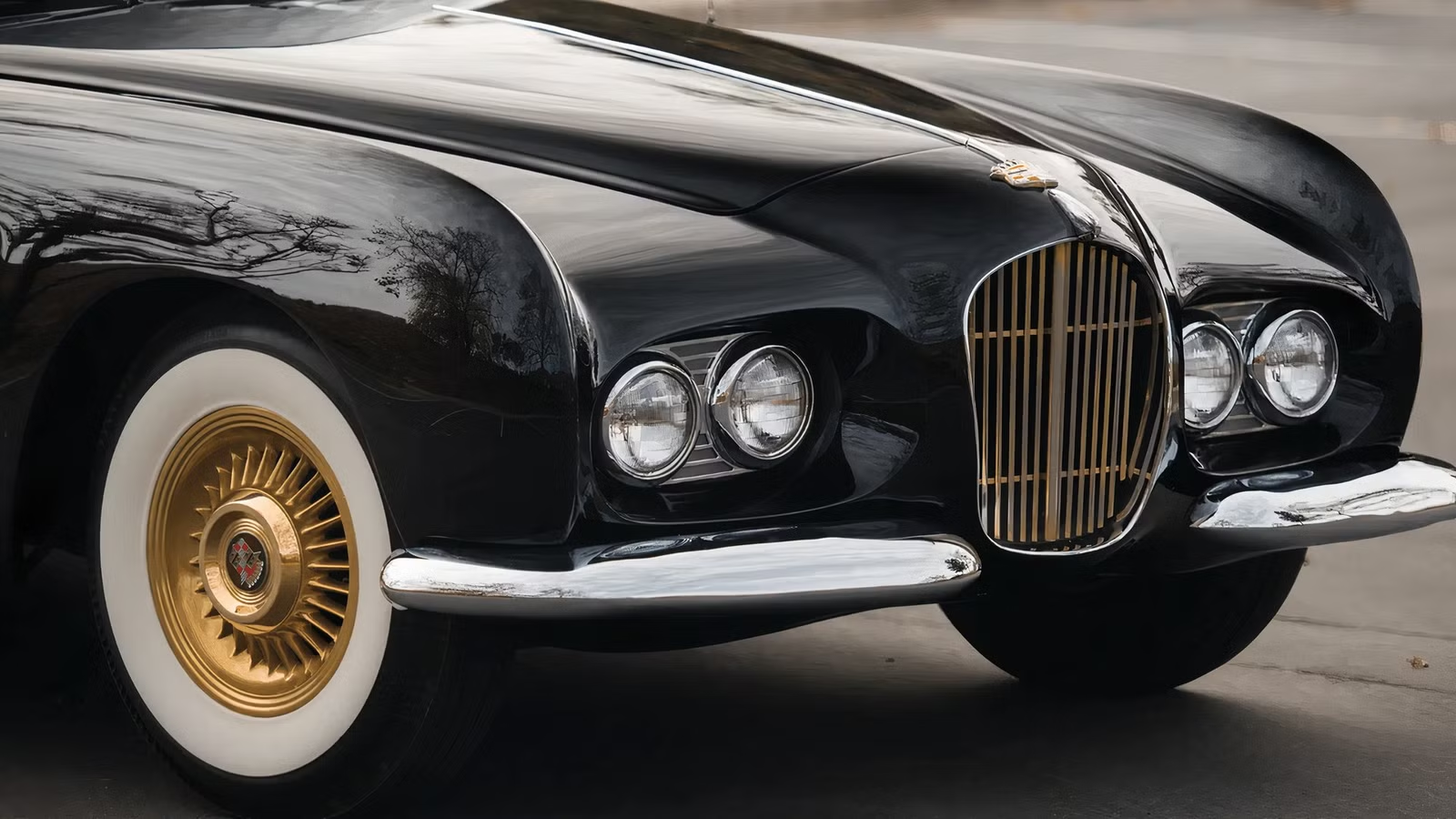
Back in 1953, Cadillac handed a standard Series 62 chassis to legendary Italian coachbuilder Ghia and asked for something extraordinary. What emerged was a bespoke coupe so exclusive that only two were ever produced — making it, without question, the rarest production Cadillac ever to turn a wheel on public roads.
HotCars has sourced information on this rarest of Cadillacs primarily from RM Sotheby’s and the Petersen Museum, in addition to other reputable sources, such as Concept Carz, for supporting data.

The 1953 Series 62 Coupe By Ghia Is The Rarest Ever Production Cadillac
Key Facts
- Only two examples of this sleek coupe were developed by Cadillac in 1953.
- Ghia provided this American 2-door with a typically Italian exterior.
- Both examples still survive to this day, in remarkable condition.
Only Two Of These Italian-Styled American Coupes Were Ever Produced
Cadillac is one of the most storied American manufacturers to have ever existed, with an illustrious history that dates back over 120 years. While for the most part, that history is decorated with some seriously luxurious models which we are mostly familiar with, several elusive gems are also scattered throughout. One such gem is the 1953 Series 62 Coupe, which was based on a typical Cadillac chassis but then completely redesigned by renowned coachbuilder Ghia.
Famed for their beautiful and often European creations, Ghia was the perfect choice for helping Cadillac produce a top-flight coupe for the luckiest customers with the deepest pockets. This was never intended to be an exercise in mass production, as only two examples were ever planned — both of which survive today in superb condition.
Underneath the gorgeous coachbuilt bodywork lies an everyday Cadillac Series 62, which at least means parts are reasonably accessible when it comes to servicing and maintaining these unicorn classics. Much of the history of these two cars remains unknown, as virtually no in-period documentation exists today. However, it’s largely believed that one car was delivered new to John Perona, owner of Manhattan’s El Morocco nightclub.
This is easily believable, as he was a devoted fan and frequent customer of Ghia’s work. The other car is thought to have belonged to actress Rita Hayworth, although no concrete evidence exists to place her behind the wheel, so it may well be nothing more than a rumor.
This ’50s Cadillac Packs A 331 Cubic Inch V8
1953 Cadillac Series 62 Ghia Coupe Engine Specs
|
Configuration |
V8 |
|
Displacement |
331 ci (5.4-liter) |
|
Power |
210 horsepower |
|
Specific Output |
39.6 horsepower per liter |
|
Torque |
330 lb-ft |
|
Layout |
Front-engine, rear-wheel drive |
The Ghia Coupe’s V8 Churns Out 210 Horsepower
Being a luxurious Cadillac from the 1950s, there could only ever be one type of engine under the hood — naturally, a V8. Specifically, a 5.4-liter unit producing 210 horsepower and 330 lb-ft of torque. Performance figures such as 0-to-60 times and top speed remain unknown, given the extremely limited production run and the intended purpose of this rarest of Cadillacs.
It’s worth noting, however, that 210 horsepower was a remarkable figure in the early 1950s — an era when 100 horsepower was genuinely something to brag about. While the number seems modest by modern standards, it was an industry-leading output at the time. As a point of reference, the stylish and sporting Maserati 150 GT Spyder from the mid-1950s had no more than 130 horsepower to play with.
Besides, these cars were built to impress in a different way — by simply looking incredible. If anything, the curvaceous lines and striking proportions of the Series 62 Ghia Coupe appear even more breathtaking today than they would have in the 1950s.
Here’s How The Two Cadillac Ghia Coupes Differ From Each Other
Key Differences
- Each Ghia coupe features a different front grille design.
- The black example has no front fender parking lights, different taillights, and a unique rear license plate holder.
- The Petersen Museum example, finished in red, boasts a full front bumper, instead of the half-sized “bumperettes”.
Each Series 62 Ghia Coupe Boasts Unique Styling Features
Despite commissioning only two cars, Cadillac ensured that certain features would differ between both examples — or perhaps the original customers requested the distinctions themselves; the surviving evidence simply doesn’t tell us. Either way, the two cars are easily told apart, thanks to a number of unique details.
One car, which now resides at the famous Petersen Museum, is finished in a deep red color, but the differences don’t stop there. Its grille features a chromed egg-crate design, whereas the other car’s grille consists of vertical slats finished in a striking gold color — a finish that extends to the wheels as well.
Around back, the Petersen example has different taillights, a different rear license plate holder and, returning to the front, a full-width bumper. The other example, by contrast, takes a cleaner approach with bumperettes in place of a full bumper. Arguably, these factory differences make each car a true one-of-one rather than merely one of two.
Here’s How Much A Cadillac Series 62 Ghia Coupe Is Worth
- Most Recent Sale: $1.43 Million in 2016
Needless to say, owning such a stylish and singular car does not come cheap. The original purchase prices are unknown, but there is at least one recent auction record to reference. The black example with gold highlights sold in 2016 at an RM Sotheby’s auction. The auction description notes that the car was restored by renowned specialist Mike Fennel, best known for his work on classic American cars and top-end hot rods.
That restoration pedigree no doubt helped the car achieve a final price of $1,430,000, which landed within RM Sotheby’s lower-end pre-sale estimates. What either example might fetch at auction today is anyone’s guess. For context, Hagerty values a standard, non-Ghia Series 62 Coupe in top Concours condition — equipped with the same 210-horsepower 331 ci V8 — at around $52,300.
Cadillac Also Toyed With Producing Several Unique Concept Cars
Key Facts
- The Cadillac Sixteen was so-named for its V16 engine.
- Cadillac’s 1959 Cyclone concept car featured a bubble canopy, instead of a typical roof.
- To celebrate Cadillac’s 100th anniversary, they designed the 2002 Cadillac Cien.
- The Ciel concept features sharp lines and 1970s-esque proportions.
The 2003 Cadillac Sixteen Concept Car Featured A 13.6-Liter, 1,000 Horsepower, V16 Engine
Any gearhead familiar with Cadillac’s history will know the brand has never been shy about a concept car or prototype. Concepts aren’t always realized in physical form, which is the case with many of these designs, while prototypes are typically built as one-offs with no path to production ever intended.
The 1959 Cyclone concept is one of the more striking creations from Cadillac, boasting retro-futuristic styling and even a transparent bubble canopy in place of a conventional roof structure. Later concepts include the Cien and Ciel; the former celebrated 100 years of Cadillac in 2002, whereas the latter hails from 2011 yet draws heavily on the proportions and excess of the 1970s.
Perhaps the most jaw-dropping of all is the 2003 Cadillac Sixteen concept, which was designed around a monstrous V16 engine. The 13.6-liter unit was planned to produce a Veyron-rivaling 1,000 horsepower, and would surely have been the ultimate statement in luxury motoring.
Sources: RM Sotheby’s, Concept Carz, Cadillac, Hagerty

Related posts



Latest Post


No Comments