
The Rare Japanese Twin Built By A Tire Company That Quit Motorcycles Entirely
It is difficult to explain why a motorcycle manufacturer would abandon a machine capable of embarrassing considerably larger motorcycles. It is even harder when that manufacturer had developed an unusually sophisticated engine, earned recognition for its manufacturing quality, and built a motorcycle that was still competitive against Japan’s emerging two-wheeled giants. Yet that is precisely what happened to one of the most interesting Japanese motorcycles of the 1960s.

Its maker had the engineering ability to challenge established motorcycle manufacturers, but its growing tire business offered a different, more lucrative opportunity. By 1971, the motorcycle operation was gone, leaving behind a relatively small production run and an unusual piece of Japanese motorcycling history.
The 350cc Twin That Had No Business Being This Fast
The middleweight motorcycle market of the late 1960s was changing. Japanese bikemakers were beginning to treat 350cc motorcycles as proper performance machines rather than smaller, less powerful alternatives to their 500cc offerings. Most bikemakers developed their middleweights by adapting existing designs, but one Japanese company took a different route. It approached the class with an unusually ambitious engine and engineering solutions that were more commonly associated with expensive performance motorcycles.

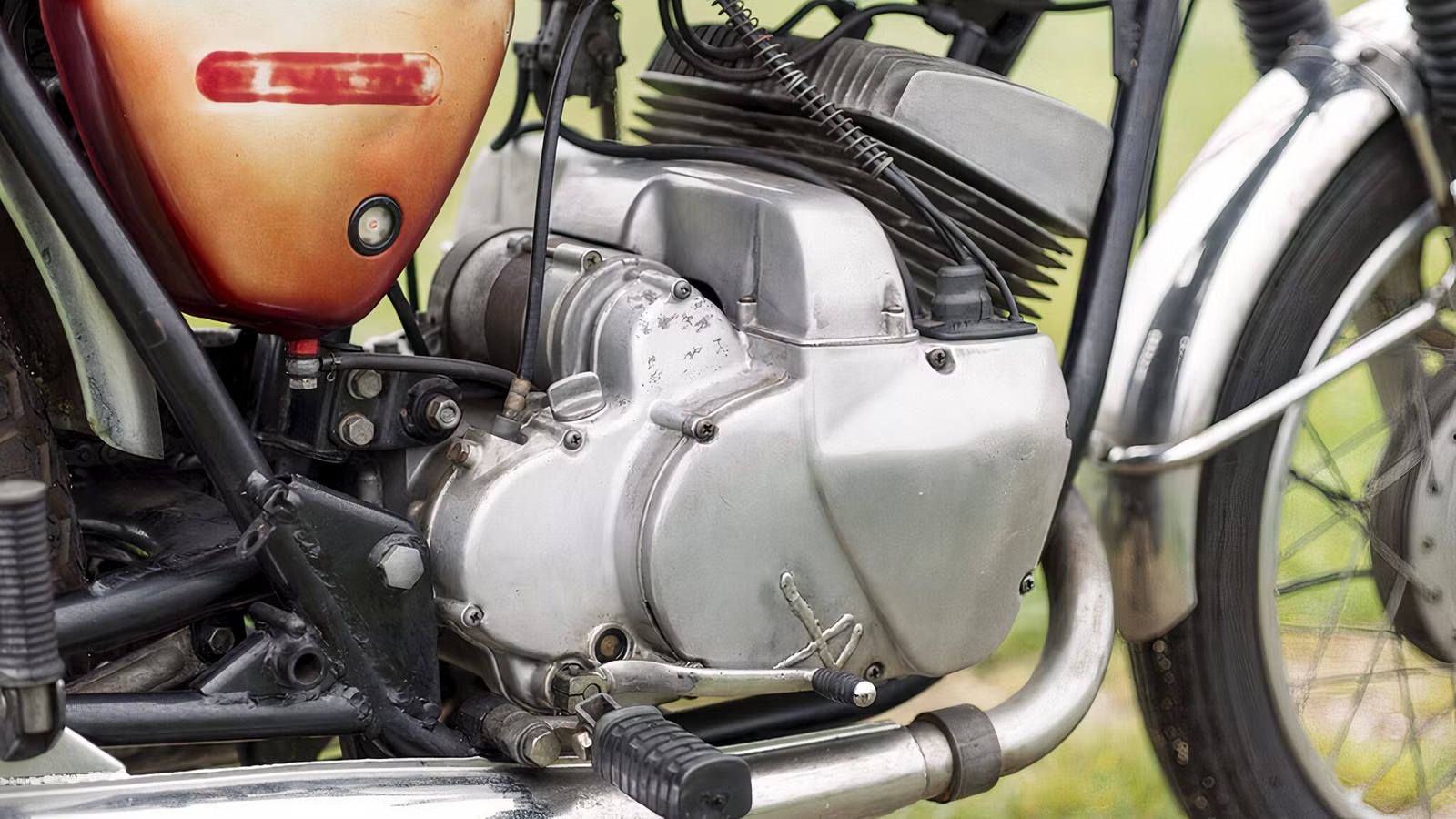
The result was a two-stroke twin that challenged the established hierarchy. Its rotary-valve induction system allowed engineers to control inlet timing independently of piston movement, giving them greater freedom to optimize the engine’s breathing. This mattered because two-stroke engines relied heavily on efficient gas exchange to produce power, particularly at higher engine speeds.
The motorcycle’s six-speed gearbox offered more ratios than many contemporary motorcycles, while lightweight construction and carefully considered chassis design helped turn the available power into usable performance. It was not simply a larger engine squeezed into an existing frame. The motorcycle was developed as a complete package. That approach was unusual for a manufacturer better known for its rubber products.
The Bridgestone 350 GTR Used Engineering To Beat Bigger Motorcycles

Introduced in 1967, the Bridgestone 350 GTR was powered by a 345cc two-stroke parallel twin producing around 40 HP at 7,500 rpm. Its defining feature was rotary disc-valve induction, with a carburetor and rotary valve positioned at either end of the crankshaft. This arrangement allowed more aggressive, asymmetrical inlet timing than conventional piston-port two-strokes.
Bridgestone also addressed the engine’s packaging challenges by positioning the generator behind the cylinders. The cylinders themselves used chrome-plated aluminum bores, produced through a process involving exploding chrome wire to deposit the coating. This avoided the conventional iron liners used by most rival engines. A seven-plate dry clutch and six-speed transmission completed an unusually sophisticated powertrain. The gearbox also allowed the shift lever and rear brake pedal to be swapped between sides.
Performance was equally impressive. Road tests reported quarter-mile times ranging from approximately 13.7 to 15 seconds, with published top speed figures up to 108 mph. Cycle World described its acceleration as similar to a 500. It was also capable of challenging larger British and Japanese motorcycles.
The GTR had its downsides too. Its high-revving engine delivered little power below 4,000 rpm, and its front drum brake felt inadequate for the performance offered.
Bridgestone Won A Quality Award Before Walking Away From Motorcycles

In 1968, just a year after the motorcycle’s introduction, the company reportedly received Japan’s Deming Award for Excellence in Quality Management. Old Bike Australasia identifies this as a major recognition of Bridgestone’s manufacturing standards. The timing makes the achievement particularly interesting. Bridgestone was producing one of its finest motorcycles while its management was increasingly focused on the profitable tire business.
Bridgestone’s motorcycle operation faced several commercial disadvantages. The GTR was expensive compared to competing Japanese two-stroke motorcycles, and its performance-oriented character did not necessarily appeal to buyers who preferred larger four-stroke machines. Its development also required investment in specialized engineering and production equipment.
There is also a story involving Japan’s Big Four motorcycle manufacturers. Honda, Kawasaki, Suzuki, and Yamaha were important potential customers for Bridgestone tires. According to folklore, these companies threatened to take their tire business elsewhere if Bridgestone continued competing against them in motorcycles. Old Bike Australasia argued that this story might not be true, and that Bridgestone could have ceased motorcycle production due to factors like factory-space requirements, financial commitments, and the growing profitability of automotive tires. By 1971, Bridgestone had exited motorcycle manufacturing, choosing to concentrate its resources on tires.
The Bridgestone 350 GTR Is An Unusual Collectible With Relatively Accessible Prices

Bridgestone’s exit from the motorcycle business makes the 350 GTR more unusual than its contemporary Japanese rivals. Production estimates are between 9,000 and 10,500 examples. The motorcycle continued to reach American buyers beyond that period, with production and distribution timelines differing depending on the markets.
The Bridgestone 350 GTR, at the time, was priced at around $695 and $800 in America. It was more expensive than most of its Japanese rivals, due to the cost of its sophisticated engine and relatively high manufacturing quality. Today, surviving examples offer an interesting entry point to the collectible Japanese two-stroke market. J.D. Power’s Bridgestone buying guide places prices at around $1,800 for ordinary examples, while exceptionally clean or restored examples can cross $7,000 in value.
The 350 GTR is not valuable simply because Bridgestone stopped making motorcycles. It represents a period when a tire manufacturer was capable of producing a genuinely competitive performance motorcycle, complete with engineering solutions that challenged established manufacturers. Bridgestone ultimately made a sensible commercial decision, but motorcycling lost an interesting manufacturer in the process.

Related posts





Latest Post


No Comments