
The Phantom Oldsmobile 4-4-2 W-30s That Outnumber The Factory Cars Nearly 2-To-1
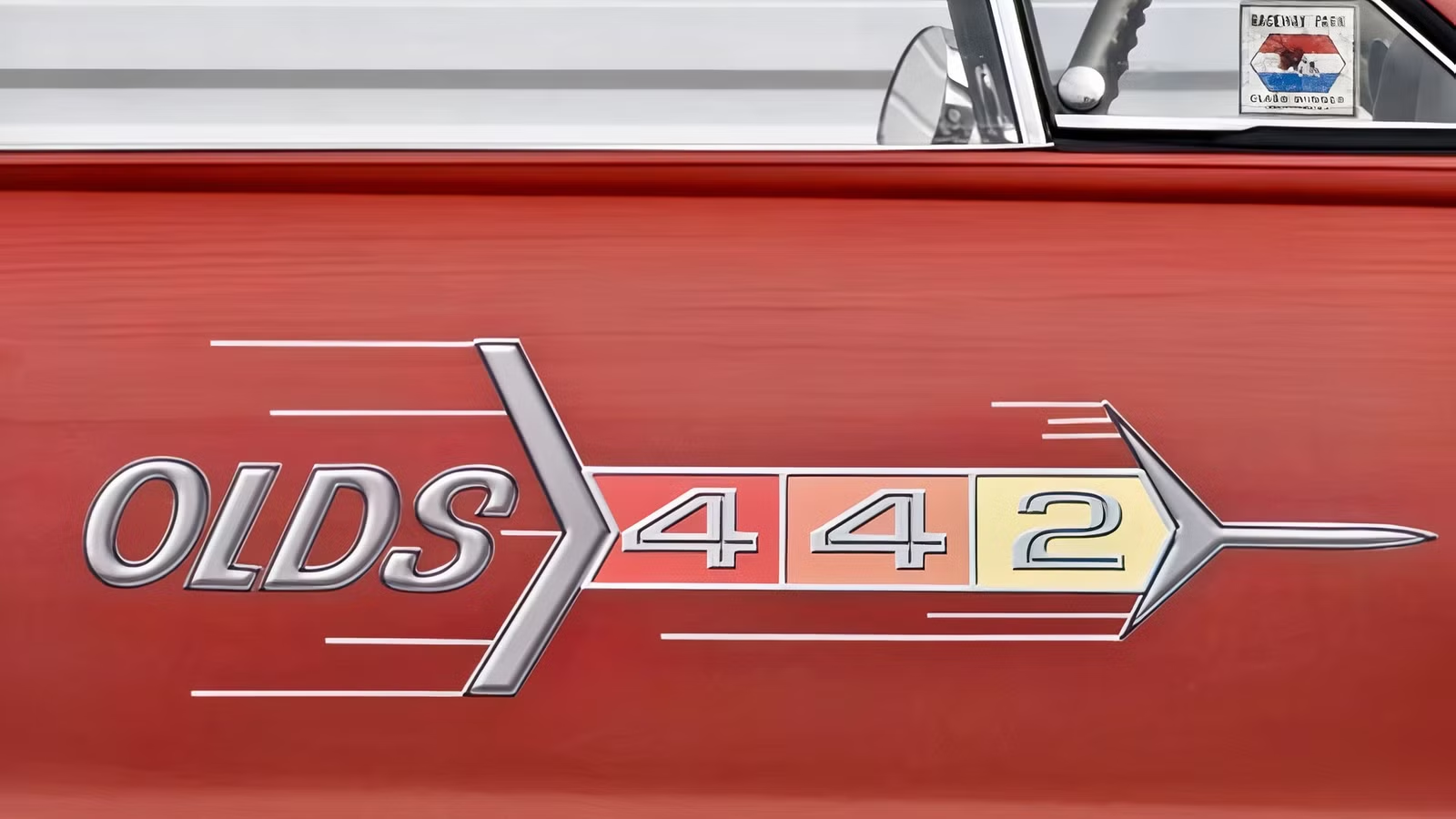
Collector car lore runs on round numbers and tidy narratives, and the 1966 Oldsmobile 4-4-2 W-30 has one of the tidiest: exactly 54 factory-built cars, each with a numbered air-cleaner shroud, all assembled in a single month in Lansing. It is the kind of origin story that closes conversations rather than opening them. But the full hardware count tells a different tale — and it starts with a chrome air cleaner. muscle car Somebody counted the chrome air cleaners. The total came to 147, leaving enough factory hardware for roughly 93 dealer-installed cars that looked and breathed much like the celebrated originals. They’re the ghosts in the record book, carrying genuine performance parts and a paper trail that can turn a purchase into forensic accounting.
The 54-Car Legend Became The Whole Story

Oldsmobile had already made the 4-4-2 a credible rival before 1966 arrived. Its 400 cubic-inch V8 produced 345 horsepower in 1965, backed by chassis tuning that made the Olds more than a straight-line missile. For ’66, the standard 400 rose to 350 hp and 440 lb-ft of torque, while the optional L69 Tri-Power engine delivered 360 hp.
The L69 used three Rochester two-barrel carburetors on a 10.5:1-compression 400. It required a manual transmission and carried a larger 286-degree camshaft. Oldsmobile built 2,129 L69 cars, making it uncommon without turning it into collector-car folklore. The W-30 package sat deeper in the catalog and aimed directly at racers who cared far more about elapsed time than commuting manners.
Only 54 factory W-30s were assembled, all during June 1966 in Lansing. The run included 25 F-85 coupes, eight F-85 Deluxe hardtops, five Cutlass Sport coupes, and 16 Cutlass hardtops — just enough to satisfy NHRA homologation requirements. Each received an air-cleaner shroud stamped from 1 through 54, giving collectors the neat sequence they love. Once those numbered cars became the accepted canon, the rest of the hardware story slipped out of view.

Oldsmobile Built A Drag-Strip Intake Into The Front Bumper

The 1966 Oldsmobile 4-4-2 W-30 started with the L69 Tri-Power 400, but Lansing gave the factory cars a more focused engine. A 308-degree, high-lift hydraulic camshaft replaced the L69’s milder grind, while high-tension valve springs helped the valvetrain cope. The 400 was described as factory blueprinted or select-fit, and the cars’ frames were checked for straightness after leaving the regular assembly line.
Outside Air Induction, or OAI, supplied the visual drama. Two bumper scoops fed cooler air through 4-inch hoses into a sealed chrome air cleaner covering all three carburetors. The parking lamps moved inward to clear the openings. It was less an air cleaner than industrial plumbing with a drag-racing habit, which is why the setup remains so memorable.
A True Homologation Special

Those hoses passed through the usual battery area, so Oldsmobile relocated the battery to the trunk above the right-rear wheel. Its new position also aided traction. The packaging ruled out a factory W-30 convertible, meaning any claimed 1966 ragtop deserves suspicion and perhaps a slow walk in the opposite direction.
Many factory cars also used a 4.33:1 Anti-Spin rear axle. The W-30 retained the L69’s advertised 360 hp and 440 lb-ft, but its camshaft, induction, and carefully assembled engine were meant for work beyond the brochure. Oldsmobile had created a true homologation special without making it a separate model, which later turned provenance into a much messier business.
The 93 W-30 Trak Pacs Lansing Never Assembled

This is where all the math comes together. Oldsmobile made 147 special Tri-Power air-cleaner assemblies for 1966. The 54 factory W-30s consumed 54 numbered units, leaving hardware for roughly 93 dealer-installed packages. Those over-the-counter conversions became known as Track Pac or Trak-Pak cars, depending on the surviving account.
The dealer kit was no mere decorative cold-air package. It included the W-30 camshaft and valve springs, bumper-mounted intakes, the chrome shroud, and hardware for relocating the battery. A buyer also needed the L69 Tri-Power components if the car didn’t already have them. A properly converted Track Pac therefore carried nearly the entire mechanical recipe that made the factory version special.
The main exceptions were the factory car’s reported blueprinting and numbered air cleaner. That matters enormously to collectors, but it doesn’t make dealer cars backyard imitations. They used Oldsmobile hardware sold for this exact purpose. In 1966, there were roughly 1.7 dealer Track Pacs for every factory W-30, so the supposedly secondary version was actually the larger population. The rare-car world does enjoy making the more numerous version harder to find, doesn’t it?
Why Oldsmobile Sold W-30 Performance Parts Over The Counter

Some enthusiasts might wonder why Oldsmobile chose to sell W-30 hardware through its dealerships instead of simply building more factory cars like the original 54. The answer comes down to timing, racing regulations, and practicality. The W-30 package arrived far too late in the 1966 model year to become a mainstream production option. Announced in May and entering production in June, it missed the standard dealer brochure altogether, leaving Oldsmobile with little opportunity to expand factory output before attention shifted to the 1967 model year.
Just as importantly, the 54 factory-built W-30s had already achieved their primary mission: satisfying NHRA homologation requirements for Stock and Super Stock competition. Once the cars began proving themselves on the drag strip, there was no competitive reason to keep building limited-run factory cars, especially given the complex and disruptive nature of the process. Producing a factory W-30 meant relocating the battery, fitting the Outside Air Induction system, modifying the front bumper, and assembling the specially prepared engines — all of which complicated the normal production flow.

Selling the components through dealers let Oldsmobile meet demand without disrupting the assembly line, while also giving owners of existing L69 Tri-Power cars a path to upgrade rather than buy a new vehicle. Ironically, Track Pac cars were never meant to replace the factory W-30s, yet today they’re nearly as intriguing — and often harder to verify — than one of the legendary 54 factory originals.
A VIN Decoder Cannot Find These Ghosts
A factory build sheet can establish an assembly-line option, but a dealer conversion lives outside that record. The VIN may confirm a real 4-4-2 and its Lansing origin, but it can’t prove that a dealer later installed the Track Pac. An authentic dealer-built W-30 can therefore resemble an ordinary L69 car on paper even when the correct hardware has been aboard since new.
There are several clues to factor in. A factory 1966 W-30 should have a June build date and late B cylinder heads with a “-1” following the casting number. A genuine Tri-Power head also carries the correct V-code and a T suffix on its front flange. The car must be a manual-transmission hardtop or coupe, and the trunk should show the battery location above the right-rear wheel.
Patience And Skepticism

Most of those pieces could also appear on a genuine dealer Track Pac. Its air-cleaner shroud won’t carry one of the factory numbers from 1 to 54, so the obvious shortcut disappears. Correct castings, rear-axle details, battery hardware, and original installation marks can strengthen the case, but no single clue tells the full story.
Dealer invoices, original sales paperwork, and old photographs therefore carry massive weight, as you might expect. They can connect the equipment to the car before restoration parts and owner modifications muddied the picture. A shiny 4-inch hose is easy enough to replace, but a dated invoice showing the package was installed when new is rather less cooperative — which is why buying one demands patience and healthy skepticism.
The Paper Trail Is Now The Rarest Bit

Oldsmobile changed the W-30 formula for 1967 after General Motors barred multiple carburetors on its A-body cars. Tri-Power disappeared in favor of a single four-barrel carburetor, while the OAI system drew air through openings around the headlamps. Factory W-30 production jumped to 502, and estimates suggest dealers converted perhaps another 100 cars with a similar Track Pac.
The factory cars also gained red inner fender liners. Dealer-installed Track Pacs didn’t receive them, making the liners a strong identifying clue when evaluating a claimed 1967 factory W-30. That distinction is clearer than it was in 1966, although replaced or restored parts can still send an inspection down a rabbit hole.
Needle In A Haystack

That leaves the first-year cars as the weird chapter. Oldsmobile’s 54 factory-built 1966 W-30s deserve their reputation, but the roughly 93 dealer conversions show how performance packages actually moved through the muscle car market. A determined buyer didn’t need Lansing to complete the entire build. A local dealer could just as easily install the same intake concept, camshaft, springs, and battery hardware.
These phantom W-30s expose the gap between production history and lived history. Factory records favor cars that left the line complete, while dealer-built machinery survives through receipts and physical evidence. Somewhere among the ordinary-looking 1966 Oldsmobile 4-4-2s may be a real Track Pac that has spent decades being misunderstood. Finding it won’t be as simple as reading a VIN, but for those on the lookout for something a little extra, it’s a task well worth undertaking.
Are Dealer-Built Track Pac Cars Finally Getting The Recognition They Deserve?

Factory-built 1966 W-30s have always grabbed the headlines, leaving dealer-installed Track Pac cars to spend decades as the overlooked members of the family. Because they lack factory option codes and rely heavily on paperwork to prove their history, many enthusiasts mistakenly lump them together with later clones or tribute builds. However, as documentation has come to light, collectors have begun recognizing them for what they are: legitimate dealer-installed performance cars assembled with genuine Oldsmobile 442 W-30 hardware.
That growing appreciation was evident when one of these dealer-installed Track Pac cars crossed the block at Mecum Dallas/Fort Worth 2025. Documented with its original bill of sale, order copy, finance records, and numerous receipts dating back to the late 1960s, the car attracted a serious $75,000 bid — showing that informed collectors recognize the value of an authentic dealer-installed Track Pac even though it ultimately didn’t sell. At the same event, one of the 54 factory-built 1966 W-30 Hardtops sold for $104,500, proving the factory cars remain the benchmark while also showing the gap isn’t as wide as many enthusiasts might assume.
Today, documented Track Pac cars have carved out a respected niche of their own, earning recognition as an important part of the W-30 story rather than simply an interesting footnote.
Sources: Hemmings, OldsJunction, Oldsmobilesforever, Oldsmobile, Mecum Auctions

Related posts




Latest Post


No Comments