
The Rare American Motorcycle Built To Bury Harleys
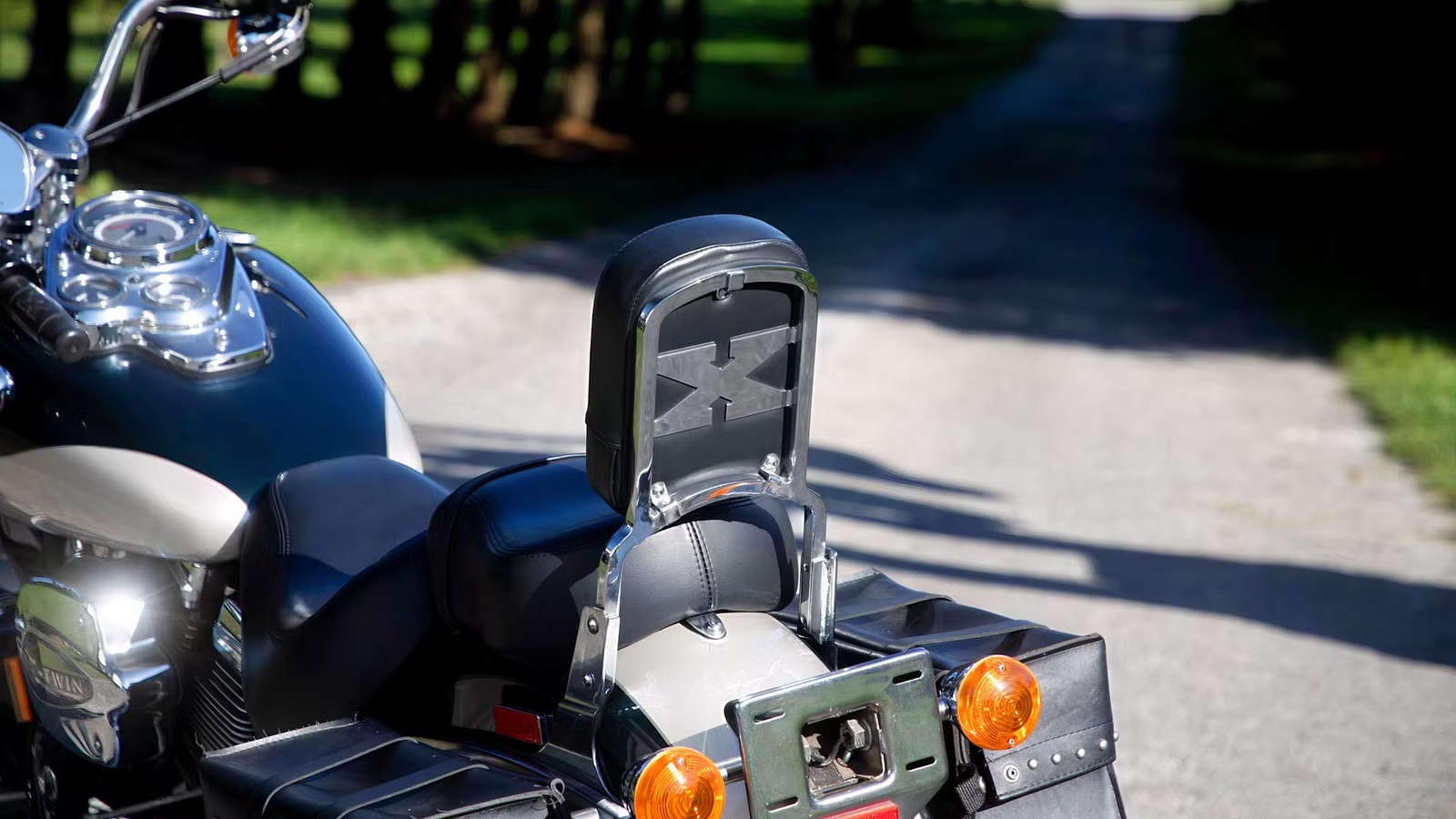
The ’90s cruiser market had one throne, and Harley-Davidson was sitting on it with its boots on the table. Dealers had demand, buyers had patience, and anyone building an American V-twin had to answer the same awkward question: why would a rider skip Milwaukee?

As ever, there’s always one to challenge the throne, though. One company thought the answer was history, hardware, and scale. It revived a name older than most biker bars, built a modern factory in Minnesota, and rolled out a heavyweight cruiser meant to feel like a legit American alternative.
Harley’s Boom Left An Opening Too Big To Miss
Harley-Davidson’s early-’90s boom created the kind of opportunity that looks obvious from 30,000 feet and terrifying once the invoices arrive. Riders wanted Fat Boys, Softails, Sportsters, Dynas, Road Kings, Electra Glides, and anything else wearing the Bar and Shield, while the broader cruiser market started orbiting Milwaukee like it had its own gravitational field.

Therein lay the monumental challenge. The cruiser world already had plenty of Harley-Davidson-inspired alternatives, and bikes like the Honda Shadow, Yamaha Virago, Kawasaki Vulcan, and Suzuki Intruder proved that everyone understood the appeal of a big V-twin silhouette. A proper American rival, however, needed more than nostalgia and a leather vest with too much fringe.
Let’s also keep in mind that Harley-Davidson wasn’t exactly selling basic transportation in the ’90s. At the risk of aggrandizing things, it was selling identity with a VIN number. Any American motorcycle trying to bury Harleys had to bring its own story, which meant either inventing a legend from scratch or digging up one that had been waiting in the ground for decades.
A Startup Tried To Out-Build Milwaukee From Scratch

The Hanlon brothers of Belle Plaine, Minnesota, chose the second route. Rather than chase Harley-Davidson with a generic clone, they revived a once-important American motorcycle badge that had disappeared after the Great Depression. Heritage gave the plan instant appeal, but heritage still needed engines, frames, workers, paint booths, federal approvals, and an overflowing bank account.
To that effect, the scale was absolutely enormous. The company in question raised around $100 million, built a 160,000-square-foot factory, and aimed for production capacity that could reach 10,000 motorcycles a year, with room to go higher. Even if you know nothing about anything, that’s an appreciably out-there move when you’re starting a motorcycle company.
Tight Timing

What made the plan even more ambitious was the refusal to build a lazy Harley-Davidson copy. To be clear, don’t think of this as a warmed-over cruiser built only to steal buyers from a Heritage Softail Classic, Road King, Low Rider, or Fat Boy. The company wanted purpose-built components, vendor-supplied parts made to its own specifications, and a motorcycle that could lean on the past without riding like a museum exhibit with a license plate.
By late ’98, the production model finally appeared, and the timing was tight. Harley-Davidson’s new Twin Cam era was changing the benchmark, Victory had arrived with serious backing from Polaris, and the Minnesota startup was trying to land a haymaker before it had fully settled into its stance.
The Excelsior-Henderson Super X Was A Brave New World

|
Engine |
Power |
Torque |
Transmission |
|
1,386cc, four-stroke V-twin |
63 hp |
70 lb-ft |
5-speed |
The 1999 Excelsior-Henderson Super X is what we’re on about, and it arrived like a parade float with pistons. Built in Belle Plaine, Minnesota, the Super X mixed prewar visual cues with a modern-for-the-time powertrain, giving it the kind of oddball presence that made people stare first and ask sensible questions later (if at all).
At its center sat an air-cooled 50-degree V-twin based on a British Weslake Engineering design. It displaced 1,386cc and used chain-driven overhead cams, four valves per cylinder, programmable Sagem fuel injection, a 9.2:1 compression ratio, and a dry-sump oiling system. Power ran through a wet clutch, a 5-speed transmission, and a toothed belt drive to the rear wheel.
The numbers were respectable for a heavyweight American cruiser. The Super X put about 63 horsepower to the rear wheel, along with 70 lb-ft of torque, and could hit 60 mph in roughly 6 seconds. Its original price was $18,690, which put it right in the premium-cruiser conversation and made sure nobody could dismiss it as a budget Harley-Davidson alternative.
The styling was even louder than the spec sheet. The Super X’s signature leading-link front fork reached back to the old Excelsior Super-X of the 1920s, only now with gas-filled damping cartridges. Sixteen-inch wheels sat at both ends, single 11.4-inch discs with 4-piston calipers handled braking, the wheelbase stretched to nearly 63 inches, and the seat sat at a friendly 26.5 inches. Friendly, at least, until you remembered the thing weighed 760 pounds wet.
The Super X Had Real Ideas And Flaws

The best thing about the Super X was that it had a point of view, in that it didn’t look like a Harley-Davidson wearing fake glasses. The leading-link fork gave the whole bike a front-end signature, the engine had more technical ambition than many expected from a cruiser, and the whole package felt like a company trying to build its own motorcycle rather than borrow someone else’s homework.
On the road, that front suspension became one of the bike’s most interesting traits. It looked somewhat fragile, but testers found it worked well over typical highway surfaces, moving constantly and soaking up regular road ugliness better than its size suggested. With the engine spinning in its happier range, the Super X could also settle into long highway runs with the relaxed, locomotive feel big cruisers are supposed to have.
There, But Not Really

Then the flaws started tapping on the helmet. Early bikes had vibration issues, neutral could be difficult to find, and the big V-twin had a habit of pinging under load, especially on hot climbs. The dry-sump oil-checking process was also comically fussy, complete with a dipstick so long it sounded like it should come with its own storage permit.
Weight didn’t help. One touring-equipped test bike came in at 807 pounds full of fuel, which is a lot of motorcycle to boss around before lunch. Cornering clearance was limited, rough corners could unsettle the suspension, and top-gear roll-on performance wasn’t exactly terrifying. The Super X had the heart of a Harley-Davidson challenger, but it still needed the polish established brands had spent decades learning the hard way.
Rarity Became The Super X’s Lasting Win

Unfortunately, the business story moved faster than the bike could. By December ’99, the money had largely run out and the company filed for Chapter 11 bankruptcy. Production stopped in March 2000, and fewer than 2,000 motorcycles were built in less than a year and a half, including the later Deadwood Special, a flashier version limited to just 77 examples.
That makes the Excelsior-Henderson Super X one of the rarest cruiser stories, though rarity hasn’t turned it into a six-figure collector darling. Auction data shows a highest sale of $3,850 over the last five years, with three listings and $6,050 in volume, while older sales include stronger results such as $7,500 examples and a still-crated Super X at $8,800.
Highly Unusual Ambition

In the end, the Super X didn’t bury Harley-Davidson. It barely got enough time to throw the first punch properly, honestly. Even then, props need to be given because it tried to fight the right way, with its own engine ideas, factory, styling, and enough ambition to make the whole thing feel highly unusual. It didn’t send Americans clamoring for one, but a hat-tip is in order for having the guts to even try going after Harley-Davidson.
Sources: TopSpeed, Rider Magazine, Cycle World, Rider Magazine, Classic.

Related posts
Latest Post


No Comments