
5 Muscle Cars So Rare, They Were Produced In Single Units
Every gearhead knows there’s a very big difference between owning a rare muscle car and one that’s a true one-off. And while enthusiasts (us included) love to look for or spec their muscle cars in unique engine, transmission, and color combinations just for the bragging rights of driving a one-of-one model, what we’re talking about in this article is much different.

One-off color, transmission, and trim combinations exist by dozens or even hundreds across any given muscle car line. That’s why, for this list, we’re zoning in on actual one-off factory muscle cars where only a single example of a body style, trim, or entire nameplate was ever factory-built. And the stories behind why these muscle cars ended up being so rare are sometimes just as impressive as their production numbers themselves.
5
1967 Mercury Comet Capri 427 W-Code
Mercury’s Comet evolved from a compact to a Fairlane-based midsizer by 1966 with the same mission as the revised Fairlane – Ford’s first true muscle car – and that was to beat the Pontiac GTO and claim a slice of the hot-new muscle car segment. For 1967, the brand offered the Comet with an ultra-rare 427 FE “Side-Oiler” V8 to homologate it for NHRA Super Stock. In total, 60 of these were produced – 51 of them in the 425-hp dual-quad R-Code variant – but nine received a slightly tamer single four-barrel W-Code rated at 410 horsepower and 476 lb-ft, designed to allow the Comet to compete in a lower NHRA class.

Of those W-Code Comets, eight were Cyclone hardtops, but just one became a Capri coupe, making it the rarest Mercury muscle car ever factory-built. The main difference was that the Capri was intended as the lower, more conservative option without the flashy accents and with a more Spartan interior. It was essentially the sleeper option, which explains why just one buyer opted for it. It’s also a true ghost car, and we weren’t able to find any record of it ever trading hands publicly. What we do know is that it’s very valuable, because the more common R-Code version sold for $169,000 at a 2024 Mecum Auction in Austin, Texas.
4
1969 Chevrolet Corvette ZL1

The case with the ‘69 Corvette ZL1 is interesting because it actually includes two completely unique models – a coupe and a convertible – making each of them a one-off. Each of them also sports what’s arguably the greatest engine Chevrolet ever built. Only ever sold to buyers for that single model year, the ZL1 V8 took the legendary L88’s recipe and made it lighter with an aluminum block, heads, and intake manifold, and special 850-cfm Holley carbs with larger exhaust ports. It weighed a staggering 150 pounds less than a 426 Hemi and was rated at 430 hp and 450 lb-ft. On the dyno, however, these were reported to be pushing at least 550 hp.
In total, 71 ZL1 V8s reached the streets, but 69 were fitted in the Camaro, and only 2 made it into Corvettes. Sure, C3 Corvettes may have been sports cars, but these big-block models were still very much muscle cars, too. Stock Corvette ZL1s recorded 12.1-second 1/4 mile times with factory axle ratios in period testing, making them quicker than virtually any other production car at the time. But many sources quote 11.2-second or even high 10s with some tweaks. Its value is just as incredible. In 2023, a one-of-one ‘69 Corvette Convertible went under the hammer for a staggering $3,140,000. Surprisingly, it still wasn’t the most expensive production Corvette ever – that honor belongs to a $3.85-million L88 Coupe.
3
1968 Chevrolet Camaro Z/28 Convertible

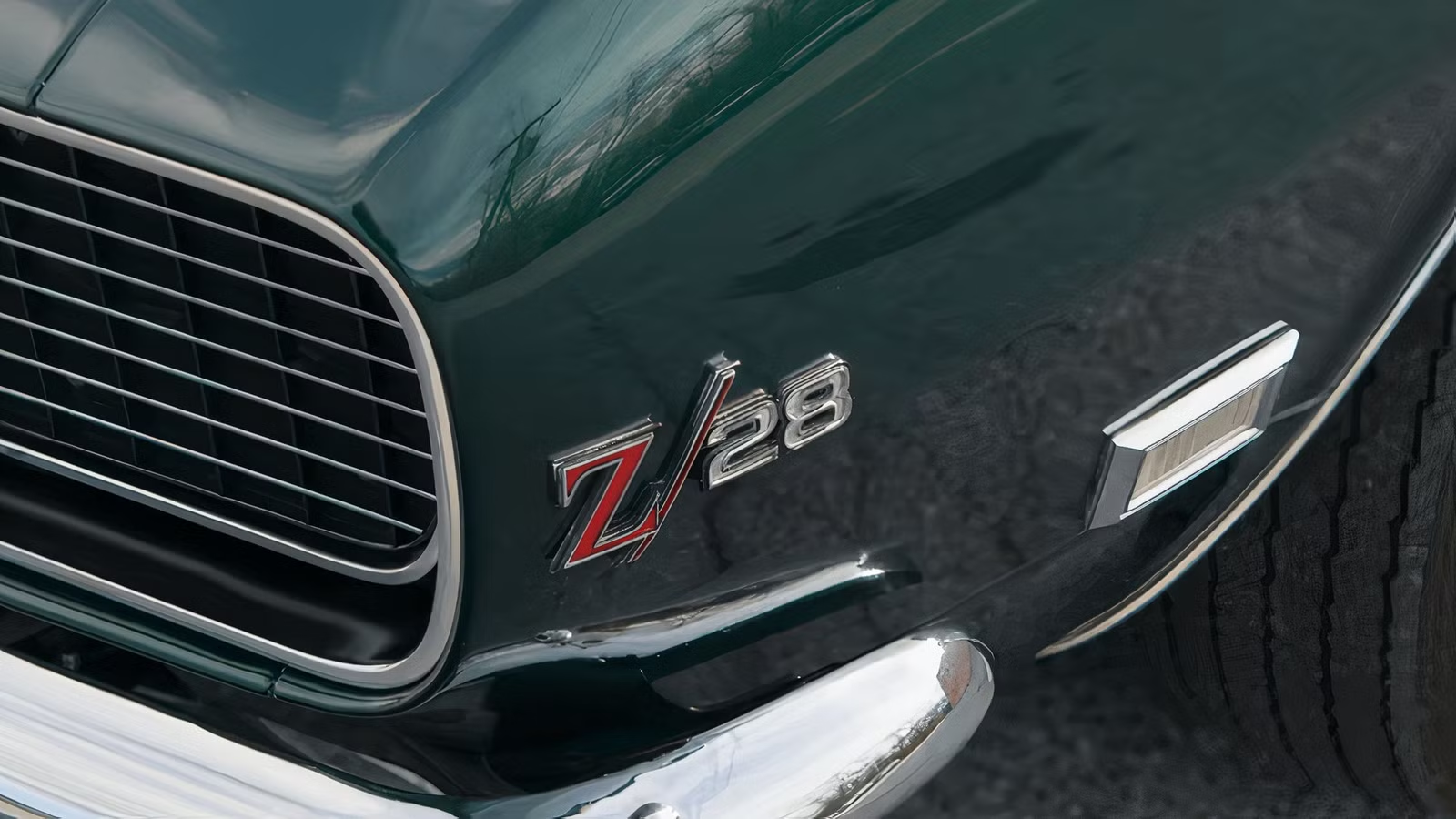
A homologation special for SCCA Trans-Am, the first-generation Camaro Z/28 is already a rare and desirable car. Featuring a 302 small block V8 designed to scream past 7,000 rpm, it pushed 290 hp through a close-ratio four-speed transmission and rode on a heavy-duty suspension. Period tests put its 1/4 mile times in the mid-14s. That’s because it came from the factory fully stripped of features that added unnecessary weight, such as radios, power steering, A/C, and even exterior badging. Buyers could also only ever get it with a hardtop, and Chevy had zero plans of ever making a convertible. That is, until CEO and later GM President Pete Estes decided he wanted one for himself.
Built in Chevy’s Norwood, Ohio plant through the brand’s Fleet Special Orders COPO system, Estes’ Camaro became the only first-gen Z/28 Camaro ever officially built with a factory convertible option. But it gets crazier. Because the buyer was not just anyone, Chevy completely ignored the Z/28’s options sheet and built Estes’ one-of-one Convertible with virtually every luxury and tech feature you could get on a Camaro back then. This included everything from power windows to auxiliary gauges and four-wheel disc brakes. It was also given a new suspension with Koni shocks and a fancy white vinyl cabin.
The car is reportedly now in the garage of Dana Mecum – the president of Mecum Auctions. The car had been in the possession of several GM employees spanning roughly 20 years since the late ’60s before Mecum discovered and purchased it. He then sold it in the early ’90s before reacquiring it a few decades later. A car this special, we doubt it will ever leave his sight again. Keep in mind, pristine first-gen Z/28s are worth well over six figures today (and prices are quickly rising), so we can only imagine how much this decked-out one-off Z/28 would cost if it crossed the auction block today.
2
1967 Shelby GT500 Super Snake

Carroll Shelby had already built several remarkably rare and fast cars before the 1967 Shelby GT500 Super Snake, including two mythical 800-hp Cobra Super Snakes, six Daytona Coupes, and two 1965 Shelby GT350R prototypes. However, none of them match the one-off GT500 Super Snake. Shelby didn’t build his ultimate Mustang to sell it. Instead, as Goodyear’s West Coast distributor, Shelby needed a car that could run at sustained triple-digit speeds to test the company’s new high-performance “Thunderbolt” tires at sustained high speeds.
Standard Shelby GT500s were plenty powerful with their 355-hp Cobra Le Mans 428 V8s, but they weren’t up to the task. So, Shelby American’s chief engineer Fred Goodell combined a ‘67 GT500 with Ford’s race-spec 427 FE side-oiler straight from the Le Mans-winning MkII GT40, along with a special exhaust, rear axle, and heavy-duty 4-speed manual transmission. The true power output of the GT500 Super Snake remains a mystery, with credible sources putting the figure at anywhere between 520 hp and over 600 hp. It also famously reached 170-mph speeds during testing, which would technically make it the fastest muscle car of its era.
Sadly, the OG GT500 Super Snake never became a production car. However, Shelby American had operated as an officially recognized car manufacturer with legal contracts to sell its production cars through Ford dealerships since the early ‘60s, so this prototype counts as a factory-built one-off muscle car. In fact, Shelby American planned on building and selling 50 of these GT500 Super Snakes, but the idea fell through because its proposed $8,000 price tag made it simply too expensive to sell. That sentiment remains true even today, after the one-of-one GT500 Super Snake fetched $2.2 million at a Mecum Auction in Kissimmee, making it one of the most expensive Ford Mustangs ever sold.
1
1970 Chrysler 300 Hurst Convertible

The Chrysler 300 has always done a great job of blending full-sized luxury with intimidating performance, but by 1970, the muscle car wars had forced the brand to think outside the box and go even flashier. Enter Hurst Performance. Legendary for its shifters and previous high-performance collaborations, Hurst Performance teamed up with Chrysler to create a special run of 485 limited-edition 300 models painted in an eye-catching Spinnaker White and Satin Tan combination with gold accents. The Chrysler 300 Hurst didn’t just look great – it also hid explosive power under the hood: a massive 440 TNT V8 that pushed 375 and 480 lb-ft to the rear axle through a TorqueFlite automatic.
A convertible was never planned, but one special promotional “Parade Float” ended up being factory-built for Hurst. Ostensibly, the idea behind the body style was to make it easier to show off Miss Hurst Golden Shifter Linda Vaughn, who went on to tour NASCAR and USAC events all around the country in it. But unlike stripped drag specials, this one retained full comfort features while still packing serious straight-line punch. We know because the exact Parade Float unexpectedly surfaced for sale on eBay in 2015, reportedly listed for $150,000 but failing to sell. The car now seems to be in private hands, owned and maintained by Tom Hergert of Rocket Restorations, who recently showcased it on his YouTube channel. It still has its 440 TNT V8 under the hood.
Sources: Hemmings, Mecum, Barrett-Jackson, Hagerty

Related posts




Latest Post


No Comments