
The Drag Racer Who Built A 576 MPH Record Car From Scrap And Tractor Paint
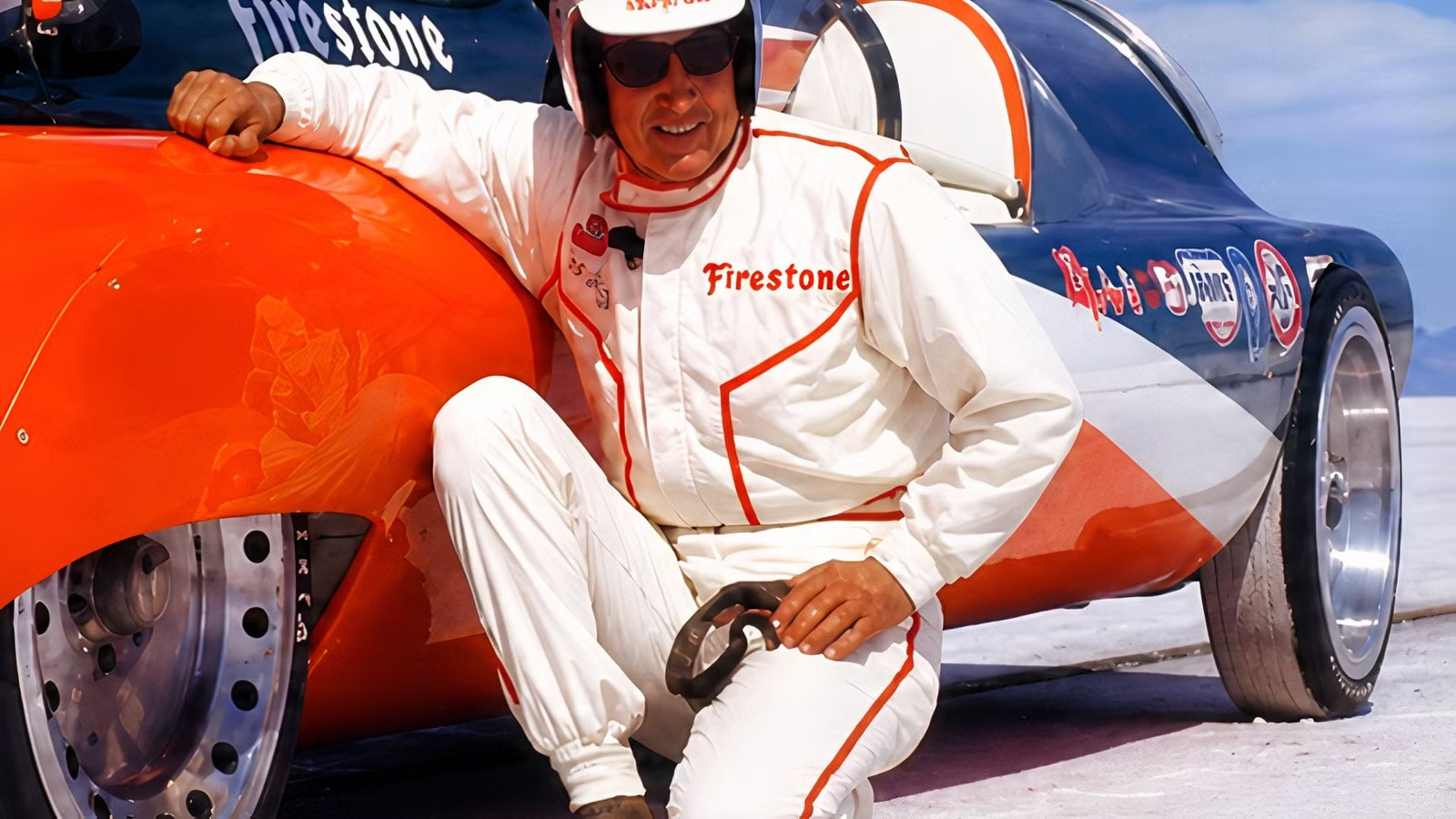
On the face of it, the re-telling of the world land speed record for an automobile is pretty linear and inoffensive. Perhaps no more than a few major names in its recent history have real staying power. Craig Breedlove & Spirit of America, Gary Gabelich and the Blue Flame, and maybe Andy Green and the Thrust SSC if you’re a little younger. It doesn’t feel like a complete retelling, because it certainly isn’t. Let’s correct the record one name at a time, starting with a man who started with little more than spare parts and a big-old turbojet engine to work with.
Born to Race, Just By His Birthplace

Our story begins like most famous Racing drivers, with a young boy growing up in an environment that practically begged folks to get behind the wheel. Akron, Ohio, is the de facto rubber capital of the world, thanks to its long-standing association with the automotive tire industry. As the home to Goodyear, BFGoodrich, and Firestone, as well as others, almost half of the world’s tires were made there at the city’s peak.
Over a quarter million people lived in Akron by the time the son of a Greek immigrant father and native Cherokee mother was born there on February 3rd, 1926. At the height of the roaring 20s and the good times before the Great Depression, the man born Arthur Eugene Arfons grew up in a world shaped by unimaginable hardships compounded by the biggest war the world has ever seen. But mixed in with the calamity and uncertainty, the spirit of backyard engineering was strong in the young Arfons’ heart.
The child of two working class individuals, Arfons didn’t have the means to attend a marquee engineering school to hone his craft as a young adult. Instead, he and his brother Walt spent their youth tinkering with whatever was at hand. In the exploding automotive landscape of the mid-to-late pre-war years, there was no shortage of automotive riffraff and scrap parts to get the hang of things. Born just in time to learn machining from the Navy during World War II, Arfons entered adulthood right as hot rodding and quarter-mile drag racing entered its full swing. By the end, he’d be a legend of the discipline.

This ‘Car’ Weighs 2,100 Lbs, Makes 900 HP, And Just Scared A Preschool
This thing looks like a rat rod, sounds like a top fuel dragster, and hits like a freight train.
Earning Drag Racing Chops, With Land Speed Record Ambitions
The path from Art Arfons’ family grain mill just outside Akron to the Navy, and then to drag racing fame, involved at least one major detour to marry his wife June, with whom he had two sons and a daughter. By 1952, the burgeoning drag racing scene in Akron and the surrounding area attracted the Arfons brothers like a moth to a flame.
In some ways, the scene wasn’t too dissimilar to the present, with Ford, GM, and Chrysler battling it out with engines of ever-increasing size and power. In May of 1951, an all-encompassing sanctioning body for American pro drag racing was formed, the National Hot Rod Association. Through sanctioned races outside of typical super stock homologation racers, Arfons put all his proverbial skill points into the radical, and the experimental.
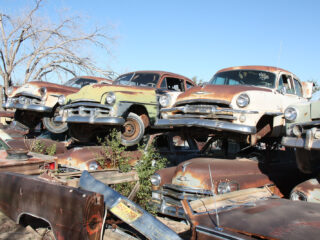
Effectively, there weren’t many rules regarding what could or couldn’t enter an NHRA Experimental race in those days. Arfons’ first foray into the discipline was literally fashioned from junkyard parts. With an Oldsmobile six-cylinder engine at its heart and bits and pieces from a junkyard Packard, the original forebearer of what became the Green Monster family was a complete three-wheeled Frankenstein’s job. The next-generation Green Monster II turned up the craziness with an aviation-sourced Allison V-1710 V12 engine. Thus, a lineage of dragsters derived directly from military aircraft hardware was born. From there, the legend of the Arfons brothers would only grow larger.
This Road-Legal Corvette Hit 254 MPH In 1988 And Then Vanished
This special Corvette shattered a 254 mph street‑legal record over three decades ago, now it’s practically forgotten.
Jet-Powered Green Monster: The Coolest Dragster/Land-Speed Racer of the 60s

For Art Arfons, it wasn’t a clean jump from an Allison V12 out of a Curtiss P-40 Warhawk to the engine out of a frontline jet fighter. The Arfons brothers tinkered and toyed with several configurations before making the leap. Among the highlights was a ludicrous six-wheeled monstrosity with quad Allison V12s, and a single-engine machine powered by a 28-cylinder Pratt & Whitney R-4360 from a Boeing B-50 strategic bomber.
Each subsequent Green Monster was essentially its own advertising campaign, with its massive broadside panels acting like an artist’s canvas for whatever bold design the Arfons racing team had in mind. Occasionally, even their own mother would get in on the fun, adding her own designs. Blistering fast drag runs that earned accolades like the first dragster to blitz a 150 mph quarter-mile pass did pretty great advertising work as well. By 1959, that speed jumped to 191 mph in the form of the legendary Green Monster No. 11. In truth, it was easy for so many generations of the same dragster to blend together. After a while, the human brain starts to sort of mix all the stats into one.
Well, the same General Electric J79 Turbojet from a Lockheed F-104 Starfighter or McDonnell Douglas F-4 Phantom did wonders to make the flagship Green Monster an icon. Dubbed simply “the Green Monster,” the ultimate evolution of the Arfons Brothers’ ingenuity simply stood on its own. Separate from all that came before it by virtue of its radical design, the jet Green Monster is by far the most memorable. So the story goes, a perfectly good J79 was undergoing checks after startup, just before a routine flight out of some unspecified Navy or Air Force installation. Then, out of nowhere, something flew head-first into the air intake. Some say it was a loose bolt, others say it was a flashlight. All we know for sure was it wound up in Arfons’ care for a measly $600.
The Forgotten German Hypercar A Sheikh Commissioned To Outrun The McLaren F1
A wealthy sheikh commissioned this incredible one-off hypercar to settle the speed debate once and for all.
Truly Amazing Speed

Remarkably, legend says the Air Force didn’t even realize a J79 was missing until Arfons was already at home rebuilding it. It’s said that a man, most likely from top brass at the air base, or even the Pentagon itself, knocked on his shop door and demanded it be returned. To which, in a display of audacity so profound it’s almost comical, Arfons shrugged, presented a bill of sale, and most accounts say he closed the door right in their faces.
From there, the rest of the build was remarkably straightforward. The body of the car was formed around the engine itself with a tube-steel chassis. Like a fighter jet, most of the rest of it was the cockpit, the wheels, and a whole bunch of fuel tanks. At full throttle and with the afterburner engaged, a J79 could jet 17,500 pounds (77.8 kN) of thrust. Because thrust converts to horsepower by multiplying thrust in pounds by the speed in mph and dividing by 375, an F-4 Phantom II flying at Mach 2 makes in the neighborhood of 63,000 horsepower. On a fateful run across the Bonneville Salt Flats in Utah, Art Arfons’ Green Monster was probably pushing closer to 26,000 hp, roughly 4,200 feet above sea level.
That’s still a remarkable amount of power for a wheeled vehicle, enough to push the Green Monster up to a speed of 576.553 mph on November 7, 1965. The run officially snatched the world land speed record back from Craig Breedlove and the Spirit of America, also J79-powered and the inspiration for the modern Ford Mustang GTD variant. In a tit-for-tat battle between the two at Bonneville, the pair would push speeds into the 600 mph zone, before Gary Gabelich’s Blue Flame rocket car took the long-term record with a 622.407-mph run in 1970. From there, the record wouldn’t be broken until the British Thrust2 project beat it again in 1983. Since then, the record’s been broken again all of once more. Depending on who you talk to, the record will probably never be broken again. For what it’s worth, Arfons took the Green Monster back to Bonneville in 1989, where it promptly went airborne at 350 mph. He tried a handful of times again in 1990 and 1991 before retiring from the sport entirely.
Source: San Diego Air & Space Museum

Related posts



Latest Post


No Comments