
The Nearly Indestructible Japanese Engine That Just Kept Going For Nearly 30 Years
Japanese brands are considered the experts when it comes to developing reliable and easy-maintenance engines, especially for pick-up trucks. For the past 60 years, the industry has maintained a leading reputation when it comes to developing engines that will stand the test of time. One giant brand in particular has always prioritized mechanical integrity in powertrain design, resulting in it achieving this dependable reputation across the global market.

As of 2026, American consumers demand reliability and low running costs above all other factors. Modern engines are proving to be efficient while offering good performance. However, they could learn a thing or two from the durable and simple engines of the past.
Toyota’s Historic Engine Development Process
Toyota prioritizes longevity and affordability through a conservative engineering strategy. The manufacturer designs engines that operate within structural stress limits, rather than chasing peak power outputs. This approach results in minimal thermal degradation and mechanical wear. The Japanese brand’s dedicated engine designers prioritize under-stressed displacement, durable block structures, and simple valve-train geometries. This is a contrast to the overly complex, unproven designs that European manufacturers typically chase.

Production relies on strict manufacturing tolerances via the Toyota Production System. This system enforces rigorous quality control and continuous incremental refinements to eliminate structural flaws before mass assembly. To control ownership costs, Toyota maintains high component standardization across modular powertrains. Shared architectural elements lower manufacturing expenses, stabilize replacement part pricing, and ensure wide component availability. Standardized service layouts simplify routine maintenance procedures like oil changes, spark plug replacements, and belt inspections. This approach means that mechanics require less labor time to diagnose and repair basic systems.
The 22R-E Is Toyota’s Strongest Four-Cylinder Engine

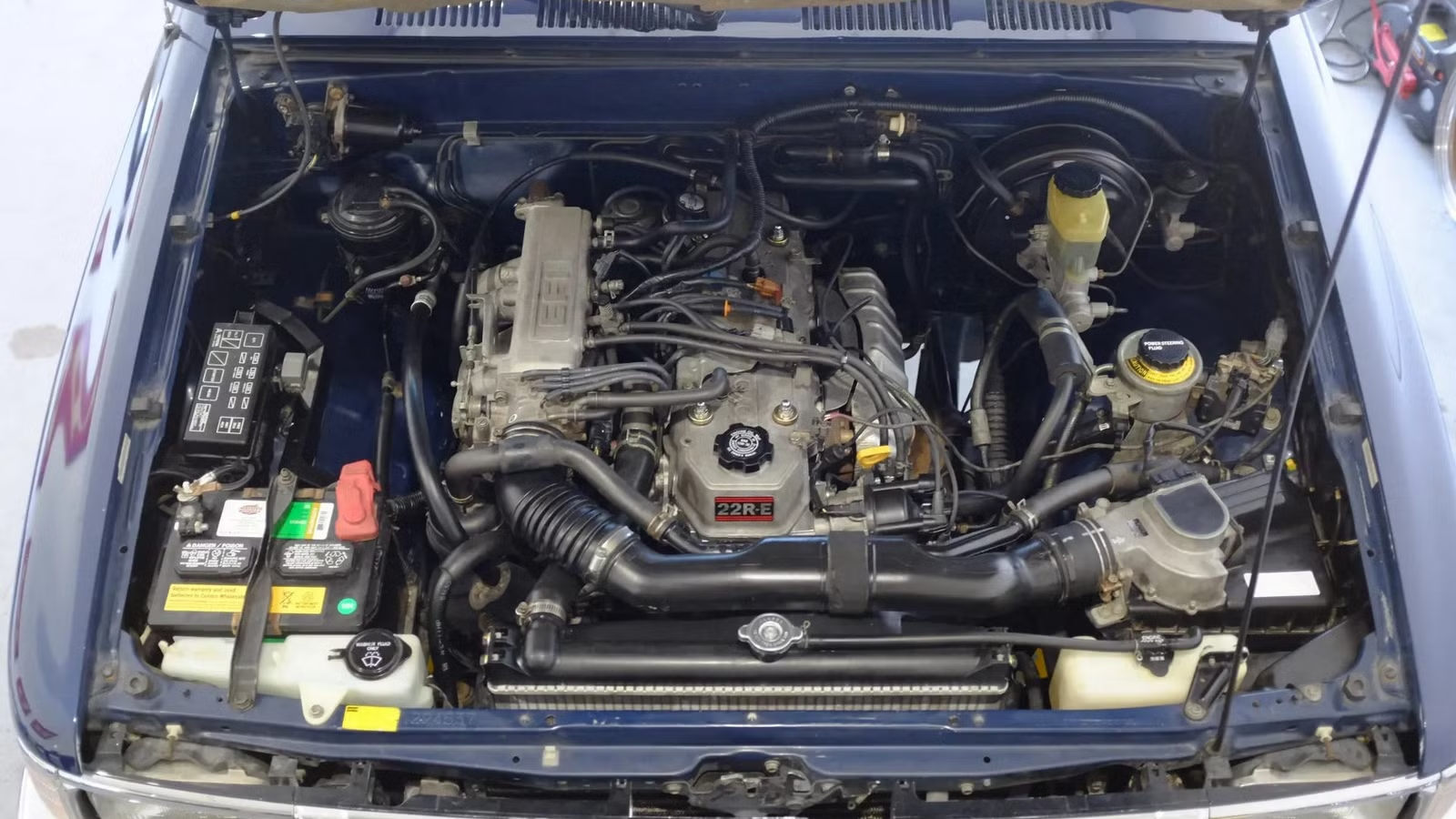
The Toyota 22R-E is a naturally aspirated 2.4-liter four-cylinder engine that has earned a reputation for being nearly indestructible on the durability front. The first version of this engine arrived in 1982 and lasted all the way up until 1995, acting as a staple powerplant for the Toyota Hilux, 4Runner, and Celica models. The E in its name signifies Electronic Fuel Injection, providing a significant leap in efficiency and cold-start reliability over its carbureted predecessor found in similar models.
The 22R-E is prized for its low-end torque, making it a favorite for off-roading and hauling, even on modern custom builds. Its mechanical simplicity allows it to reach 300,000 miles or more with basic maintenance. The most notable weak point is the plastic timing chain guides, which can wear and break over time. To fix this, many owners replace these with metal-backed versions to further strengthen the engine. Today, the 22R-E remains a cult classic, wholeheartedly representing an era when Toyota earned its reputation for building vehicles that simply refuse to quit.
Built To Stand The Test Of Time

The Toyota 22R-E was engineered with a truck-first philosophy, prioritizing thermal stability and structural rigidity over high-revving performance. At its core is a thick-walled cast-iron block with a deep-skirt design, providing a massive foundation that resists warping under heavy loads. Its 2.4-liter displacement is achieved through a 92 mm bore and an 89 mm stroke. This configuration proved to be great for emphasizing low-end grunt. The cylinder head is cast from aluminum alloy to aid heat dissipation, featuring a cross-flow design and a single overhead camshaft, thus simplifying the valvetrain.

Bolstering long-term reliability is a forged steel crankshaft held by five main bearings, ensuring the bottom end can withstand decades of stress. The transition to electronic fuel injection in the early 1980s replaced the finicky carburetors of the past, allowing for precise air-fuel ratios that reduce carbon buildup and improve longevity.
Toyota uses a timing chain to connect the engine’s lower and upper halves, which creates a durable mechanical link. Older Toyota designs use a thick, dual-row chain for extra strength. Newer models switch to a lighter single-row chain. Both designs reduce the risk of snapping compared to flexible rubber belts. Rubber timing belts require regular replacement, but steel timing chains generally last for the full life of the engine. This engineering choice removes a major routine service expense and prevents catastrophic engine failure. The decision to over-engineer the cooling passages and keep tolerances relatively loose allowed Toyota to create an engine that can survive extreme neglect and harsh environments.
The 22R-E Was Designed To Be Easily Maintained

The Toyota 22R-E is widely considered one of its easiest engines to work on, thanks to its straightforward and accommodating design, making it a masterclass in mechanical accessibility. Bear in mind that, like most engines, its longevity depends on regular maintenance tasks. This includes routine valve adjustments, timing chain inspection, and coolant and oil care. The most vital maintenance task is the valve adjustment, typically required every 30,000 miles, as the mechanical lifters can drift out of specification, causing the infamous Toyota tick. The aforementioned single-row timing chain found in models produced after 1983 relies on plastic guides, which experts consider to be its most noteworthy weakness. With time and use, these parts become brittle and shatter around 100,000 miles, potentially allowing the chain to eat through the aluminum timing cover and mix coolant with oil.
Common owner grievances often involve head gasket failure, frequently caused by overheating due to a clogged radiator or a failed fan clutch. In 1988, Toyota recalled certain models due to V-belt pulley failures, which could cause power steering or cooling loss. This could fail and lead to a loss of power steering or cabin cooling. Additionally, there were service campaigns addressing the fuel pulsation damper, which posed a fire risk if the diaphragm leaked.
Emissions Led to the 22R-E’s Retirement

The final models to feature the Toyota 22R-E in the North American market were the 1995 Toyota Pickup, right before it adopted the Tacoma moniker, as well as the 1995 4Runner. In international markets, Toyota kept the love for this engine going in the Hilux up until 1997. The primary reason for evolving this engine was to align with strengthening emissions regulations and consumer demand for more power. Toyota replaced the aging SOHC design with the RZ engine family, specifically the 2.7-liter 3RZ-FE. This new engine was a significant technological leap, featuring a dual overhead cam 16-valve head and twin balance shafts to reduce the inherent vibration of a large four-cylinder.
While the 22R-E remains beloved for its tractor-like simplicity, the 3RZ-FE addressed its predecessor’s weaknesses by offering roughly 150 hp, representing a nearly 40 percent increase, and a stronger timing chain system that eliminated the notorious plastic guide failures. The 3RZ-FE manages to retain the 22R-E’s legendary reputation, with many enthusiasts considering it the only worthy successor to the R-series throne. It bridges the gap between the analog 1980s and the modern era, eventually paving the way for the VVT-i-equipped 2TR-FE engines found in today’s Toyota models.
It’s An Engine That Will Live On As A Legend

The Toyota 22R-E powered a generation of iconic workhorses, most notably the Toyota Hilux truck in global markets and the first two generations of the 4Runner. It was also found in the rear-wheel-drive Celica and the Land Cruiser II J70 series in international markets as well. Beyond passenger vehicles, its torque-heavy nature made it the go-to choice for commercial applications like the Toyota Dyna and various 1980s-era micro-motorhomes. These vehicles have become the poster children for extreme longevity, with many original engines surpassing the 300,000 to 400,000-mile mark.

Famous high-mileage examples often surface in the community, such as George Nodarse’s 1985 One-Ton Pickup, which Hagerty reports to have logged over 370,000 miles in a custom cabinet business. There are even anecdotal accounts of these engines reaching 500,000 miles without a full rebuild, earning it the nickname The Million-Mile Engine among enthusiasts. While a million miles often requires at least one head gasket or timing chain refresh, the bottom end remains remarkably stout. These high-mileage survivors prove that as long as the cooling system and oil are maintained, the 22R-E’s basic architecture is designed to outlast the chassis it sits in.
Sources: Toyota, The NHTSA, Hagerty, RepairPal, and Engine Specs.

Related posts


Latest Post


No Comments