
The Japanese Middleweight Motorcycles Now Trading At 55% Of New-Bike Money
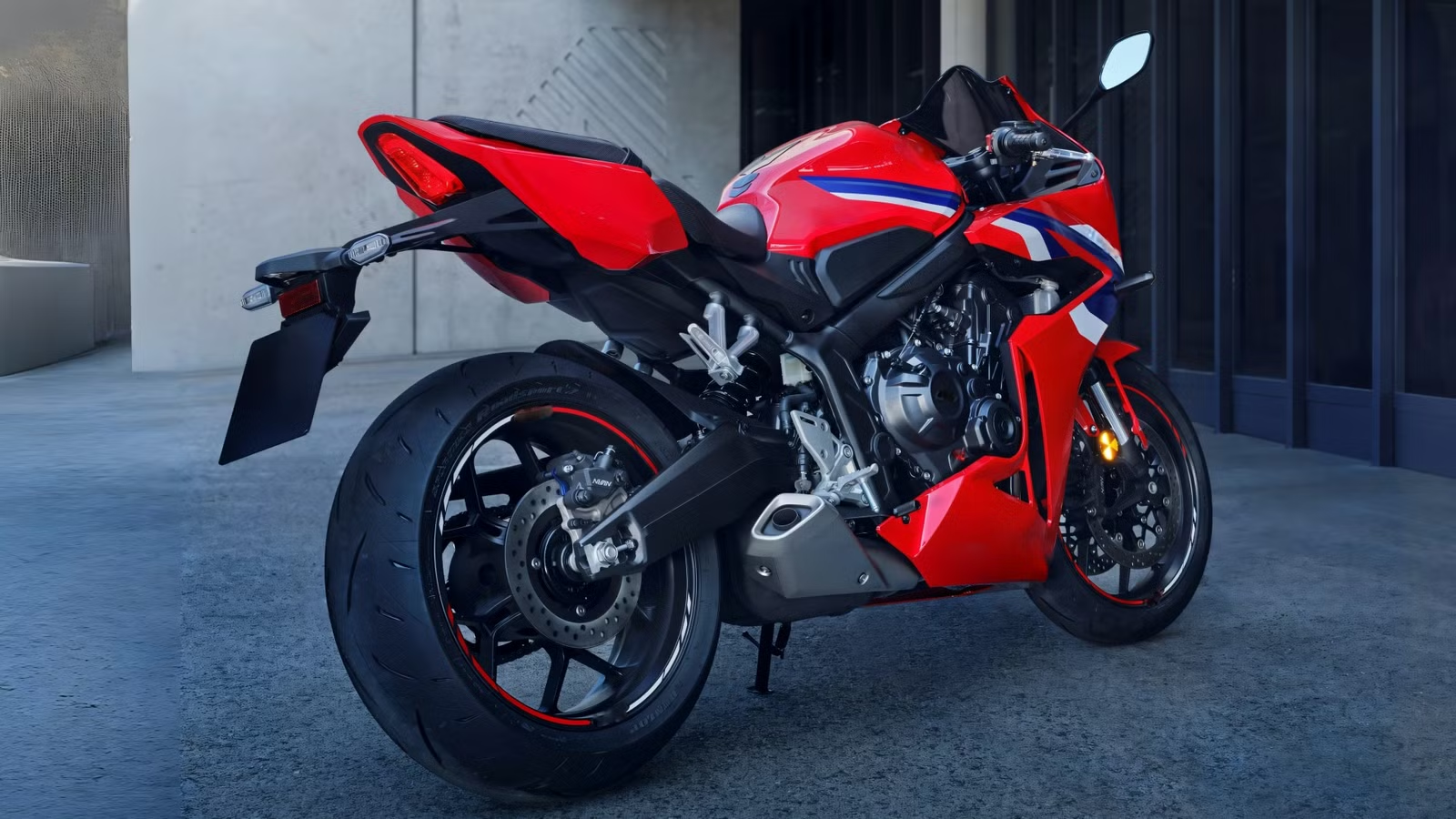
The used motorcycle market has pulled off a pretty dramatic reversal. During the pandemic, shortages pushed secondhand prices high enough that buying new could genuinely make more sense. In 2026, used prices have finally cooled while the cost of walking out of a dealership with a new bike hasn’t fallen nearly as quickly. That has created a particularly attractive window where depreciation has already done plenty of damage to a motorcycle’s value, but age hasn’t done much damage to the motorcycle itself.
The Used Motorcycle Market Has Finally Come Back Down To Earth

Used-bike prices are finally behaving like used-bike prices again. Market estimates suggest comparable motorcycles are selling for roughly 12-18% less than they were in 2024 as inventory improves and the pandemic-era buying frenzy fades. As such, five-year-old motorcycles can now settle around 55-65 percent of their original MSRP, depending on factors such as mileage, overall condition, and upgrades and modifications. Suddenly, letting someone else take the initial depreciation hit makes sense again.
Five Years Is Where Depreciation Starts Working For The Buyer

The sweet spot isn’t simply “older is cheaper.” A two-year-old motorcycle may still cost close enough to new that a warranty and financing incentives make the showroom option worthwhile. Go eight or ten years back and maintenance history, suspension wear, seals, hoses, tires, modifications, and crash repairs matter much more. Bikes from roughly 2020 through 2022 sit between those extremes. They’re old enough to have lost serious value, but young enough to still be thoroughly modern machines.
Cheap And Good Are Finally Overlapping Again

That’s especially important with mainstream Japanese motorcycles. Five years doesn’t suddenly make fuel injection, ABS, proven engines, widespread dealer support, and easy parts availability obsolete. New generations might bring nicer displays, smarter electronics, better suspension, or additional rider aids, but they rarely transform the basic ownership experience. In other words, depreciation has moved much faster than technological obsolescence.

New Bikes Never Followed Used Prices Back Down

New motorcycles aren’t universally outrageously expensive, but MSRP no longer tells the whole story. Destination, setup, documentation, registration, taxes, and financing can push the actual transaction price considerably higher. A 2026 Yamaha MT-07 starts at $8,599 before its $675 destination charge, while Kawasaki’s 2026 Z900 ABS costs $9,999 before another $840 in destination. Used prices, meanwhile, have been moving in the opposite direction.
That widening gap matters more than any arbitrary price ceiling. You don’t need every Japanese middleweight to cost north of $15,000 for a five-year-old example to look attractive. If the used bike costs several thousand dollars less while delivering most of the same mechanical experience, the new-bike premium becomes increasingly difficult to justify for buyers who don’t care about owning the latest version.
New Tariffs Aren’t Making Things Any Better For New Bikes

Tariffs add another pressure point. The current US-Japan framework established a 15 percent baseline tariff for many Japanese imports after an earlier 25 percent proposal created considerably more uncertainty. That doesn’t mean manufacturers simply tack 15 percent onto every motorcycle, and pricing proves it. Honda actually cut the 2026 CBR650R E-Clutch to $9,199, while Kawasaki’s Z650 S ABS remains $7,699. Tariffs aren’t the whole problem, but they aren’t helping imported-bike costs come down either.
The Real Sweet Spot Is The Motorcycle That Has Already Taken Its Biggest Hit

This brings us to the real opportunity: roughly five-year-old Japanese motorcycles in the 650cc-to-1000cc range. Used examples commonly fall somewhere around $5,500-$8,500 depending on model, mileage, condition, and location. That’s enough depreciation to save thousands without dropping into genuinely old-bike territory, while proven engines, reasonable running costs, abundant parts, and enormous aftermarket support keep ownership relatively straightforward.
There’s another reason this category works so well. Middleweights have evolved, but the basic formulas haven’t changed radically. A newer version might have an IMU, quickshifter, TFT display, or better suspension, yet the older motorcycle hasn’t suddenly become slow, unreliable, or difficult to live with. In many cases, you’re essentially buying the same core experience after someone else has already paid for the steepest part of its depreciation curve.

The obvious hunting ground is the 2020-2022 era, and four motorcycles make especially convincing cases. They cover everything from approachable twins to serious four-cylinder performance, but they share one important characteristic: their current replacements are evolutionary enough that a well-kept older version still makes an enormous amount of sense.
MT-07 And Z650 For Value, Z900 And CBR650R For Maximum Motorcycle Per Dollar

The Yamaha MT-07 is the easy recommendation. Today’s $8,599 version uses the familiar 689cc CP2 parallel twin with roughly 72 horsepower and 50 pound-feet of torque, weighs 403 pounds wet, and adds ride-by-wire, traction control, ride modes, an inverted KYB fork, radial brakes, and a TFT display. Older examples miss some of those toys, but they retain the charismatic engine, simple mechanical package, and huge aftermarket that made the MT-07 popular in the first place.

The Kawasaki Z650 can be an even cheaper way into the same general experience. The current $7,699 Z650 S ABS uses a 649cc parallel twin with 67 horsepower and 47.2 pound-feet of torque, weighs 416.7 pounds, and includes traction control, ABS, a TFT display, smartphone connectivity, and an assist-and-slipper clutch. It doesn’t attract quite the same cult following as the Yamaha, which can make clean older examples especially appealing to value-focused buyers.

Then there’s the Kawasaki Z900, arguably the standout of the group. The $9,999 2026 model’s 948cc inline-four makes 123 horsepower and 73.1 pound-feet of torque and now comes with cruise control, an IMU, selectable power modes, a quickshifter, a 5-inch TFT, and adjustable suspension. An older Z900 won’t have all the latest electronics, but depreciation can put serious four-cylinder performance into the same financial territory as considerably smaller new motorcycles.

The Honda CBR650R adds fairings and another inline-four to the mix. The 2026 E-Clutch model costs $9,199, makes about 94 horsepower and 46 pound-feet from 649cc, weighs 466 pounds, and uses a Showa SFF-BP fork, radial four-piston front brakes, ABS, and Honda’s E-Clutch system. Older versions don’t get the clever clutch tech, but they still deliver the smooth engine, practical ergonomics, and everyday usability that make the CBR650R such an unusual middleweight sport bike.
The Best Used-Bike Deal Isn’t Necessarily The Cheapest One

The smart purchase still isn’t the cheapest listing you can find. Service records, sensible mileage, healthy tires and brakes, stock or tasteful modifications, and a clean crash history are worth paying for. The price also needs to sit far enough below a new motorcycle’s actual transaction cost to compensate for losing the factory warranty. Otherwise, saving money simply becomes taking on somebody else’s problems.
That’s why this particular window is so compelling. These motorcycles have already lost a meaningful chunk of their financial value without losing much of their mechanical usefulness. Rather than chasing the bike with the biggest depreciation number, buyers should look for the point where depreciation and remaining useful life overlap. Right now, five-year-old Japanese middleweights are sitting remarkably close to it.
Sources: Various Manufacturers

Related posts


Latest Post


No Comments