
The Only Japanese Production Car To Get A V12 Engine
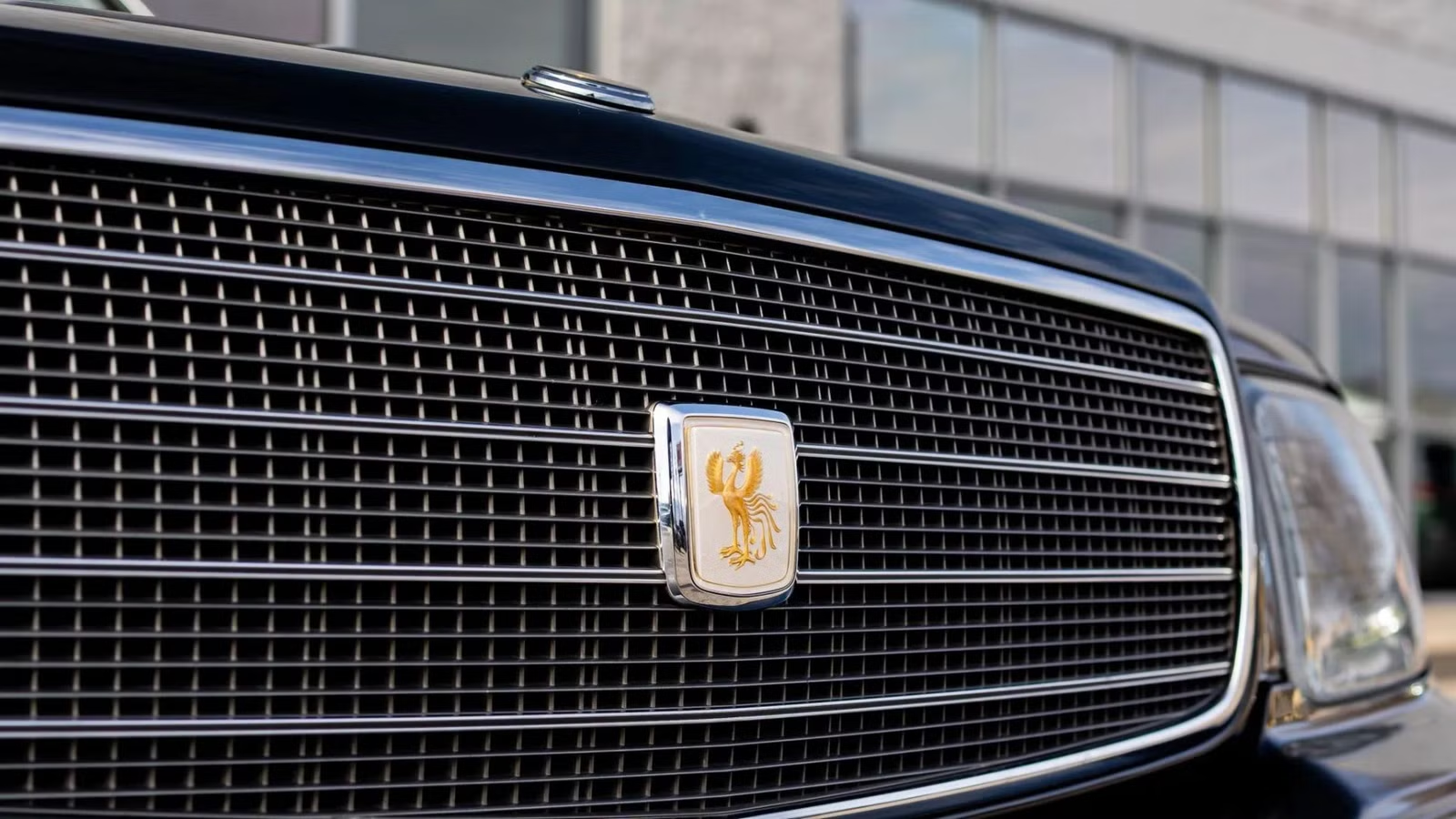
From Italian supercars to German luxury sedans, the V12 engine has long been associated with some of the world’s most prestigious cars. Japan has given us some legendary inline-six engines, such as Toyota’s 2JZ-GTE in the Supra, or Nissan’s RB26DETT in the Skyline GT-R, as well as some iconic inline-fours coming from Honda, but the V12 isn’t an engine that you would link to Japanese manufacturers. There is, however, one exception. One Japanese automaker decided that its flagship luxury sedan deserved a rarer, more uncommon engine. Contrary to the ostentatious Italian V12s, this Japanese luxury sedan discreetly hid the country’s only V12 engine ever fitted in a Japanese production car.
Why Japanese Manufacturers Never Embraced The V12 Engine

With twelve cylinders arranged in two banks, the V12 is the ultimate engine configuration you can put into a production car. Its complexity, size, and high production costs mean it is often synonymous with some of the most prestigious carmakers in the industry, such as Ferrari, Lamborghini, Rolls-Royce, and Mercedes-Benz.
There are two primary advantages to having a V12 engine. On one hand, the V12 offers exceptional smoothness and balance, making it perfectly suited for luxury sedans, while on the other hand, it also provides enormous power, making it equally suited for high performance cars.
Japan, however, never really embraced the V12 formula for its production cars. Iconic inline-six engines such as Toyota’s 2JZ-GTE and Nissan’s RB26DETT were less complex and less expensive to manufacture, fulfilling other criteria such as efficiency and reliability. With extra help coming from turbochargers, these engines could extract impressive performance capable of rivaling the power output of larger engines. Japanese laws at the time weren’t very V12-friendly either: the domestic tax system was based on engine displacement, and the “Gentlemen’s Agreement” limited Japanese cars to 276 hp from the late 1980s until 2004. Such laws and agreements reduced the incentive to develop high-cylinder-count engines for the domestic market, yet in this unwelcoming environment that favored smaller engines, one production car went against the grain.

The Toyota Century: Japan’s Answer To The World’s Finest Luxury Cars

Toyota introduced the Century in 1967 to commemorate the 100th birthday of Toyota founder Sakichi Toyoda, with the very specific ambition to create the ultimate Japanese luxury sedan. Rather than simply imitating established European luxury models, the Century was a reflection of Japan’s heritage and craftsmanship. The Century was a flagship vehicle that carried important cultural symbolism, such as a phoenix emblem borrowed from Japanese mythology, selected materials made by skilled Japanese craftsmen and colors reminiscent of Japanese culture and landscapes. As it represented the finest of what Japan had to offer, the Century became the preferred form of transportation for Japanese corporate executives, political figures, and members of the Imperial family, establishing it as Japan’s ultimate luxury sedan. While the first-generation G20 Century received a 3.0-liter V8 (followed by 3.4-liter and 4.0-liter versions), things drastically changed for the second-generation G50 Century, as it became the only V12 engine ever fitted to a Japanese production car.
Toyota Built A V12 For A Luxury Sedan: The 1GZ-FE

Toyota launched the G50 Century in 1997, with an engine unlike anything it had previously offered in a production car. The Century’s 1GZ-FE is a 4,996 cc (5.0-liter), naturally aspirated V12 with DOHC, 48 valves and a 60-degree bank angle. The use of aluminum for the engine helps reduce weight, while the 60-degree V12 block helps lower vibrations. With an 81 mm bore and 80.8 mm stroke, the engine has almost perfectly square dimensions, contributing to the smooth and balanced performance expected of the Century. Producing 276 hp at 5,200 rpm and a maximum torque of 340 lb-ft at just 4,000 rpm, Toyota made the Century engine deliberately low-revving. Most of the 1GZ-FE’s usable power is available from relatively low engine speeds to provide effortless acceleration for cruising.
Compared to the 4.0-liter V8 it replaced, the V12 is both more powerful and considerably smoother thanks to the balance that the twelve-cylinder configuration provides. The 1GZ-FE also features Toyota’s VVT-i (variable valve timing system) to further reduce vibration at idle and improve fuel efficiency. Another noteworthy feature is the 1GZ-FE’s reliability, built into the engine’s design. The Toyota V12’s two cylinder banks pretty much operate as independent systems, as each bank is supplied by its own fuel pump. This means the engine can continue running as a six-cylinder even if a problem disables one bank.
Unlike the performance-oriented engines produced by the likes of Ferrari and Lamborghini, Toyota’s V12 was engineered to deliver effortless, imperceptible power to suit the Century’s role as Japan’s ultimate luxury sedan.
The Century V12 Almost Didn’t Happen

While the V12 appears to be a perfectly fitting engine to power the G50, the Century’s 1GZ-FE almost didn’t happen. According to a later account of a 2003 interview given by veteran Toyota engineer Yoshiro Kanehara, the V12 prototype for the second-generation Century was developed without the approval of Shoichiro Toyoda, Toyota’s president at the time. When learning about the project, Toyoda was reportedly furious at the prospect of spending significant money to develop such a complex engine for a low-production luxury sedan. Toyoda was said to have initially rejected the idea of a V12, and a version of the existing Lexus V8 engine was considered for the Century instead. Presented with a follow-up proposal, Toyoda eventually allowed the V12 project to move forward.
The 1GZ-FE was never marketed as a rival to European supercars, and even today, you would almost forget that the second-generation Century was given a V12 engine. The understated engine complemented the conservative and elegant exterior design, as well as the luxurious interior. The cabin was designed to insulate passengers from the outside world, offering a quiet, spacious environment. Seats were made with wool upholstery and were power adjustable, while lace curtains on windows offered passenger privacy. The imperceptible V12 engine was the Century’s ultimate feature for the most luxurious cabin experience.
The End Of Toyota’s V12 Era

After a 20-year-long production run from 1997 to 2017, Toyota did eventually put an end to the second-generation Century along with its 1GZ-FE V12 engine. Wider industry changes, such as stricter emissions regulations and a shift toward hybrid and electric powertrains, made it increasingly difficult for Toyota to justify keeping the naturally aspirated V12. For the third and current generation Century, Toyota replaced the V12 with a 5.0-liter V8 paired with a hybrid system, which helps provide the smooth and effortless power expected of a Century while lowering emissions and offering better efficiency. While discontinuing the 1GZ-FE meant closing a unique chapter in the company’s engineering history, Toyota was essentially able to deliver V12 qualities while moving on to modern powertrain technologies by replacing the V12 with a hybrid V8. The hybrid system in the current Century allows for instant torque from the electric motor, which keeps the Century’s low-speed response and seamless acceleration characteristics.
Over the decades, Toyota has given us some memorable engines, but the 1GZ-FE is perhaps its most unique and unusual one. Made for the Japanese domestic market, Toyota’s V12 never truly competed against European V12 engines, and that was never the point anyway. Through the Century, Toyota was able to demonstrate its pursuit of engineering excellence and showcase the very best of Japan’s carmaking industry.

Related posts





Latest Post




No Comments