
Shelby’s Secret Twin-Turbo Pantera That Previewed the Viper
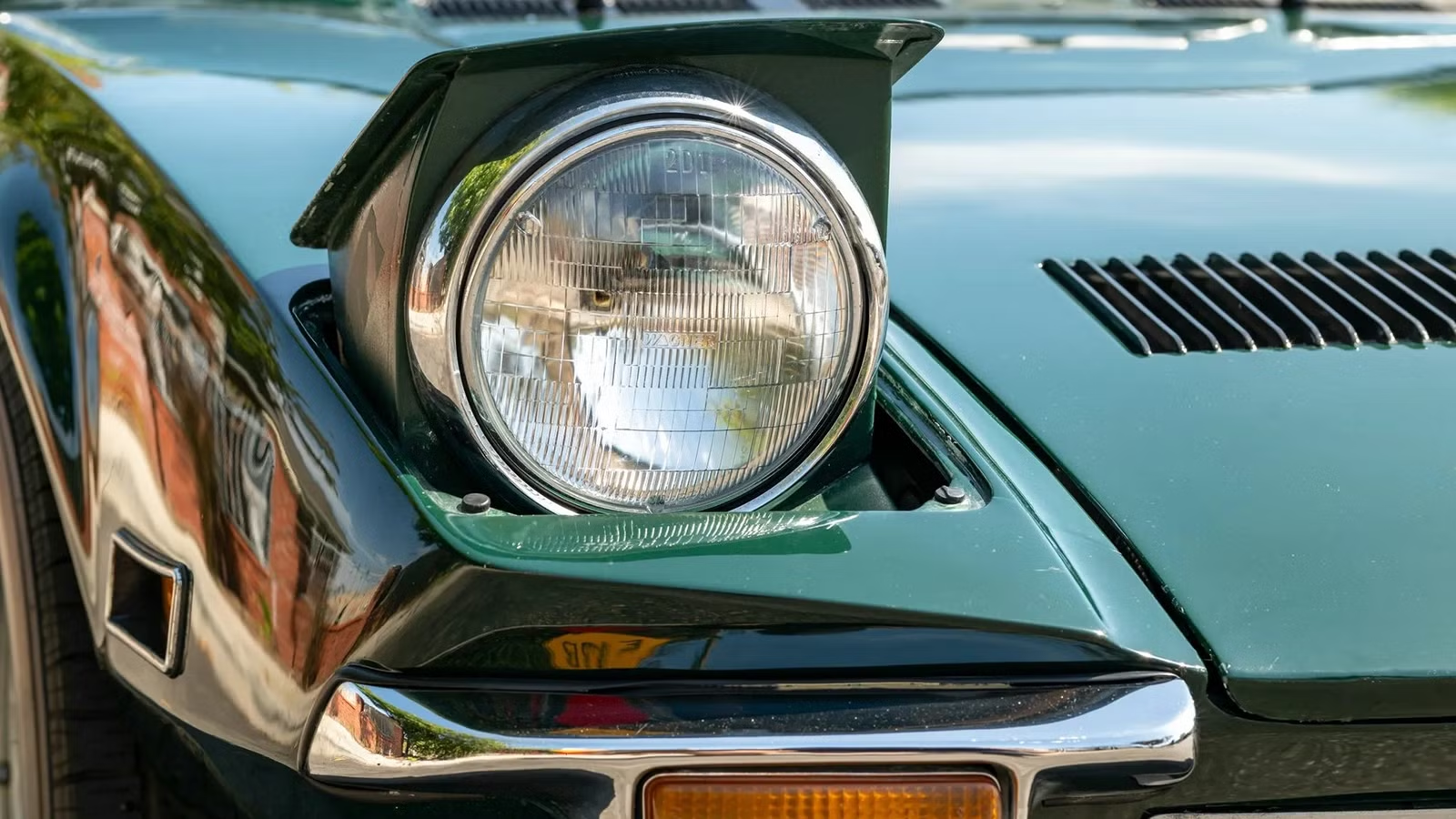
Carroll Shelby is one of America’s most iconic car builders, and the car that comes to mind first is the AC Cobra, which dominated the European circuits and Mustangs and Corvetteson the drag strip. But during the late 1980s, Shelby was designing a car, a wild machine, not for Ford; it didn’t even have a Cobra badge. It was meant to be a rolling laboratory: a wide-body supercar powered by a twin-turbo Chrysler V8, which eventually paved the way for what would become the legendary Dodge Viper.
Detroit’s Darkest Era of Power

In the mid-1980s, the American automotive landscape looked dire as strict federal emissions standards took hold, including catalytic converters and corporate fuel economy mandates that choked cars down. As a result, the Big Three churned out underpowered cars that were meant to be performance-oriented.
The V8s at the time were reduced to shells of their former selves; they felt sluggish, and manufacturers replaced high-compression engines with low-compression ones, adding restrictive intake manifolds and choked exhaust systems. As a result, Detroit’s performance was viewed as incapable of competing on a world stage. American enthusiasts had given up on the idea of a domestic supercar that could hold its own and challenge European competition.
Building a Supercar in the Shadows


Chrysler chairman Lee Iacocca assessed the automotive landscape and knew they needed a top-of-the-line halo car to break the conservative image. The goal was to build an uncompromising, ambitious, awe-inspiring world-class American exotic that could compete with any global supercar.
Translating a radical supercar concept from the page into the real world required extensive testing. Chrysler wanted to keep the operation completely secret, without alerting the press or domestic rivals. They needed a secret rolling laboratory that could be hidden in plain sight, rather than doing years of research and spending millions of dollars.
Iacocca turned to longtime friend and performance legend Carroll Shelby. He had already developed a hatchback and sedan through programs such as the Omni GLH and the Shelby Charger. Shelby needed a mid-engine platform that could handle immense torque and thermal loads while providing aerodynamic performance. Rather than build a fragile prototype from scratch or create an expensive tubular space frame, Shelby acquired an existing European mid-engine exotic and converted it into a twin-turbo V8 covert testbed.
The De Tomaso Pantera A 600 HP Twin-Turbo V8 Laboratory

Shelby chose the Italian-American De Tomaso Pantera GT-S as his testbed; it featured integrated steel fender flares, lightweight aluminum body panels, and a massive delta wing. The Ford 351 Cleveland engine originally powered it; Shelby pulled it from the chassis and turned the car into the testbed for Chrysler’s upcoming supercar program.
Shelby partnered with Gale Banks, who was a pioneer in forced-induction platforms. To support the supercar vision, they went all out, installing a NASCAR-derived Chrysler 360 V8 block mated to a heavy-duty ZF five-speed manual.

Gale Banks engineered a custom twin-turbo, liquid-intercooled induction system for the V8, which also featured custom headers and aggressive wastegate management. On the dyno, the V8 produced a verified 611 horsepower and over 600 lb-ft of torque, outperforming its European rivals, the Countach and the Testarossa.
This testbed proved that forced induction could reliably deliver world-class performance without failure. However, for the upcoming Viper program, Chrysler wanted a unique identity separate from the V8, which was traditionally associated with muscle cars. Iacocca and Chrysler ultimately opted for a front-mid layout powered by a V10.
The Legacy of the Shelby Experiment

After Carroll Shelby’s passing, his personal car collection was liquidated at the 2018 Bonhams Greenwich auction, where the Pantera sold as an engineless rolling chassis for 168,996 pounds. The twin-turbo V8 was missing, assumed to have been lost to history. Then came Beau Boeckmann, president of Galpin Motors, who bought the empty chassis at auction and tracked down the original long-lost twin-turbo Chrysler V8 sitting abandoned in a dusty California tow yard. He took the engine back to his shop and enlisted Gale Banks himself to rebuild the historic engine to its original glory and fully restore the car to an active, running state.
Driving Impressions Of The Brutal Hot-Rod Supercar
Once reunited with its heart by Beau Boeckmann’s team, the driving impressions published by Autopian revealed the true nature of Shelby’s creation. Unlike modern supercars with power steering, traction control, ABS, dual-clutch systems, and other electronic aids, the twin-turbo Pantera is a proper exercise in old-school performance. No power steering means you have to work the car through the corners; paired with the old-school gated manual and heavy clutch, it demands precision.
The twin-turbo engine, unlike modern turbo engines, comes alive in an aggressive manner that demands taming, all while producing a distinct, raw mechanical wail the moment the throttle is pinned to the floor. Despite its intimidating, hot-rodded personality and raw mechanical feedback, the chassis remains balanced and compliant through the sweeps, behaving like a true performance car rather than the smog-choked machine that domestic performance cars of that era had become.
Autopian co-founder David Tracy also gave his real-world test-drive impressions: “I was hopping from a fast, modern race car to what was almost certainly going to be a smog-era slowpoke. Going into driving Carroll Shelby’s old De Tomaso Pantera with this mentality set my mind up to be completely and totally blown.” He also shared his views on the acceleration of the Pantera: “I moved my right foot off the brakes and onto the gas, lifted off the clutch, and experienced one of the greatest automotive nirvanas I’ve ever felt. VROOOOOM!!! The engine behind me pushed my back with prodigious force, propelling me to what felt like warp speed.”
The Wild Predecessor to the Viper Legacy

The twin-turbo Pantera shattered the conventional narrative of Shelby’s career. It proved that even in his later years, Shelby remained a technical genius, capable of blending exotic Italian design with American forced induction power that pushed the performance boundaries, even if it was for a test vehicle, more than any manufacturer. Had Galpin Motors not rescued the engineless rolling chassis and hunted down the abandoned Gale Banks V8 in a dusty tow yard, this 611 hp anomaly would have remained a footnote.
While Chrysler ultimately chose a front-mid V10 layout for the production Viper, this mid-engine hybrid validated the extreme power thresholds and thermal demands the project required. By serving as the secret, high-speed proving ground for Lee Iacocca and the early Viper concept, the GT5-S represents one of the most significant chapters in modern automotive history — one that was almost hidden away.
Source: Autopian, Bonhams, Bring a Trailer.

Related posts

Latest Post



No Comments