
The One-Year Corvette Big-Block That Killed The $538 Fuelie 327
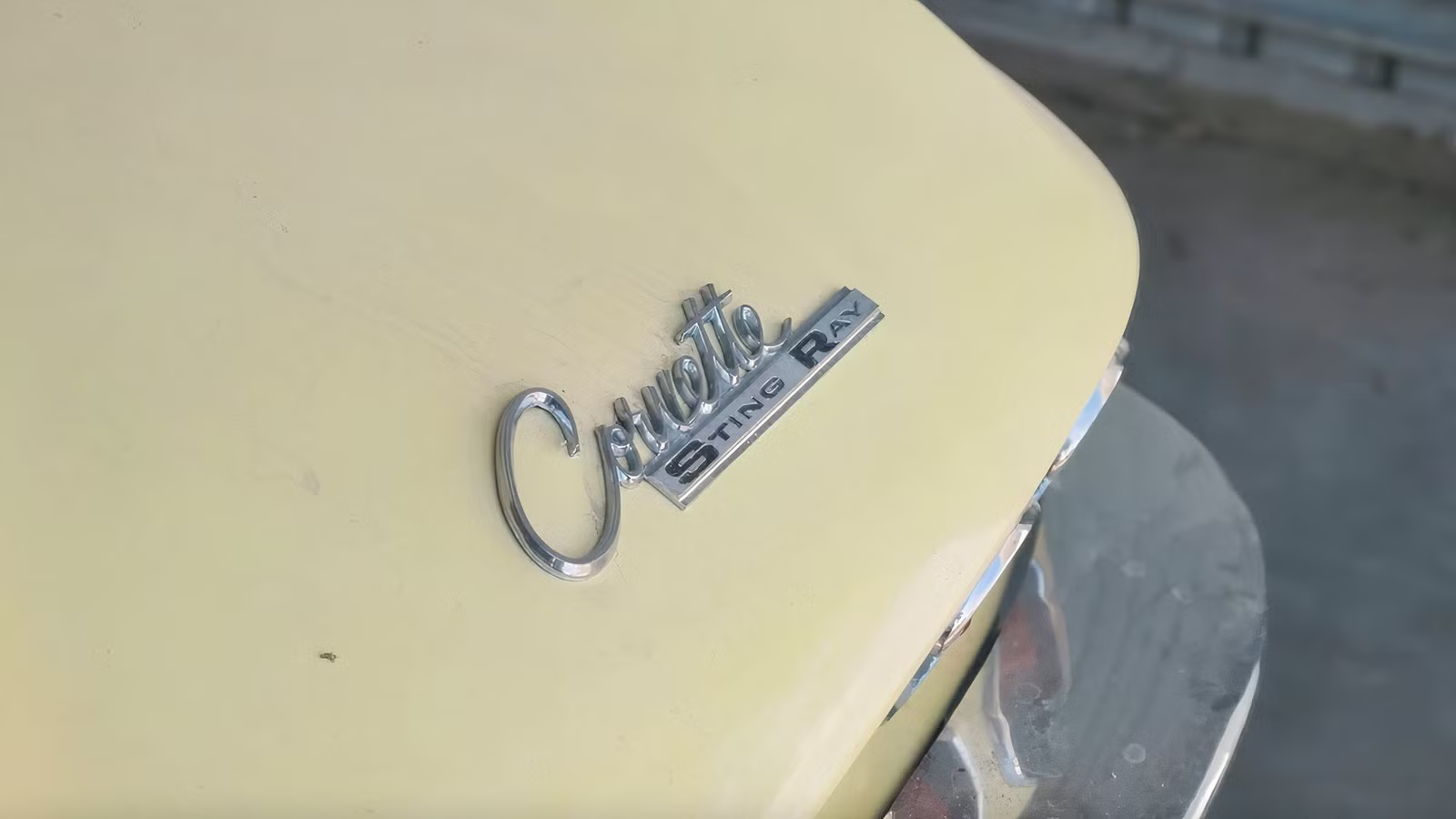
Even the biggest Chevrolet Corvette fans gloss over a forgotten big-block engine that killed the Fuelie 327, despite it being available for only a single year. It was available for a very long time, but it made a lasting impact by changing Corvette’s entire philosophy. Plus, it only cost $292.70 to add, compared to the $538.00 Fuelie. The big-block led to more power and lower production costs to help Chevy grow against competitors. But it gets passed over as enthusiasts throw stupid money at the Fuelie 327 instead.
The Fuelie 327 Is An Important Step In The Corvette’s Story

Hey, put your pitchforks down. I know my intro was a little hot, but I’m not here to disrespect the Fuelie 327; instead, I’m here to shed light on a forgotten piece of important Corvette history. The 327 is certainly an important piece of automotive heritage to honor. This 327 cubic-inch (5.4-liter) small-block V8 engine delivers between 360 and 375 hp depending on the year and 350 lb-ft of torque.
It helps the Corvette accelerate from 0 to 60 mph in about 5.5 seconds and complete a quarter-mile in around 14.2 seconds at 100 mph, with a top speed of 135 mph. It replaced traditional carburetors with Rochester mechanical fuel injection. Plus, it has solid-lifter camshafts and high-flow cylinder heads to reliably reach high RPM.

Adding the Rochester Ramjet 327 was a high-performance option that originally cost $538. This was a massive expense as it made up about 25% of the cost for an entry-level Corvette convertible. But it was worth buying as it helped the Corvette outrace options with big-block V8 engines.

The Fuelie 327 stands out to collectors due to its modern fuel injection upgrades and because it put the C1 Corvette on the map. Then it gained even more power to propel the C2 Corvette to victory. It was also the first production Corvette Stingray model. Also, this engine was produced in small numbers, making it an exceptionally rare find.
But The L78 396 Killed The Fuelie

The Fuelie 327 had a good run from 1962 until 1965. It met its end when the L78 396 dropped in the middle of 1965. This 396 (6.5-liter) big-block V8 produces 425 hp and 415 lb-ft of torque. It allows the Corvette to accelerate from 0 to 60 mph in roughly 5.6 seconds and finish a quarter-mile in around 13.9 seconds at 104 mph, with a top speed of 140 mph.
Adding the L78 cost about $292.70, making it more affordable than the Fuelie 327. But going for this engine came with required add-ons like the heavy-duty Muncie four-speed manual transmission, K66 Transistor ignition, high-capacity Positraction rear axle with aggressive ratios of 3.31:1 to 4.56:1, and suspension upgrades.

Along with being more affordable than the Fuelie 327, the 396 also produces more low-end power. Plus, it has more street-friendly power with a refined hydraulic cam instead of the sensitive solid-lifter setup. Also, the Fuelie has intricate mechanical linkages and finicky cold starts, leading to more expensive service costs.
Chevrolet found that it was more affordable to shift its focus to more affordable carbureted power than to refine the Fuelie’s low-volume fuel injection system. Basically, the Fuelie was phased out because it was expensive and convoluted compared to big-block V8 engines, and its sales were declining.
The L78 396 Set The 427 L72 Up For Success

The L78 396 is a direct descendant of the legendary Daytona 427 cubic-inch Mystery Motor that Chevrolet secretly built for NASCAR in 1963. The 396 gained its canted-valve, or porcupine, cylinder head to set it apart from older W-series and wedge engines. It also got a solid-lifter camshaft to create a street-friendly version of the high-powered racing engine by scaling down the bore and stroke.
The L78 396 revved so the 427 L72 could race and was quickly replaced by it. This engine helped the 427 L72 become a reality by establishing the Mark IV big-block architecture and proving its success. In 1966, General Motors lifted its engine displacement cap of 400 cubic inches for the Corvette. So, Chevrolet stoked the verified L78 design to 427 ci.

Both big-block V8 engines have robust four-bolt main blocks and a high-flow cylinder design with a high-output forged-steel mechanical lifter camshaft, 11.0:1 compression ratio, and a high-rise aluminum intake manifold paired with a vacuum-secondary or double-pumper Holley four-barrel carburetor setup.
The 427 cubic-inch (7.0-liter) big-block V8 churns out 425 hp and 460 lb-ft of torque. It helps the Corvette fly from 0 to 60 mph in about 4.7 seconds with a 12.8-second quarter-mile time at 111 mph and a top speed of 152 mph. This engine could be added to the Corvette for $312.85, so it was also more affordable than the Fuelie 327.
Now The L78 396 Is Undervalued

Even though the L78 396 exists in limited numbers, it’s not as popular as other historic engines. About 2,157 units were built, and roughly 748 of those may have been placed in coupes. If found in a Corvette that’s in average condition, it’s worth about $115,000. Corvette L78 396 models in excellent condition are worth around $127,000. Then models in pristine condition can fetch over $177,000.
Corvette models equipped with the Fuelie 327 engine from 1962 and 1963 with 360 HP often cross the auction block for between $110,000 and $140,000. But the models with the split-window design are worth significantly more. Corvette models with the 327 from 1994 and 1965 with 375 hp are worth around $125,000 in average condition. But show-quality models are often sold for over $750,000.
The Chevy Corvette models with the L72 472 engine found in average condition are worth about $85,000 to $110,000. If discovered in good condition, they can sell for about $135,000 to $157,000. Examples in concur or pristine condition fetch over $165,000, with the highest record sale of $250,000.
Source: Hagerty, Fastest Laps, Classic

Related posts




Latest Post


No Comments