
The One-Off Ferrari Owned By Aston Martin’s Boss That Just Flopped At Auction
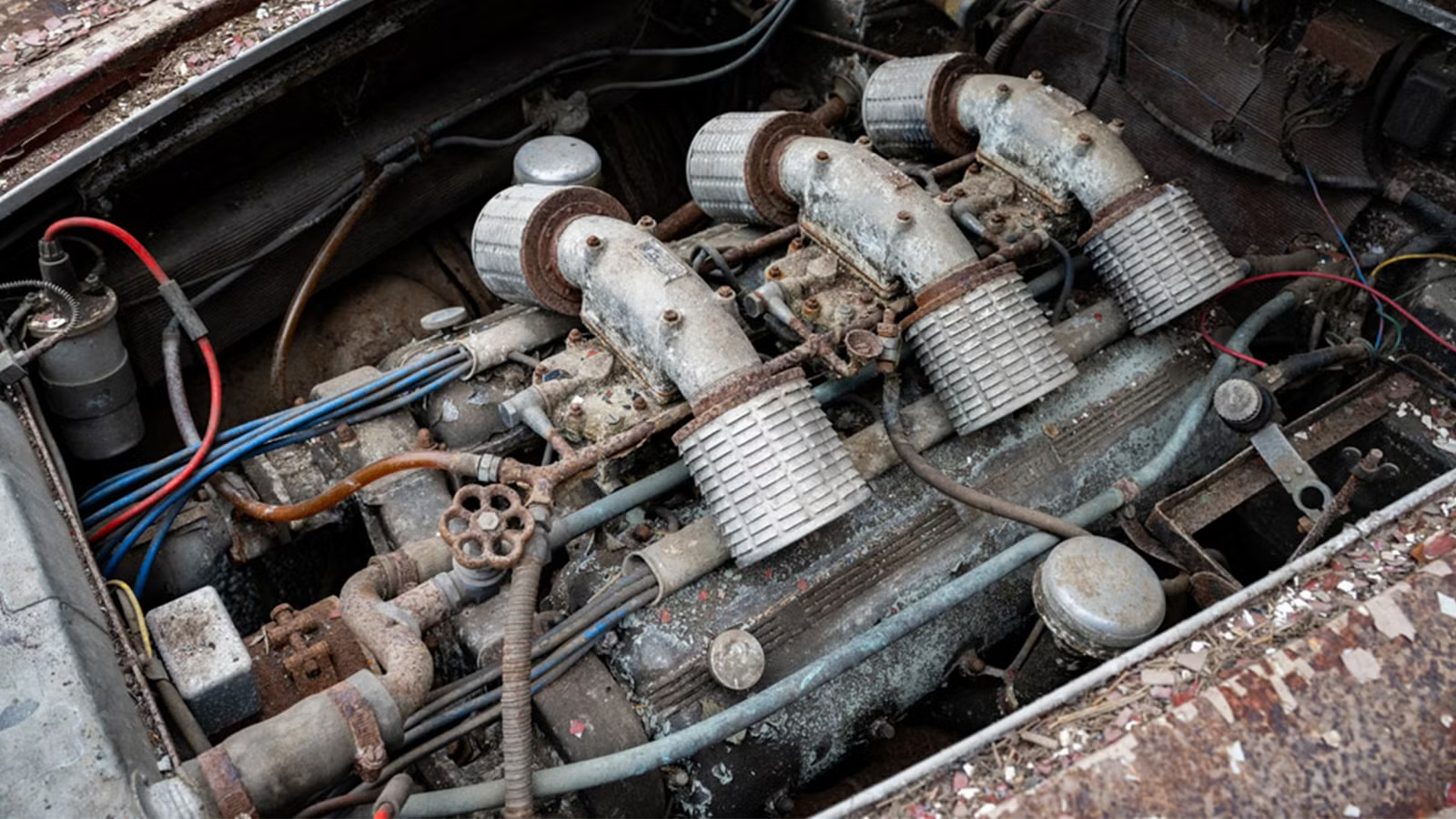
When this car crossed the block four months ago, most observers expected it to comfortably clear the million-dollar mark. Instead, the hammer fell at just $533,000, making it one of the most surprising auction results of the year. That outcome was difficult to reconcile with a car boasting one-off coach-built styling, a Formula 1-derived V12 engine, ownership by Aston Martin boss David Brown, and a remarkable barn-find story spanning nearly six decades. On paper, it possessed every ingredient collectors typically prize. So why did this exceptionally rare Italian grand tourer fail to meet expectations, and what does its disappointing sale reveal about today’s collector car market?
This One-Of-One Rarity Had Everything Going For It, Yet Still Flopped At Auction

Some collector car auction results leave enthusiasts scratching their heads, and this was certainly one of them. Entering the sale with an estimated value of $900,000 to $1.2 million, this remarkable Italian grand tourer appeared destined to become one of the highlights of the event. Instead, bidding stalled well below expectations before the hammer finally fell at just $533,000, barely 60 percent of its low estimate.
The disappointing result surprised many observers because cars with exceptional rarity, fascinating provenance, and genuine motorsport pedigree typically command fierce competition among collectors. On paper, this example possessed every ingredient associated with a blue-chip classic. So why did a coach-built, Formula 1-inspired Italian with an extraordinary history fail to ignite a bidding war? The answer says as much about today’s collector market as it does about the car itself.
A Ferrari Unlike Any Other 342 America Ever Built


Unlike the majority of early Ferrari grand tourers, chassis 0130 AL was never intended to blend into the crowd. It was commissioned as a one-off 2+2 coupé by the Turin coachbuilder Ghia, making it unique among the 342 America models. Its elegant styling was complemented by an unusual dark blue exterior paired with a silver-gray roof, a far cry from the traditional Rosso Corsa associated with Maranello. Inside, the dashboard featured a distinctive centrally mounted Jaeger instrument cluster, another detail that set it apart from its contemporaries.
Even its identity remains a topic of debate among historians. Gooding Christie’s identifies it as a 342 America, while Supercar Nostalgia classifies 0130 AL as a 340 America. That disagreement also extends to production numbers, with some sources, including Ferrari, listing six 342 Americas built, while others include this Ghia-bodied example as a seventh car.
Its Lampredi V12 Came Straight From Ferrari’s Formula 1 Program

Beneath the long hood sat one of Ferrari’s most significant early engines: a 4.1-liter Lampredi V12 producing 200 bhp at 5,000rpm. Designed by Aurelio Lampredi, the single overhead camshaft V12 was created as a larger-capacity alternative to Gioacchino Colombo’s smaller V12 that powered many of Ferrari’s early road and racing cars. While the Colombo engine excelled with its willingness to rev, the Lampredi design prioritized greater displacement and stronger low-end torque, making it better suited to larger grand tourers and endurance racers.
More importantly, the engine shared its architecture with the V12 used in Ferrari’s 375 Formula 1 car, which helped Ferrari claim its first Formula 1 victory when José Froilán González won the 1951 British Grand Prix at Silverstone. That racing pedigree gave the grand tourer genuine Grand Prix DNA, making its disappointing auction result even more surprising.
Even Aston Martin’s Boss Wanted This Ferrari

The car’s story became remarkable long before it disappeared into a New York barn. It made its public debut at the 1951 Paris Motor Show before appearing at the London Motor Show later that year, where it caught the attention of one of Britain’s most influential automotive figures. The buyer was David Brown, the businessman whose ownership transformed Aston Martin and ultimately gave birth to the marque’s famous DB model designation.
Having the head of Ferrari’s British rival purchase one of Maranello’s latest grand tourers added an unusual layer of historical significance. In the collector car world, provenance of this caliber often commands a substantial premium, particularly when ownership can be traced to a pivotal figure in automotive history. Combined with its rarity and originality, Brown’s name should have strengthened its appeal, making the subdued auction result even harder to explain.
The Ferrari That Vanished For Nearly Six Decades
After passing through several owners during the 1950s and 1960s, the rare grand tourer made what is believed to be its last documented public appearance at the 1967 Watkins Glen Sports Car Grand Prix in New York. Shortly afterward, it disappeared from the collector car scene altogether. Rather than being exported or restored, it was reportedly parked in a New York barn, where it remained hidden from public view for nearly six decades.
During that time, it became one of the many forgotten classics whose whereabouts were largely unknown outside a small circle of enthusiasts. Its rediscovery generated considerable excitement because the car had survived largely intact, complete with its distinctive Ghia coachwork and remarkable provenance. Following its emergence from long-term storage, it was consigned to Gooding Christie’s for the Amelia Island auction in March 2026, marking its first public sale in almost 60 years.
Why Collectors Expected It To Sell For More Than $1 Million
On paper, few early Ferraris ticked as many boxes as this one. It combined one-off Ghia coachwork, an F1-derived 4.1-liter Lampredi V12, documented ownership by David Brown, and a fascinating history that included nearly 60 years hidden from public view. Those attributes explain why Gooding Christie’s assigned a pre-auction estimate of $900,000 to $1.2 million.
Historically, early Ferraris with exceptional provenance, limited production, and unique coach-built bodies have commanded substantial premiums, particularly examples linked to the marque’s formative years. Models such as the 212 Inter, 340 America, 342 America, and 375 America are among Ferrari’s most collectible early grand tourers because they bridge the gap between the company’s racing success and its first luxury road cars. With so many desirable qualities wrapped into a single chassis, most observers expected bidding to comfortably exceed the million-dollar mark.
So Why Did Buyers Only Pay $533,000?

There is no single explanation for why bidding stopped at $533,000, but several factors likely contributed. While the car’s rarity was beyond question, collectors often gravitate toward early Ferraris that fit a more familiar formula: red paint, Pinin Farina (later Pininfarina) coachwork, and the smaller Colombo V12 that powered many of the marque’s most celebrated road cars. By comparison, this example wore an unconventional blue-and-silver color scheme, featured unique Ghia bodywork, and was powered by the less common Lampredi V12.
Its condition may also have tempered enthusiasm, as returning a long-stored car to concours standards would require a substantial investment. More broadly, the result clearly indicated what this room full of collectors thought on the day. While one auction does not establish a market trend, it suggests collectors have become increasingly selective, even when a car appears to have all the ingredients for a blockbuster sale.
What This Sale Says About Today’s Collector Car Market

This auction result is significant because it raises questions that extend far beyond a single early Ferrari. For years, exceptional rarity, fascinating provenance, and long-lost barn-find stories were often enough to generate intense bidding and record prices. However, this sale suggests today’s collectors may be placing greater emphasis on broader appeal, originality, and long-term desirability rather than rarity alone.
Even a one-off, coach-built Ferrari with Formula 1-derived engineering and ownership by one of Britain’s most influential automotive figures could not reach its estimated value. While it would be premature to call this a market-wide shift based on one transaction, it does illustrate that buyers are becoming increasingly selective. The biggest question is whether exceptional provenance and uniqueness are still enough to command a premium, or whether collectors now expect those qualities to be accompanied by broader market appeal.
Sources: Gooding Christie’s, Auto Motor und Sport, Ferrari

Related posts




Latest Post


No Comments