
8 First-Year Muscle Cars Purists Value Above The Full Runs
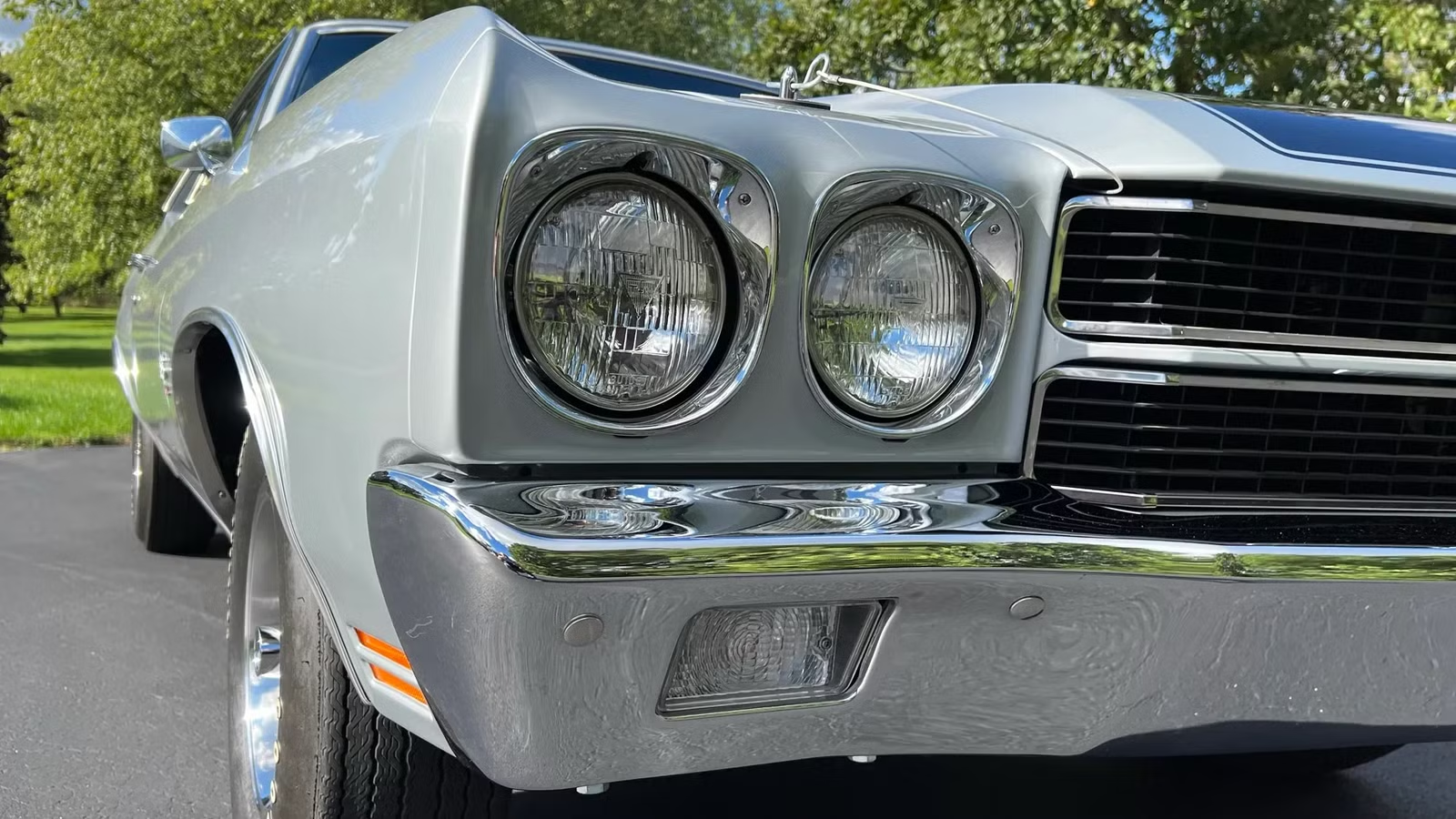
First-year muscle cars occupy a unique place in the collector market because they preserve the moment a performance legend was born. Before horsepower figures climbed, styling evolved and manufacturers refined their formulas, these debut models introduced the engines, trim packages and engineering decisions that defined an entire lineage. Many also carried details that lasted only a single model year, making authentic restorations considerably more difficult decades later.

That’s why matching-numbers collectors often value first-year examples above faster or more powerful successors. From the car that launched the factory muscle-car era to limited-production homologation specials, these eight debut-year machines prove that being first can matter more than being the quickest.
8
Pontiac GTO
Year of Launch: 1964
Widely regarded as the car that launched the factory muscle-car era, the 1964 GTO arrived as an option package on the Pontiac Tempest rather than a standalone model. Spearheaded by John DeLorean and his team, it established the formula Detroit would spend the next decade refining.

The GTO paired Pontiac’s 389-cubic-inch V8 with either 325 hp in standard form or 348 hp with the Tri-Power induction system. Buyers could choose a three-speed manual, four-speed manual or two-speed automatic. More than any later GTO, the 1964 model represents the birth of the muscle-car movement, which is why matching-numbers examples remain the benchmark for collectors.
7
Chevrolet Camaro Z/28
Year of Launch: 1967

Chevrolet introduced the Z/28 in 1967 to homologate the Camaro for SCCA Trans Am racing, and only 602 examples were produced during its first year. That combination of racing pedigree and low production has made it one of the most desirable early Camaros.
Every 1967 Z/28 used Chevrolet’s high-revving 302-cubic-inch V8, officially rated at 290 hp, paired exclusively with a Muncie four-speed manual. Although Chevrolet understated its output, the engine quickly earned a reputation for exceptional performance at high rpm. Recent auction results continue to show documented, matching-numbers ’67 Z/28s outperforming many later examples.
6
Dodge Charger R/T
Year of Launch: 1968

The redesigned 1968 Charger R/T introduced the performance formula that would define Dodge’s muscle-car flagship for years to come. Its new Coke-bottle profile and hidden-headlamp grille transformed the Charger into one of the era’s most recognizable coupes.
Standard power came from Chrysler’s 440 Magnum V8, producing 375 hp, while buyers could upgrade to the legendary 426 Hemi with 425 hp. Manual and automatic transmissions were both available. Collectors particularly value the debut-year R/T for its unique grille, round side markers and trim details that changed on later models.
5
Pontiac Trans Am Ram Air III
Year of Launch: 1969

Pontiac introduced the Trans Am in 1969 as a limited-production Firebird performance package, building only 697 examples during its debut year. Its white paint, blue stripes, fender extractors and pedestal rear spoiler immediately distinguished it from every other Firebird.
The standard performance engine was Pontiac’s 400-cubic-inch Ram Air III V8, rated at 335 hp, while the more potent Ram Air IV remained an extra-cost option. Buyers could choose either a four-speed manual or Turbo Hydra-Matic automatic. Because the first-year Trans Am combined low production with one-year-only styling details, matching-numbers survivors continue to command strong collector interest.
4
Ford Mustang Boss 302
Year of Launch: 1969

Ford developed the Boss 302 to homologate its Trans Am race engine, making the 1969 model far more than a styling exercise. Engineered with significant input from Kar Kraft, it became one of the sharpest-handling Mustangs of the muscle-car era.
Its unique 302-cubic-inch V8 combined a Windsor block with Cleveland-style cylinder heads, producing a factory-rated 290 hp. Every Boss 302 came with a close-ratio four-speed manual and rear-wheel drive. Many enthusiasts prefer the debut-year model because it introduced the package before later styling revisions, helping authentic 1969 cars maintain a strong collector following.
3
Buick GSX Stage 1
Year of Launch: 1970

Buick entered the muscle-car graphics war in 1970 with the GSX, a limited-production halo model based on the GS 455. Only 678 examples were built during its debut year, making authentic first-year cars significantly rarer than many better-known rivals.
The optional Stage 1 package upgraded Buick’s 455-cubic-inch V8 with revised cylinder heads, a hotter camshaft and improved induction. Officially rated at 360 hp and 510 lb-ft of torque, it was available with either a four-speed manual or Turbo Hydra-Matic 400 automatic, sending power to the rear wheels. Matching-numbers Stage 1 cars consistently command premiums over standard GS 455 models because of their rarity and documented provenance.
2
Chevrolet Chevelle SS LS6
Year of Launch: 1970

The 1970 Chevelle SS LS6 wasn’t just another big-block Chevelle—it represented Chevrolet’s ultimate factory muscle-car package. While thousands of buyers opted for the LS5, the LS6 quickly became the model enthusiasts wanted to own.
Its 454-cubic-inch LS6 V8 featured higher-compression internals, a larger Holley carburetor, aluminum intake and a more aggressive camshaft, producing a factory-rated 450 hp and 500 lb-ft of torque. Buyers could choose a Muncie four-speed manual or Turbo Hydra-Matic automatic. Today, documented matching-numbers LS6 cars occupy an entirely different value bracket from comparable LS5 Chevelles.
1
Plymouth AAR ‘Cuda
Year of Launch: 1970

Named after Dan Gurney’s All-American Racers team, the AAR ‘Cuda was built solely to homologate Plymouth’s Trans Am race car. Production lasted roughly five weeks, with just 2,724 examples completed, making it one of the shortest-lived muscle cars ever offered.
Unlike most rivals, every AAR used Chrysler’s 340 Six Barrel V8, producing 290 hp, paired with either a four-speed manual or TorqueFlite automatic. Its fiberglass hood, side-exit exhaust, matte-black graphics and staggered Goodyear tires were unique to the model. Because those parts are difficult to replace correctly, collectors place a premium on well-preserved, matching-numbers examples.
Sources: GM Heritage Center, Hagerty and Bring a Trailer

Related posts




Latest Post


No Comments