
The One-Of-One Pontiac Trans Am Built From An Engine GM Never Wanted You To See
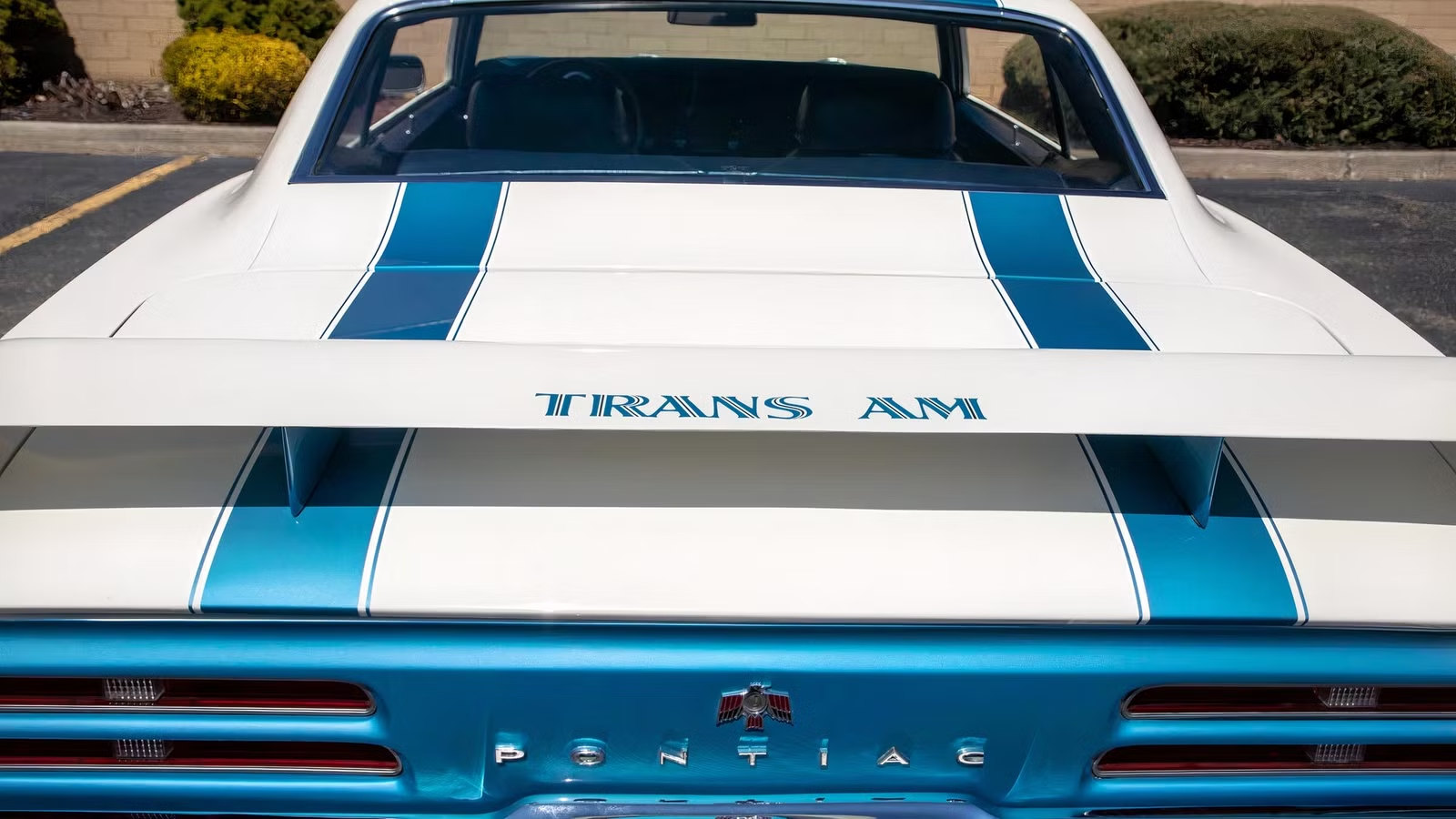
There are Muscle Cars that become rare because buyers completely ignored them. This one, however, became rare because the corporation behind it apparently wanted the whole idea to disappear before customers could even place an order. The machine belonged inside a dyno cell, not under the hood of anything carrying license plates.

And yet, a developmental V8 escaped the engineering department and ended up beneath a striped hood. Its survival raises a better question than what it sold for: how did hardware meant for Pontiac’s internal program reach the street at all?
Pontiac’s Engineers Were Building Trouble For GM
Pontiac entered the late ’60s with an awkward problem. Its engineers had helped turn performance into a sales weapon, but General Motors still had a corporate hierarchy to protect. Chevrolet owned the Corvette, while Pontiac was expected to create excitement without making the family’s favored sports car look slow. That’s a narrow lane when your engineers keep designing faster engines.

The division’s Special Projects Group continued working beyond what the regular showroom catalog offered. Its tunnel-port program targeted racing and serious street performance, with a 303 cubic-inch version intended for SCCA Trans-Am competition and a 366ci design aimed toward NASCAR. A 400ci street and strip version brought the same thinking closer to something a customer might actually use.
The Last Thing GM Needed

That work landed at a lousy moment. GM’s public retreat from organized racing still shaped internal decisions, while insurance companies were beginning to punish high-performance cars with increasingly painful premiums. Legislators and emissions requirements were also changing the mood around Detroit. An engine built to breathe hardest above 5,000 rpm wasn’t likely to charm anyone carrying an actuarial table.
Pontiac’s budget made the fight harder, and financial trouble at a supplier added another obstacle. The program had engineering ambition but lacked the corporate shelter needed to survive. GM brass didn’t need another engine that might rearrange the company pecking order. Pontiac, naturally, had built exactly that.
The Ram Air V Was Too Much Engine For GM’s Rulebook

The Ram Air V took Pontiac’s familiar V8 architecture and pushed airflow far beyond the production Ram Air III and Ram Air IV. Its tunnel-port cylinder heads used intake passages so large that the pushrods ran through the ports. Airfoil-shaped sleeves guided the incoming charge around them, which sounds like something from an aircraft drawing because subtlety had already taken its leave.
The supporting hardware was equally serious. Ram Air V specifications included four-bolt main caps, reinforced webbing, and a forged-steel crankshaft. Specially designed forged connecting rods and forged pistons supported an estimated compression ratio near 11.0:1, while a solid-lifter camshaft helped the engine operate where those large ports made sense. An 800-cfm Holley handled the fuel and air.
Jekyll And Hyde Behavior

That high-rpm focus also exposed the engine’s street manners. The tunnel-port layout reportedly didn’t begin working properly until around 4,000 rpm, with the intake tuned to deliver its best above 5,000 rpm. In traffic, it could feel sleepy. Once awake, it behaved like it had remembered an urgent appointment several counties away.
Exact output remains slippery. Claims vary considerably, and no definitive factory rating settles the argument. Published estimates for the street and strip version climb toward 500 horsepower, while other accounts suggest a lower advertised figure would have been used. Either way, the Ram Air V offered more performance than GM seemed willing to explain to insurers, regulators or Chevy.
The 1969 Trans Am That Escaped Pontiac Engineering

Pontiac built only 697 Trans Ams for 1969, and eight were convertibles. Every one is collectible today, but the coupe associated with longtime owner Lance Kramer occupies a different category. It’s regarded as the only documented 1969 Pontiac Trans Am carrying a Ram Air V engine, even though the tunnel-port V8 was never listed as a regular production option.
The car’s significance rests heavily on the block and its markings. Developmental stamps connect it to Pontiac’s internal engineering work, while a stamped ‘1’ has led enthusiasts to identify it as the first Ram Air V block cast. That interpretation has become central to the car’s engineering-mule reputation, though the surviving evidence doesn’t justify turning every disputed detail into courtroom fact.
The displacement deserves the same caution. The Ram Air V program covered several capacities, and accounts disagree over whether the surviving engine should be treated as a true 400-cubic-inch unit or as a block connected more closely to the 303 racing effort and later enlarged. Calling it a Ram Air V tunnel-port V8 is accurate. Pretending the remaining ambiguity has vanished would only make the story tidier, not stronger.
What matters is the combination. A 1969 Pontiac Trans Am that no buyer could officially order carries hardware tied to a factory-only development program. Its wide-ratio Muncie four-speed and 3.55 rear gearing remained with the car, creating a package that looks like an engineering exercise that slipped through a side door.
A Michigan Garage Held The Missing Evidence

The trail becomes clearer in 1988, when Kramer bought the Trans Am in Michigan. Unsurprisingly, it wasn’t sitting beneath flattering showroom lights. The car was apart, accompanied by a cache of new-old-stock parts that would become crucial to its restoration. That setting has fueled the belief that someone with inside access preserved the project after Pontiac moved on.
Kramer spent five years completing a frame-off restoration, using the parts that came with the car and additional Ram Air V components gathered over time. Another original 1969 Trans Am reportedly served as a reference. The result wasn’t a casual engine swap assembled around whatever happened to fit. Rare tunnel-port pieces, correct internal hardware and the car’s documentation gave the finished machine a much stronger case.
The Most Intriguing Survivor

Still, the phrase ‘factory-built engineering mule’ needs a little breathing room. Pontiac didn’t leave behind a neat certificate explaining who authorized the car, where it was tested or why it escaped disposal. Its identity comes from the unusual block, the developmental markings, the production configuration and the circumstances of its discovery. Collectively, that evidence has made the Lance Kramer car the program’s most intriguing survivor.
The Muscle Car GM Killed Before It Could Exist

The one-of-one Pontiac Trans Am later crossed the auction block more than once, selling for $90,000 in 2011 before bringing $143,000 in 2019. Those numbers sound substantial until they’re compared with the prices attached to famous Hemi convertibles or top-tier Shelby Mustangs. For a car with this much unresolved factory intrigue, $143,000 almost feels like someone forgot a zero.
Its greater value lies in what it proves. Pontiac’s engineers had moved the Ram Air V beyond a sketch or a collection of dyno parts. Here was a tunnel-port engine installed in the division’s new halo pony car, backed by hardware built to survive serious rpm. A showroom Ram Air V Trans Am could have challenged Ford’s Boss engines and Chevrolet’s Z/28 while creating a particularly awkward conversation inside GM.
One Last Monster

Insurance pressure and regulatory change would still have arrived, but Pontiac might have squeezed one more monster through the showroom doors before Detroit’s horsepower party received the bill. Instead, the Ram Air V became a crate-engine legend, while this 1969 Pontiac Trans Am carried the abandoned idea into the collector world. Shame, really.
Sources: firstgenfirebirds, Pontiac, Mecum.

Related posts





Latest Post


No Comments