
The Cheapest Parallel-Twin Sports Bike In 2026
In the recent past, the new age of sports bikes is truly in full swing. Not only are the ergonomics more relaxed than ever, but there’s been a shift in the engine type as well. Screaming powerhouses are no longer common, as they are being replaced by punchy parallel-twins. These range from the very entry-level to beyond 900 cubic centimeters, ensuring there’s something to keep all kinds of riders entertained. This popularity has urged popular brands to make some interesting moves in the market, and one such move is what birthed the new cheapest parallel-twin sports bike in 2026.
There Are Several Parallel-Twin Sports Bikes Under $10,000

Since parallel-twin sports bikes usually resort to part-sharing for their engines, you find several competitively priced examples under $10,000 today. This is particularly true for the middleweight segment, where you’ll find Yamaha’s YZF-R7, Suzuki’s GSX-8R, and Kawasaki’s Ninja 650. They all have parallel-twin engines borrowed from nakeds, packaged with sportier ergonomics and underpinnings.

Below these is a set of 400-500cc parallel-twin sports bikes that sit in the $6,000 to $8,000 ballpark. Kawasaki has the Ninja 500 SE, while Aprilia joins the party with its RS 457. Honda also has the CBR500R, which recently became cheaper by a massive $1,000.
But The Number Shrinks As The Price Reduces

Bring down the price further, though, and you’ll see a serious lack of parallel-twin sports bikes. There are just a handful of bikes under $6,000, which is what Team Green is trying to exploit with its latest Ninja launch in the US. This has become the cheapest parallel-twin sports bike of 2026, being the only machine of its kind under the $5,000 mark.

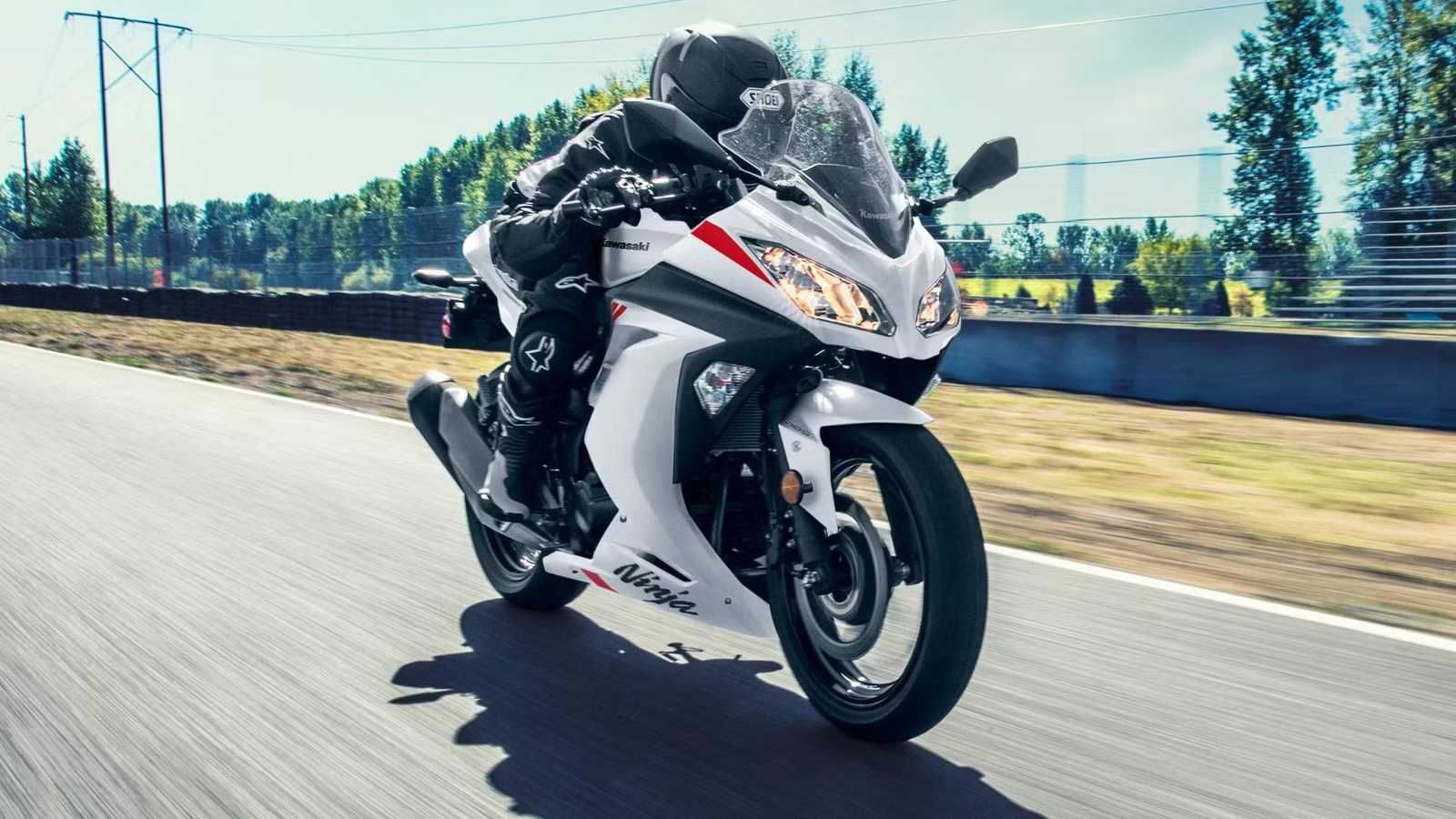
The Kawasaki Ninja 300 Brings You Parallel-Twin Goodness Under $5,000

We’re talking about the new-for-2026 Ninja 300 that sells for an MSRP of $4,999. The next best thing in this space is the CFMoto 450SS, which has recently received a price drop from $5,699 to $5,199. Then, we have the two other Japanese bikes: the $5,399 Kawasaki Ninja 500 and the $5,499 Yamaha YZF-R3. Everything else breaches $6,000.
Why The Ninja 300 Makes A Solid Case As A First Sports Bike

While the MSRP is impressive, the Ninja 300’s package is impressive in general. It checks all the right boxes for an entry-level sports bike, be it a trusty engine, a proven chassis, and just the right features. The only catch is that this is largely the same bike from 2016 with minor tweaks. But hey, you could say the same about the Ninja 650, too. Anyway, here’s a lowdown on what you get.
A Sub-300cc Parallel-Twin Engine Brings Almost 40 HP

We start with the heart of the matter: the familiar parallel-twin engine, which we’ve also seen on the Versys-X 300. This displaces 296 cubic centimeters via a 62 X 49 mm bore and stroke, while using a traditional 180-degree firing order. These things, along with a 10.6:1 compression ratio and liquid cooling, help the engine rev up to 13,000 RPM. That’s around ~1,500 RPM higher than its elder sibling: the Ninja 500.
As for the output, you’re looking at 39 horsepower and 19.3 pound-feet. They kick in at 11,000 RPM and 10,000 RPM, so the engine’s character is high-revving, unlike the new breed of torque-friendly entry-level bikes. A six-speed transmission driven by a chain sends all the power to the wheel, and you’ll easily reach close to 120 miles per hour if you keep the bike pinned in the top gear.
Basic Suspension Attached To A Reputed Chassis

Under the skin, the Ninja 300 hides Kawasaki’s staple steel trellis frame. We’ve seen such a setup on almost every non-ZX Ninja (including the midweight Ninja 650), so there’s a lot of credibility here. The subframe is a joint unit here, unlike the usual bolt-on setups, though. Joined to that is a basic suspension setup. Regular 37 mm telescopic forks are present up top, alongside a preload-adjustable monoshock.
It’s a similar case in the braking department. A simple 290 mm petal disc sits up front with a two-piston caliper, whereas the rear uses a 220 mm disc and a two-piston caliper. They attach to 17-inch alloy wheels with 110 and 150-section tires. All of this is essentially the same package as the 2016 Ninja 300, and we feel Kawasaki should’ve put in a little more effort to bring the bike up to the times.

All these budget parts also add to the weight, as the Ninja 300 tips the scale at 388 pounds with ABS. Not only is that higher than its direct rival–the Yamaha YZF-R3–but it’s also higher than Kawasaki’s own Ninja 500. Luckily, all other dimensions remain accessible for newbies. The saddle height is under 31 inches, the wheelbase measures 55.3 inches, and you get a decent ground clearance of 5.5 inches.
Standard ABS Is A Good Touch

Regardless of the segment, any new bike is expected to boast a handful of features like digital instrument clusters, traction control, and a quickshifter. Such is the reality of modern-day motorcycling. Yet, the Ninja 300 sticks to the true basics. There are none of the above fancy bits, and instead, you get just dual-channel ABS in the name of rider aids. This is topped with a slipper clutch.

Meanwhile, the cockpit comprises a semi-digital instrument cluster. This has an analog tachometer (which we love) and an LCD for showing necessary bits like fuel level or temperature. A big miss, however, is the lack of color options. Only Pearl Blizzard White is available, although Kawasaki usually offers several shades for its other Ninjas.
Source: Kawasaki USA

Related posts


Latest Post


No Comments