
The Next Porsche Cayenne Won’t Make You Choose Between Gas And Electric
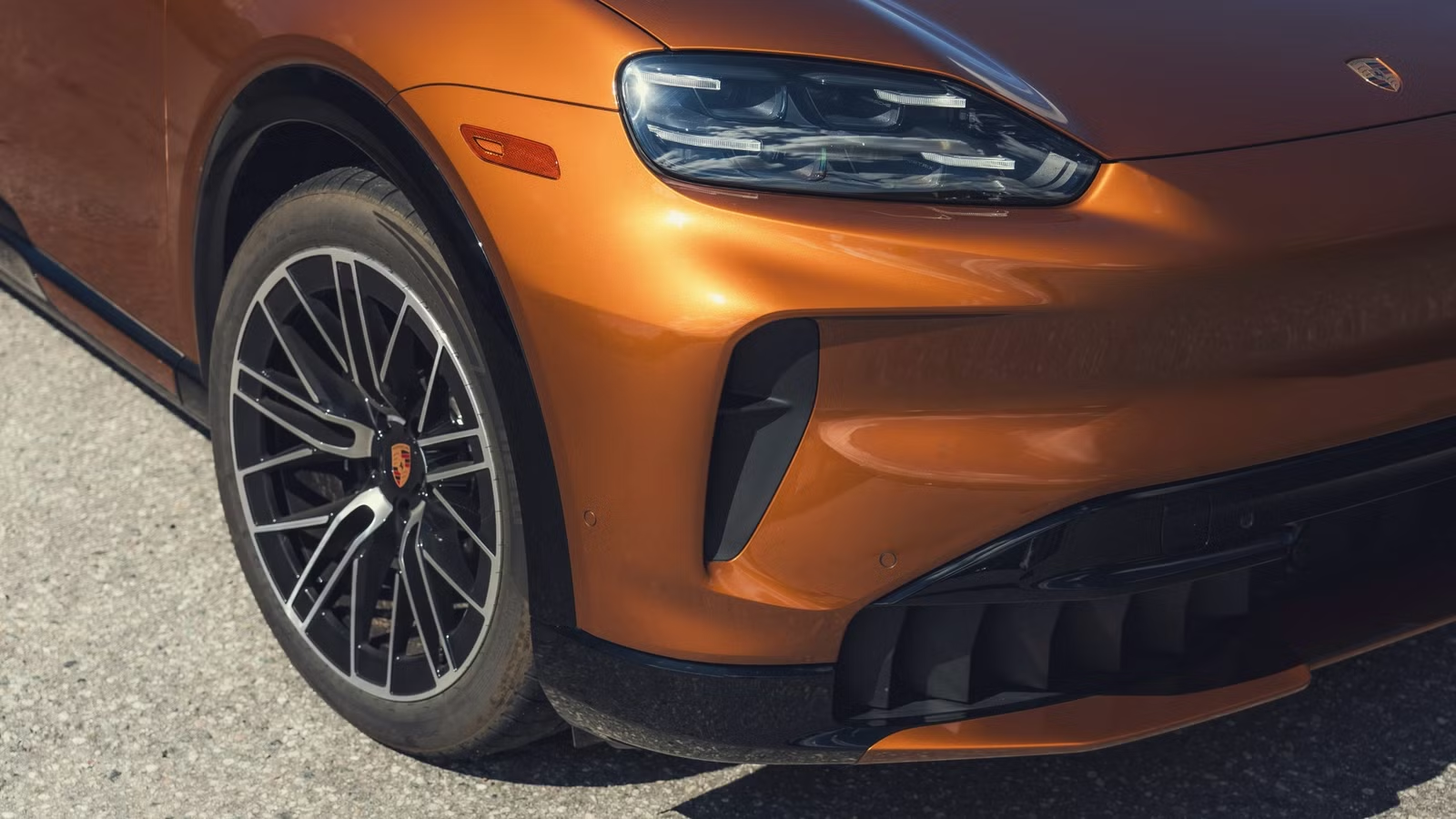
When build quality, performance, and ride comfort are all non-negotiable, no other luxury SUV on the market does itquite like the Porsche Cayenne. For the 2027 model year, the Cayenne is entering a period of trim diversification and customization potential unlike anything seen before. This isn’t just another new-generation refresh: Porsche will now give Cayenne buyers an unusually wide array of trim and powertrain choices, starting under $90,000 and rising to over $160,000 before options. That’s a serious amount of money, but Porsche is giving buyers just about every configuration possible with a restructuring of its lineup that will be a determining factor for Cayenne shoppers moving forward.
Porsche Is Expanding The Cayenne Into Six Variants Instead Of Forcing A Single Direction

For this new generation, Porsche isn’t just replacing the old with the new; it’s giving shoppers more freedom than they’ve ever had with the nameplate while keeping the baseline foundation across trims the same.
The Cayenne Is No Longer Following A Simple Replacement Cycle

Most automakers nowadays have been focusing on simplifying their model lineups. The popularization of modular chassis platforms has made this possible, allowing a single platform to serve as the basis for a wide variety of different models. However, the Porsche Cayenne, despite being part of a modular platform, will now offer a broader family of powertrains rather than a single baseline model and a single premium option.
The reality is that Porsche has invested significant resources in electrification in recent times, so it is almost nonsensical not to offer an electric variant of just about every model it sells. At the same time, the German brand also continues to push the development of its combustion-powered platforms, and Porsche wants to be able to appeal to the widest range of luxury shoppers. So, if your ideal SUV is suited to road trips, delivers strong performance, or offers electric capability, the new Cayenne is proving to be more versatile than ever before.
A $90,000 Cayenne And A $160,000 Cayenne Tell Different Stories

While a $90,000 starting price may seem steep, what is even more intriguing is how broad a price range the 2027 Porsche Cayenne offers. At the top of the trim levels, you can spend well beyond $160,000, and that’s without adding the infamous sea of options that Porsche offers.
However, the trim levels now mean more than they did before because, depending on what you pick, you can opt for a combustion-powered model, a combination of combustion and electric power, or a model that eliminates the combustion engine. The only way to know which is the right choice is to determine your intended use and pick accordingly, because there are too many options to enter the process undecided.
The Cayenne Gives Buyers Three Ways To Experience The Same SUV

With the 2027 model year, the Cayenne will offer three distinct powertrain options while also introducing the choice between the standard Cayenne body and the sleeker Coupe.
How Porsche Kept Gas Buyers Happy While Adding Full EV Capability

Porsche will now sell the Cayenne with combustion-only, plug-in hybrid, and fully electric powertrains. Many shoppers believed the dawn of a new generation would mean the combustion-powered staples of the past would disappear. However, Porsche didn’t take anything away from the model range. Instead, it added even more depth with the introduction of the all-electric Cayenne.
The name hasn’t changed, but now the Cayenne has a broader appeal while also being more specialized than before. Giving shoppers different options means there is more likely to be a configuration that fits them perfectly, rather than having to compromise on a trim that feels insufficient for their use case. If road trips and pure convenience are your priorities, the tried-and-true gas-powered model remains the obvious pick, while the PHEV finds the middle ground as an ideal commuter without losing long-distance capability. The all-electric model provides the full experience for buyers who are committed to making the complete transition away from combustion.
The Differences Between The Standard Cayenne And Cayenne Coupe

Just when you thought the configurability couldn’t get any deeper, you also have to consider the differences between the standard Cayenne body and the Cayenne Coupe. Of course, if you want the traditional SUV experience and silhouette, the standard Cayenne is the optimal pick, as it offers more utility and practicality than the Coupe model.
However, most shoppers buying a six-figure luxury SUV care deeply about how it looks. If they didn’t, styling wouldn’t be such a massive part of the equation. Thus, the lower and more dramatic roofline of the Cayenne Coupe appeals to many shoppers who are willing to trade some of that utility for the swooping silhouette of the Coupe. If you are seriously shopping for a Cayenne, you will need to consider multiple powertrains, trim levels, and two distinct body styles before making a decision. Let’s break down each variant to see what fits your lifestyle and needs best.
The Gasoline And Hybrid Cayenne Lineup Covers $89,900 To $164,500

At a near-six-figure starting price, it’s difficult to call any Cayenne model “entry-level,” and even the simplest trim is packed with features that would appeal to most, if not all, luxury SUV shoppers.
The $89,900 Cayenne Starts The Range

Kicking off the lineup is the Porsche Cayenne, which produces 348 horsepower from a 3.0-liter turbocharged V-6 mated to an eight-speed automatic transmission and achieves a 5.7-second 0-to-60 mph time. Notable standard equipment includes 20-inch Cayenne Design wheels, Matrix Design LED headlights, eight-way power seats, a heated steering wheel, Sound Package Plus, and brushed stainless steel tailpipes.
For a little more performance, the $103,100 Cayenne E-Hybrid is the first step into electrification, producing 463 horsepower and achieving a 4.6-second 0-to-60 mph time. Additional standard features include 20-inch AeroDesign wheels and the Sport Chrono Package. Sport Chrono unlocks extra performance features such as launch control while also enhancing the capabilities of Porsche Stability Management.

For buyers who want similar performance to the E-Hybrid without any of the electrification, the combustion-only $108,300 Cayenne S features a 4.0-liter twin-turbocharged V-8 that produces 468 horsepower and achieves a 4.7-second 0-to-60 mph time. The Cayenne S also comes with a unique set of 20-inch wheels along with twin dual-tube brushed stainless steel tailpipes. Because the pricing and performance of the E-Hybrid and S are so close, the choice largely comes down to personal preference, and Porsche provides whichever configuration best suits a buyer’s needs.
The $164,500 Turbo E-Hybrid Delivers 729 Horsepower From A V-8 With Hybrid Backup

Once we move into the $111,600 Cayenne S E-Hybrid, performance takes another meaningful step forward. This trim produces 512 horsepower and achieves a 4.4-second 0-to-60 mph time while retaining many of the same standard features found on the E-Hybrid.
The $132,400 GTS delivers nearly the same performance as the S E-Hybrid while relying exclusively on its twin-turbocharged V-8, which produces 493 horsepower and achieves a 4.4-second 0-to-60 mph time. The GTS also upgrades to 21-inch RS Spyder Design wheels, HD-Matrix Design LED headlights in Black, a heated GT Sport steering wheel in Race-Tex, Bose Surround Sound, the SportDesign exterior package in High Gloss Black, and a sport exhaust system with tailpipes finished in dark bronze.

If that still isn’t enough performance, the range-topping $164,500 Turbo E-Hybrid awaits. Combining the potential of a twin-turbocharged V-8 with hybrid assistance, this Cayenne produces 729 horsepower and achieves a 3.5-second 0-to-60 mph time, easily cementing it in super-SUV territory. Additional standard features include exclusive 21-inch Cayenne Turbo wheels in Turbonite finish, HD-Matrix Design LED headlights, 18-way Adaptive Sport Seats Plus, a heated GT Sport steering wheel in leather, Bose Surround Sound, the Sport Chrono Package, and Turbo-exclusive dual tailpipes finished in dark bronze.
The Electric Cayenne Creates A Second Performance Ladder

If the appeal of a combustion engine simply isn’t there for you, or if you want to experience the latest technology Porsche has to offer, the all-electric lineup is built specifically for that purpose.
The $109,000 Electric And $126,300 S Electric Expand The Choice

Starting the electric lineup is the $109,000 Cayenne Electric, which produces 435 horsepower and achieves a 4.5-second 0-to-60 mph time with launch control and Overboost. Porsche estimates a 10 to 80 percent charging time of about 16 minutes, with total range expected to fall between 328 and 350 miles on a full charge. Notable standard equipment includes 21-inch Aero Design wheels, eight-way Comfort Seats, a heated multifunction steering wheel in leather with a mode switch, and Sound Package Plus.

The base Cayenne Electric already exceeds the performance of the standard Cayenne, but stepping up to the $126,300 S Electric places you close to the performance level of the top-trim Turbo E-Hybrid for nearly $40,000 less. The S Electric produces 657 horsepower and achieves a 3.6-second 0-to-60 mph time with launch control and Overboost. Other than the substantial power increase, standard features remain largely identical to those found on the base Electric model.
The $163,000 Turbo Electric Becomes The New Performance Flagship
Just when you thought the Cayenne couldn’t become any more powerful or capable, the $163,000 Turbo Electric arrived. With 1,139 horsepower and a 2.4-second 0-to-60 mph time with launch control and Overboost, this Cayenne competes with hypercars while comfortably outperforming the Turbo E-Hybrid. Indeed, if you want the fastest Cayenne Porsche has to offer, that model is now electric. Notable standard features include exclusive 21-inch Turbo Aero wheels, 18-way Adaptive Sport Seats Plus with Comfort Memory, a heated GT Sport steering wheel in leather, Bose Surround Sound, and the Sport Chrono Package with Push-to-Pass.
However, just because the fastest model is now electric doesn’t mean the gas-only and hybrid versions have become irrelevant. Quite the contrary: Porsche is making clear that the electric model is not the exclusive future of the nameplate. Instead, freedom of choice has become one of the Cayenne’s defining characteristics.
Sources: Porsche

Related posts




Latest Post


No Comments