
The Naked Bike That Feels Surprisingly Comfortable For Long Trips
Naked bikes are rarely the top priority for riders when it comes to touring. Such motorcycles are too exposed, too focused, too eager to turn every mile into an event. That is exactly why they work so well for everything else, though. They can carve canyons, cut through city traffic, and when the occasion calls for it, they can chug along the highway for hours on end. The question is never whether they can do it. It’s whether they can do it without making you pay for it by the 200th mile.
Why Long-Distance Riders Usually Avoid Super Nakeds

The case against riding a naked bike long-distance isn’t hard to make. Without a fairing, there’s nothing standing between your chest and 80 mph of solid air. That’s not just uncomfortable but draining. Wind fatigue accumulates quietly over a full riding day, and by the time most riders notice it, the damage is already done. The ergonomics compound the problem. Rear set foot pegs fold your knees upward and funnel weight directly onto your wrists and palms. Sport seats shed grams by sacrificing foam.

Further, the throttle maps on most liter-class nakeds are calibrated for snap and response, not for the kind of relaxed, half-wrist inputs that make eight hours on the highway bearable. The result is constant low-level physical tension — and that tension adds up. It’s not a criticism unique to any one bike. The KTM 1390 Super Duke R, Yamaha MT-10, and Ducati Streetfighter V4 are all exceptional machines, but none of them could honestly be called touring-friendly. They were built to thrill, not to cruise, and that priority becomes obvious past the 150-mile mark. One of their rivals, however, has way more touring ability without robbing you of the usual naked experience.
The Aprilia Tuono V4 Feels Surprisingly Comfortable For Long Trips
Base Price: $16,699


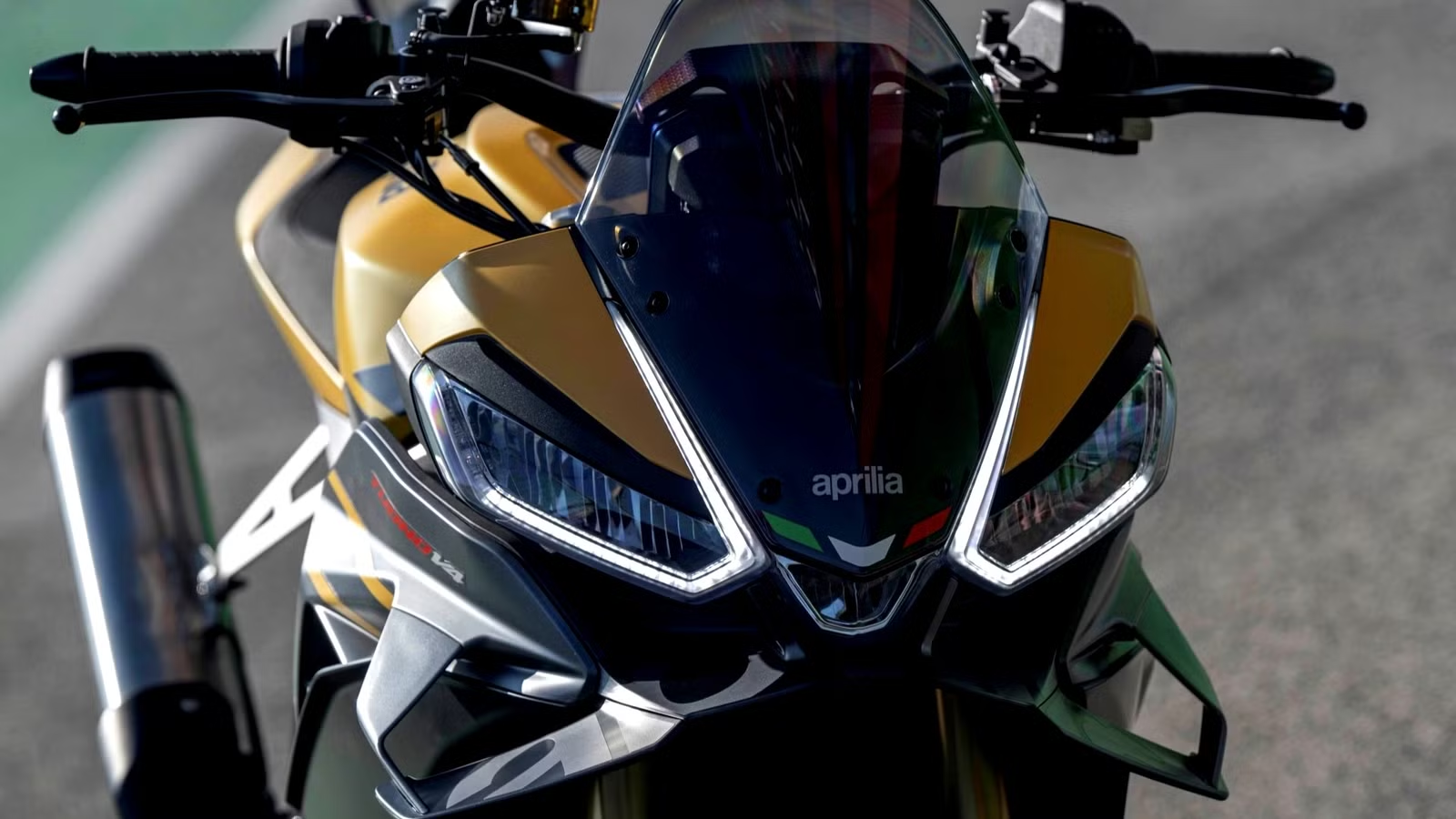
This is where the Aprilia Tuono V4 1100 starts to make a strong case for itself. With a base MSRP of $16,699, Aprilia positions the Tuono V4 as a sport-oriented naked with enough road-friendly equipment to make longer rides realistic. That is not bargain territory, but it is also not outrageous for a machine with superbike-grade hardware, premium brakes, and an engine that sits squarely in the top tier of the class. The Tuono’s trick is that it is not fully naked in the way many rivals are. You get half fairings to keep air flow crisp and your legs shielded.
Beyond the fairing, Aprilia deliberately repackaged the base Tuono V4 1100 to serve a different brief than the track-biased Factory trim. The standard model has bar risers that lift the handlebars and redistribute weight back off the wrists. The foot pegs sit lower, giving your legs more room to breathe across an extended ride. All this while, the seat is quite roomy with big tank indents for your knees.

*2021 Touring variant shown
Even the final drive gearing is longer than the Factory’s — a quiet detail that keeps engine revs lower at cruise speeds and trims the vibration. Besides this, you should also know that there is a great aftermarket support for the Tuono V4. Several owners have put saddlebags and top boxes on this for charting through miles and miles across countries. In fact, Aprilia itself sold official luggage accessories for its flagship naked till 2024, and there used to be a ‘Tour’ variant on sale, too. We believe the brand will soon offer those again for the latest edition.
The Motorcycle That Feels Better The More Miles You Put On It
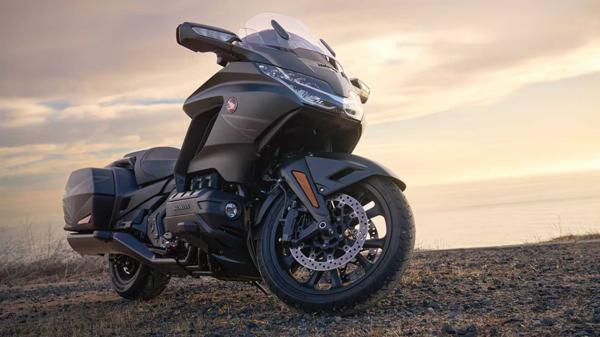
The Gold Wing’s charm doesn’t wear off with age; in fact, the more miles you cover on it, the better it feels.
Heart Of A Superbike, Manners Of A Tourer

The mechanical heart of the Tuono V4 1100 is Aprilia’s 65-degree V4 — 1,099cc, liquid-cooled, DOHC, with four valves per cylinder and a 13.6:1 compression ratio. This motor churns out 180 hp at 11,800 rpm and 89 lb-ft of torque at 9,600 rpm. Fueling comes via Marelli injection through 52 mm throttle bodies, with full ride-by-wire throttle control across a six-speed manual gearbox with chain final drive and a bi-directional quick-shifter included as standard.

What would catch riders off guard is the composure down low. The V4 architecture helps distribute power more evenly across the rev range, making the engine easy to manage in stop-and-go conditions. This is also a way less aggressive tune than the RSV4, so reliability should be better here. On the highway, the Tuono’s torque curve quietly becomes one of its most compelling attributes. At 75 mph in sixth gear, sweeping past a semi won’t require a downshift. That quality, low-drama torque on demand, is what separates a genuine mile-muncher from a machine that’s merely fast.
An Electronics Suite That Tames the Open Road

*Factory model shown
On the go, the APRC (Aprilia Performance Ride Control) holds all of it together. Aprilia lists a six-axis IMU and three riding modes for the Tuono V4— User, Tour, and Sport — which alter throttle response and the cornering ABS strategy. Drop it into the softest mode, and the character of the motorcycle changes substantially — the throttle loses its edge, the responses smooth out, and the bike stops trying to demonstrate what it can do at every intersection.
Standard electronic cruise control is the feature that seals the deal for real-world distance riding. Set it, roll your shoulders back, and let the bike carry you across Nevada or the open Texas panhandle without your throttle hand doing the arithmetic for every mile. Any rider who has crossed a 400-mile state without it knows precisely why it belongs on this list.
Cornering ABS And Traction Control As An Invisible Defensive Net

The six-axis IMU gives the Tuono a strong safety advantage when the road gets unpredictable. By understanding lean angle and movement, the electronics can tailor traction control and cornering ABS behavior to the conditions at hand. The bi-directional quick-shifter is another feature that sounds optional until the miles start piling up. Once fatigue sets in, clutchless shifts reduce effort and keep the pace flowing more smoothly.
The Adventure Motorcycle That Makes Long Trips Feel Effortless
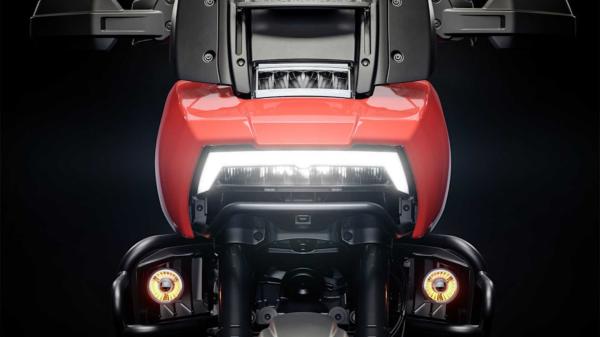
The Harley-Davidson Pan America combines a powerful V-twin, semi-active suspension, and modern tech to make long rides feel effortless.
Fully Adjustable Suspension Lets You Tackle Different Terrains

Up front is a 43 mm Sachs inverted fork, fully adjustable for preload and rebound damping, with 4.6 inches of travel. Out back, a Sachs mono-shock sits on an aluminum swingarm, also fully adjustable, with 5.1 inches of travel. The tune on the base model is meaningfully softer than the Factory’s Öhlins hardware — calibrated for road compliance rather than circuit precision. That’s the right call for American pavement, which has a way of presenting expansion joints, chip seal patches, and stretches of worn interstate that haven’t seen a resurfacing crew in years.
Aluminum Wheels And Brembo Brakes Make Touring Easy And Safe

The wheels and brakes reinforce that same idea. The rolling package is a set of 17-inch aluminum wheels — 120/70 ZR17 up front, 190/55 ZR17 at the rear — speed-rated for the performance on offer and well-suited to the mixed highway and backroad mileage this bike is built for. Stopping hardware is Brembo Monobloc radial calipers clamping dual 330mm front discs, with a single 220mm hydraulic disc at the rear.
Feel at both ends is progressive and linear — no aggressive bite under light pressure in slow traffic, no vagueness under trail-braking into an unfamiliar corner. They build confidence quickly and hold it over a long riding day, which is the most useful thing a brake system can do. Combined with the bike’s chassis balance and electronics, the braking package is one more reason the Tuono V4 can cover ground in a way that feels calm instead of exhausting. It is still a wild motorcycle, but it is a wild motorcycle with manners.
Source: Aprilia

Related posts



Latest Post


No Comments