
The Muscle Truck That Was Too Wild For Its Era
Pickup trucks with huge-horsepower V8s are as American as baseball and apple pie. But things haven’t always been this way. Once, such performance was reserved for cars. Pickup trucks were simple utilitarian tools. Some manufacturers offered slightly quicker pickup trims, but no one bothered to build a street brawler truck. Then everything changed.

Decades before the term ” muscle truck” was even a common phrase, one gnarly pickup trounced every other truck—and most cars—with 450 horsepower and a low six-second 0-60. It was a true muscle truck and far too wild for its era.
The Golden Era Of The Muscle Truck
The past decade has been a golden era of the muscle truck. Ram changed the game when it dropped the Dodge Charger/Challenger’s supercharged Hellcat V8 into a desert-racing monster: the 2021-2024 SRT TRX. Ram is bringing the TRX back for the 2027 model year, alongside a lowered, street-fighter pickup with the same power plant: The SRT “Rumble Bee.”

Ford had long been building the F-150 Raptor desert racer-inspired pickup. But after the launch of the TRX, Ford upped its game with the Raptor R. This trim features a 5.2-liter supercharged V8, borrowed from the Mustang GT500 and retuned for the truck. Street racing fans can opt for the Shelby F-150 Super Snake, which has a 5.0-liter V8 fitted with a Shelby supercharger for 810 horsepower. It even has lowered and sport-tuned suspension to match.

Not to be left out, General Motors shipped its Silverado 1500 to Hennessy. The tuning company built the “Goliath” with sport suspension, enhanced brakes, and a supercharged version of the famed 6.2-liter V8, rated at 650 horsepower. But the golden era of the muscle truck wouldn’t be possible without the pioneers of yesteryear.
When Trucks Were Underpowered Work Machines

The year was 1970, and Detroit had built some high-powered muscle monsters. But such performance was almost exclusive to cars. Pickup trucks were considered utilitarian work vehicles. Many came with underpowered I6 engines that wouldn’t even keep up with modern highway traffic. There were several notable exceptions.
Dodge offered its 383 V8 in the D100 truck’s “Adventurer” trim. The engine made a total of about 330 horsepower and about 425 lb-ft of torque. The real big dog at the time was the Ford Ranchero GT, available with the 429 Cobra Jet engine. It borrowed this V8 from the Shelby GT500 built on the Mach 2 Mustang. It churned out 370 horsepower and 450 lb-ft. These were sensible performance trims that fit the era. But one muscle truck was far too wild for this era.
General Motors looked at the competition and asked a seemingly innocent question. “What if we dial the pickup to 11? What if instead of a muscle car we build…a muscle truck?” The result was legendary.
The 1970 El Camino SS 454
An LS6-Powered Monster

|
Vehicle |
1970 Chevrolet El Camino SS 454 LS6 |
|---|---|
|
Engine Name |
Chevrolet LS6 Big-Block V8 |
|
Displacement |
454 cu in (7.4 L) |
|
Bore x Stroke |
4.25 in × 4.00 in (107.95 × 101.6 mm) |
|
Compression Ratio |
11.25:1 |
|
Carburetor |
Holley 800-cfm four-barrel |
|
Horsepower |
450 hp @5,600 rpm |
|
Torque |
500 lb-ft @3,600 rpm |
|
Transmission Options |
Muncie M22 4-speed manual or Turbo Hydra-Matic 400 automatic |
|
Curb Weight Range |
~3,850–4,050 lbs |
|
0–60 mph |
6.0 sec (Car Life, 1970 LS6 El Camino test) |
|
1/4-Mile |
13.44 seconds |
With 11.25:1 compression and a Holley 800-cfm carburetor, the 7.4-liter LS6 V8 was a drag-racing monster, barely suitable for street use. After it proved its mettle, Chevy would actually use the engine for its legendary 1971 Corvette. But in 1970, the only car it was available in was the big Chevrolet Chevelle. Then someone at GM asked, “Will it truck?” The answer was “Yes” and Chevy dropped this bonkers engine in the El Camino compact truck.

The third-gen El Camino wasn’t just a Chevelle with a rear-seat delete. It had a longer wheelbase and a boxed frame beneath its bed. These features made it a capable compact truck, but they also allowed it to handle the big V8’s power well.
In 1970, Car Life took the El Camino SS 454 to the test track. Its times proved that there really is no replacement for displacement. The 7.4-liter V8 rocketed the truck to 60 mph in 6.0 seconds. It continued on through the 1/4 mile in 13.44 seconds with a top speed of 105.5 mph.
The World’s First Factory Supercharged Pickup Truck Could Outrun Muscle Cars
In the late ’90s, one bold truck changed the game, becoming the first factory pickup to pack a supercharger and real street performance.
A Muscle Truck The World Wasn’t Ready For

Chevrolet built just 4,663 LS6 V8 engines in 1970 and 1971. Most of them went into Chevelle cars. Around 500 were installed in El Camino trucks, all during the 1970 model year. For 1971, GM pivoted away from muscle trucks, offering the LS6 exclusively in Chevelle cars and 188 Corvettes. The El Camino SS 454 was dead before most of the world even knew it had lived.

For one year only, Chevrolet stuffed its most powerful regular-production engine into an El Camino. The result was a 450-horsepower muscle truck so outrageous that it would take more than three decades for another factory vehicle with a bed to decisively top it. The 1990 Chevrolet 454 SS had just 230 horsepower. The 1993 Ford Lightning could only claim 240 horsepower. It was the full-size 2004 Dodge Ram SRT-10 that finally broke the 500 horsepower barrier.
10 Pickup Trucks That Are Way Too Fast For Their Own Good
Check out some of the fastest trucks on the used market right now.
A Wild Muscle Truck Finally Gets The Credit It’s Due

Collectors are most certainly taking note of the El Camino SS LS6. LS6 models account for many of the highest resale prices in the third-gen El Camino market. Values of these trucks are currently nearing the $200,000 mark.
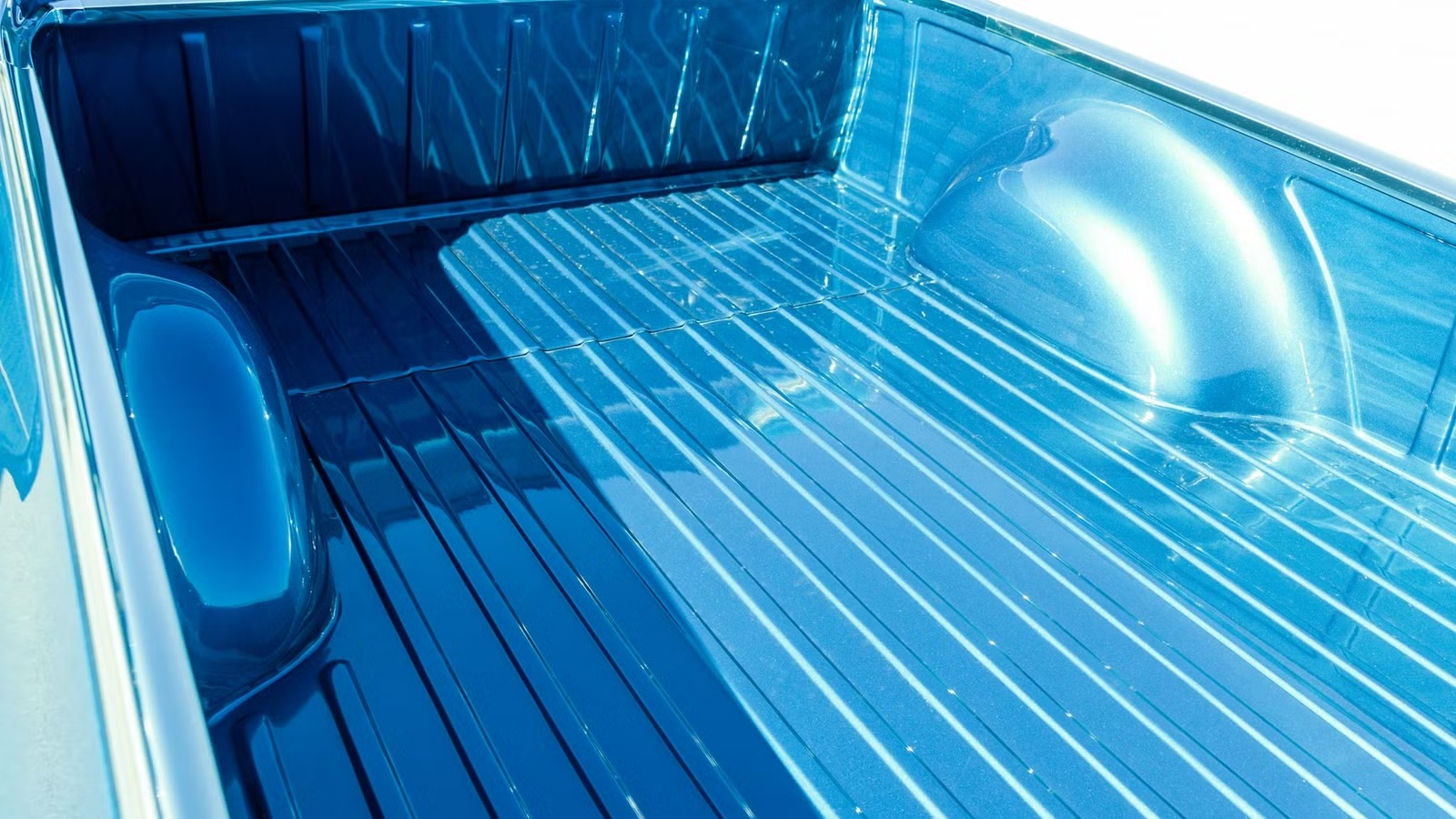
In May 2025, VIN 136800B192459 sold for $189,750. In February 2024, VIN 136800K210296 (pictured) sold on Bring a Trailer for $175,000. That’s quite the turnaround for a truck with an original MSRP of $3,764.

Related posts


Latest Post


No Comments