
The Fastest Buick Of The Muscle Era Was Never Supposed To Exist
The quickest Buick of the muscle car era never appeared on a window sticker. It never received an RPO code, and the factory’s own copy of it was scrapped after an engineer put a rod through the block at GM’s proving grounds. Officially, it did not exist. That is a strange fate for a muscle car that could embarrass the most celebrated names of 1970. While Mopar and Chevy fans still argue Hemi versus LS6, the real answer to the era’s horsepower question may have come from the brand that sold cars to doctors and bankers.

To understand how that happened, start with the Buick everyone does know.
Buick’s Banker-Car Image Hid The Torque King Of 1970
By 1970, Buick had quietly built one of the most complete muscle cars in America. The GS 455 with the Stage 1 package made 360 gross hp and 510 lb-ft of torque, the highest torque rating of the entire muscle car era. Motor Trend famously ran one through the quarter mile in 13.38 seconds at 105.5 mph.

Those numbers put the polite luxury brand in uncomfortable company. Some period rankings placed the Stage 1 as the third-fastest car of the first muscle era, behind only the 427 Cobra and the 1966 427 Corvette. Both of those are arguably sports cars, which would make the Buick the quickest true muscle car of the bunch.
Racers from the period tell the same story in plainer terms. You rarely lined up against a Buick at the strip, but when you did, you usually lost. The car simply did not match the brand’s image, and that made it easy to underestimate.
Buick’s engineers looked at all of this and reached a conclusion nobody expected from Flint’s gentleman’s division, but it was not enough.
Stage 2 Was A Factory Race Program Killed Before It Was Born

The plan was called Stage 2, and it was never meant to be a dealer accessory. Buick engineering intended it as a factory-built, streetable drag car that could compete in Super Stock classes straight off the line. The team developed the hardware, built test cars, and pushed the project toward production.

Then the outside world closed in: emissions standards were tightening fast, and the Stage 2 engine’s high-compression tune was never going to pass them. At the same time, safety pressure was mounting, with the Department of Transportation uneasy about titling what amounted to drag-strip-ready vehicles for the street.
Buick was forced to axe the production program before it started. The Stage 2 never received an RPO code, and its existence was not even made public until 1972, when the parts finally appeared in dealer literature and could be ordered in any combination.

That is where the story should have ended, but instead, Buick’s engineers found a back door. Every component the canceled program had developed was released through the dealer parts counter, available over the counter at any Buick store in the country.
The workaround was simple and completely legal. A buyer ordered a GS Stage 1 from the showroom floor, then walked to the parts department and bought the rest of the race program piece by piece. GM’s corporate crackdown killed the Stage 2 on paper, but the hardware kept moving out the back door, one box at a time.
The Parts-Counter Arsenal That Turned A 455 Into A Race Engine

|
Engine |
Transmission |
Power |
Torque |
|
7.5-liter Stage 2 V8 |
4-speed manual or 3-speed automatic |
500-540 hp (est.) |
Not officially rated |
The Stage 2 package read like a race team’s shopping list because that is exactly what it was. At its center sat a set of Stage 2 iron cylinder heads with full-round exhaust ports, a radical reshape of the restrictive stock design. Feeding them was an Edelbrock B4B aluminum intake topped by an 850 CFM Holley carburetor.

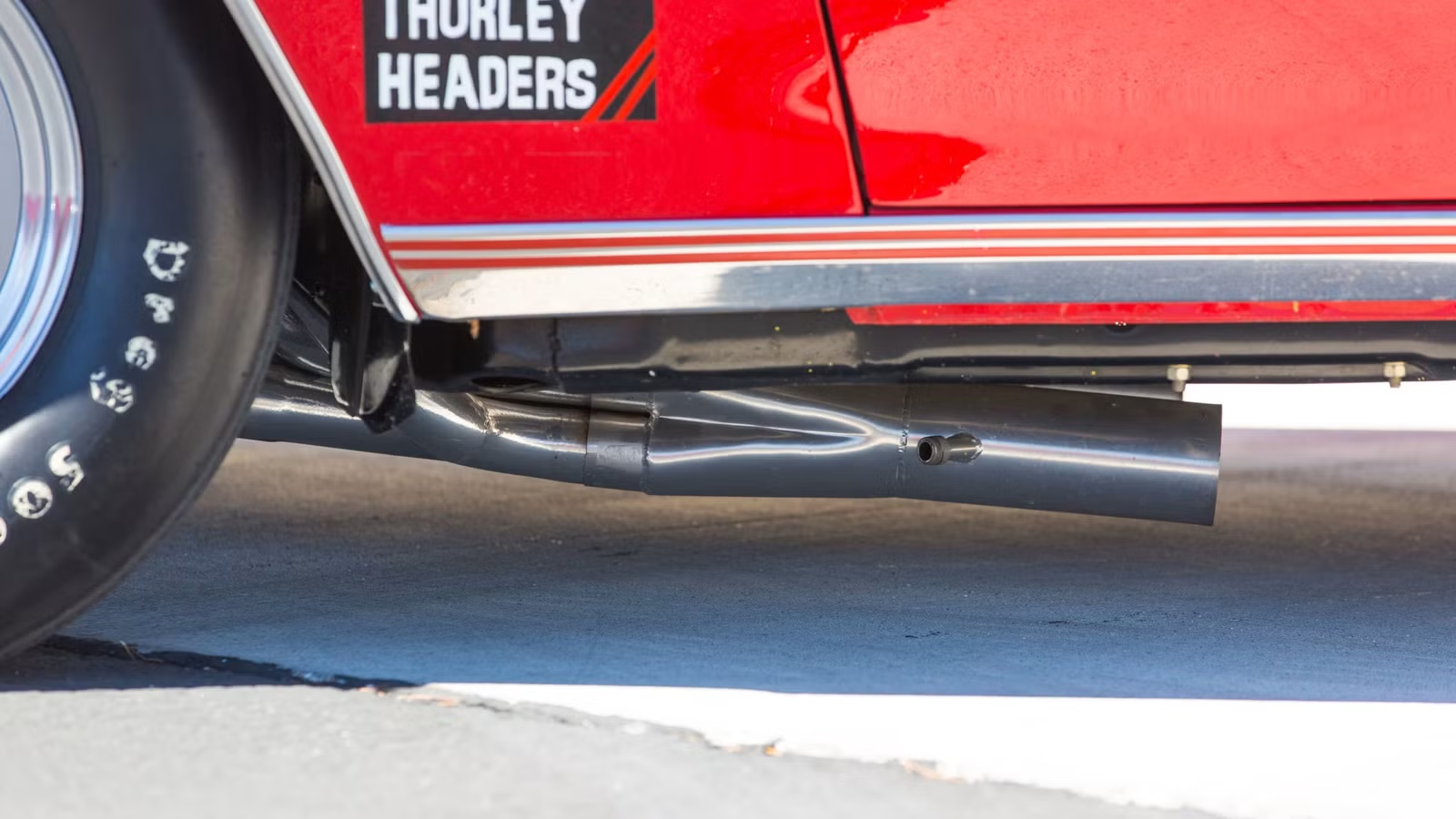
The bottom end got equally serious. Forged flattop TRW pistons pushed compression to 11.0:1, while a camshaft built for 7,000 rpm handled the valvetrain. Kustom brand headers carried the exhaust out, since no cast manifold was ever made to fit the Stage 2 heads.
The paper trail behind those heads is where the story gets granular. Buick informed dealers of Stage II head availability in April 1972 under part No. 1235714, and installing them required ten shorter head bolts under part No. 1238391. The head program was ultimately scrapped over casting difficulties, and the later heads can be identified by their missing freeze plugs.

Nobody published an official output figure. Estimates start around 500 hp, and one Stage 2-equipped 455 reportedly produced 540 hp on the dyno. Either number embarrassed everything in GM’s showrooms.
Two Test Cars Survived, But Buick Destroyed Its Own Prototype

Buick sent the Stage 2 hardware to two factory-supported test cars before the program died. A white GSX went to Reynolds Buick in California, where Pappy Kennedy and Jim Bell of Kenne-Bell fame developed and tested the package. A red 4-speed GS went to racers Doug Jones and Dave Benisek, who received their Stage 2 components in GM boxes in the trunk.
There was a third vehicle, and its fate explains why so few people know this story. According to retired Buick engine engineer Dennis Manner, writing to Hemmings years later, Buick Engineering built its own prototype GSX in Flint and sent it to California to show to dealers, racers, and magazine writers. After the program was cancelled, an engineer missed a shift at the GM proving grounds and put a rod through the block, so the car was scrapped and its special hood was donated to the Jones/Benisek racer.

The surviving cars proved the hardware worked. Both test cars ran consistent 10.7-second quarter miles, though it is worth being precise here: these were race-prepped cars on slicks, not showroom-stock street cars. The often-quoted 10.64 at 124.65 mph came later, from Jim Turner’s “Wiley Coyote” Stage II race car, which ran a 0.030-over block, 12.5:1 Arias pistons, and a grout-filled bottom end well beyond kit spec.
Even with that framing, the numbers stand up. The Hemi and LS6 cars that magazines tested ran deep in the 13s from the showroom, and their race-prepped Super Stock versions were the Buick’s real competition. The Jones/Benisek car campaigned in Super Stock through the 1970s, and Benisek won the 1972 NHRA World Championship.
Proving A Real Stage 2 Exists Is Harder Than Finding One

Here is the problem with a car that was never officially built: nobody kept records. Buick tracked no dealer Stage 2 conversions, so there is no registry, no VIN sequence, and no build sheet to check. Stage 2 badges are cheap and easy to find, which means clones outnumber genuine cars by a wide margin.
That leaves the heads as the only reliable evidence. Roughly 75 sets of the later Stage II heads were ever produced, and only 10 to 20 sets are accounted for within the Buick GS club’s ranks. Their rarity is exactly why the heads became the accepted litmus test for calling any car a real Stage II.
Even the package’s most famous visual cue is a trap. The Stage 2 hood scoop was never sold as part of the package, and it was not even legal in NHRA class racing.
So the fastest Buick of the muscle era survives as a parts list, two restored race cars, and one engineer’s letter. It is a legend the paperwork can barely prove, which may be exactly why it endures.
Sources: Hagerty, Mecum Auctions

Related posts


Latest Post


No Comments