
The Muscle Car That Was Too Wild Even For The 1970s
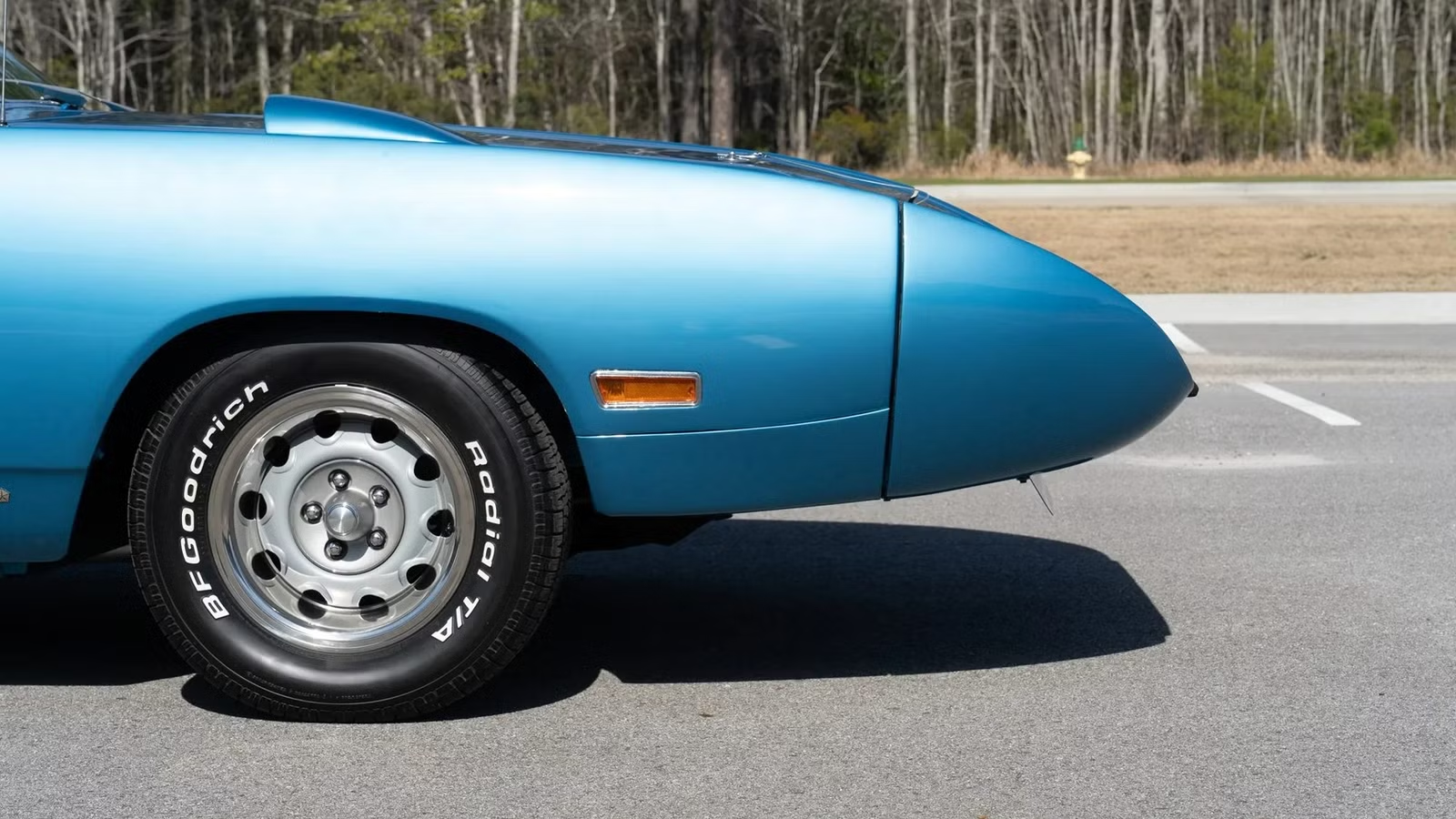
The golden era of American muscle cars was coming to an end by the late 1960s, due to federal emissions mandates and insurance companies slapping surcharges on high-displacement V8s. As all the automakers started to back down and detune their cars, one manufacturer went against the grain, and an engineering team out of Detroit unleashed a car that stunned enthusiasts with its visuals and track-tested legacy that proved too wild for regular suburban driving.
The Brick Wall That Hit American Horsepower

By the late 1960s, Detroit engineers had squeezed massive displacement figures out of the V8 iron blocks. One reality that they had to face was physics. Pushing these literal heavy boxes past 180 mph on super-speedways was just not possible with raw horsepower alone. These boxy intermediate car bodies were like a literal brick wall: they created extreme drag and produced dangerous front-end lift while trying to punch a hole through the air. Insurance companies were simultaneously blocking access to high-displacement performance vehicles that young people often bought.
To gain an edge in performance and take the next step, automakers realized that power alone would not cut it, so Chrysler, instead of throwing bigger carburetors and higher compression ratios at the problem, decided to cheat the wind.
When Chrysler Borrowed Rocket Scientists To Win At 200 MPH


Chrysler’s radical shift from horsepower to aerodynamics began when stock car legend Richard Petty abandoned Plymouth for rival Ford in 1969. Petty famously cited the boxy Plymouth Road Runner‘s aerodynamic disadvantage as the primary reason for his departure.
To get him back for the 1970 season, Chrysler had to completely rewrite the book and move away from the traditional Detroit muscle style. They turned to missile-defense aerodynamics and wind-tunnel testing. Led by engineer John Pointer, they completely transformed the car: the team took a B-body coupe and turned it into a low-drag, high-downforce weapon.
Using small-scale models in Lockheed Martin’s wind tunnel, Pointer’s team designed the nose of the car to reduce the drag coefficient, creating a shape that sliced through air friction at high speeds.
The Mandate That Forced Race Cars Onto The Streets

To get their radical new aero-car approved for NASCAR competition, Chrysler faced a massive logistical obstacle. NASCAR enforced a strict homologation mandate: for the 1970 season, manufacturers were required to build one street-legal production unit for every two franchised dealerships in the country.
This meant Plymouth had to manufacture nearly 2,000 production units for retail buyers, unexpectedly bringing an uncompromising, 200-mph race car design directly to suburban driveways.
To get the newly designed aero-car approved for NASCAR competition, Chrysler had to comply with the homologation mandate, which required building one street-legal production car for every two franchised dealerships in the country.
That meant Plymouth had to manufacture nearly 2,000 examples of a production-ready car for retail. That meant enthusiasts could walk up to their nearest dealer and literally walk off with a purpose-built race car that was fully legal for the road. It was as close as you could get to NASCAR performance on the streets. But what was the aero miracle?
The 1970 Plymouth Superbird

The 1970 Plymouth Superbird was impossible to mistake for anything else on the road: it stretched 221 inches long, and up front was a custom eighteen-inch steel nose cone that housed pop-up headlights and created a low-pressure area to slice through air. At the rear of the car was a towering 24-inch aluminum rear wing, designed to deliver maximum downforce at high speeds. And underneath the hood sat a big-block V8, but that’s only part of the story.
Three Engines For The Street

Plymouth offered three distinct V8 powertrain options with the Superbird for factory buyers. The most common option was the entry-level 440 Super Commando V8, equipped with a single four-barrel carburetor, which produced 375 hp and accounted for 1,084 cars. Above it sat the mid-tier 440 Six-BBL V8, which used three Holley two-barrel carburetors to generate a rated 390 hp, fitted to 716 units.
But at the top sat the ultra-rare 426 Street Hemi V8, the crown jewel of Chrysler performance, featuring dual four-barrel carburetors and hemispherical combustion chambers. It was factory-rated at 425 hp, with only 135 units built. That said, Chrysler sandbagged these figures to help buyers avoid rejection by insurance companies.
In reality, a well-tuned 426 Hemi could produce closer to 470 hp. Enthusiasts could buy these engines with an A727 TorqueFlite three-speed automatic transmission or a heavy-duty A833 four-speed manual with the Hurst Pistol Grip shifter.
Living With A Road-Legal NASCAR Special

The Superbird had an aerodynamic design made for the track, but in street use it came with its own unique set of problems: its signature low-slung, long nose made navigating driveway ramps, gas stations, and parking spaces a challenge, as you could not see where the front bumper ended.
Also, because the restrictive front grille inlet was optimized for high-speed airflow rather than stop-and-go traffic, the big V8s in the Superbird tended to run hot during slow city commutes. But Chrysler did install a heavy-duty cooling package that had a 26-inch high-capacity radiator, a seven-blade viscous fan, and a dedicated power steering cooler.
Once the Superbird was on the highway at speed, there was no catching it: no car on the road at the time could keep up with the aerodynamic rocket that cut through crosswinds with ease.
Factory Quirks And Design Hacks

Many of the car’s iconic features were clever production workarounds rather than pure styling choices. While it was designed for maximum downforce, engineers actually made it taller so that the trunk lid could open fully without hitting the vertical wing struts inside the trunk.
Chrysler also modified the rear quarter inner structure and mounted reinforced steel backing plates beneath the rear decklid. Even the standard vinyl roof was not a styling element but a functional cover to hide hand-welded seams created when fitting the flush rear window glass to the modified C-pillars.
The reverse front fender scoops also served a functional purpose: to vent trapped air pressure inside the wheel wells and prevent front-end lift at high speeds.
From Showroom Flop to Million-Dollar Icon

Despite the Superbird being an engineering marvel, buyers in 1970 rejected the car for its polarizing styling and impractical length. Hundreds of Superbirds sat on dealer lots for months. Desperate to move inventory, dealers eventually unbolted the nose and high rear wing, replaced them with a standard Road Runner front end and flat decklids, and sold them as regular Road Runners.
NASCAR also effectively neutralized the aero-cars after the 1970 season. Rather than an outright ban, NASCAR imposed a restrictive 3-5-cubic-inch engine displacement cap specifically for cars with big wings for 1971, which made the heavy, big-block Superbird completely uncompetitive and forced its immediate retirement.
Over time, the Superbird has earned genuine appreciation for its innovation and design, reflected in its price as well. Today, a clean example with the original 426 Hemi engine can easily cross the $1,000,000 mark at auction at Barrett-Jackson, standing as one of the most iconic and daring muscle cars to come out of 1970.
Source: Audarain Auto Museum, Hemmings, Bring a Trailer

Related posts



Latest Post


No Comments