
The Muscle Car Era’s Most Reckless Decision
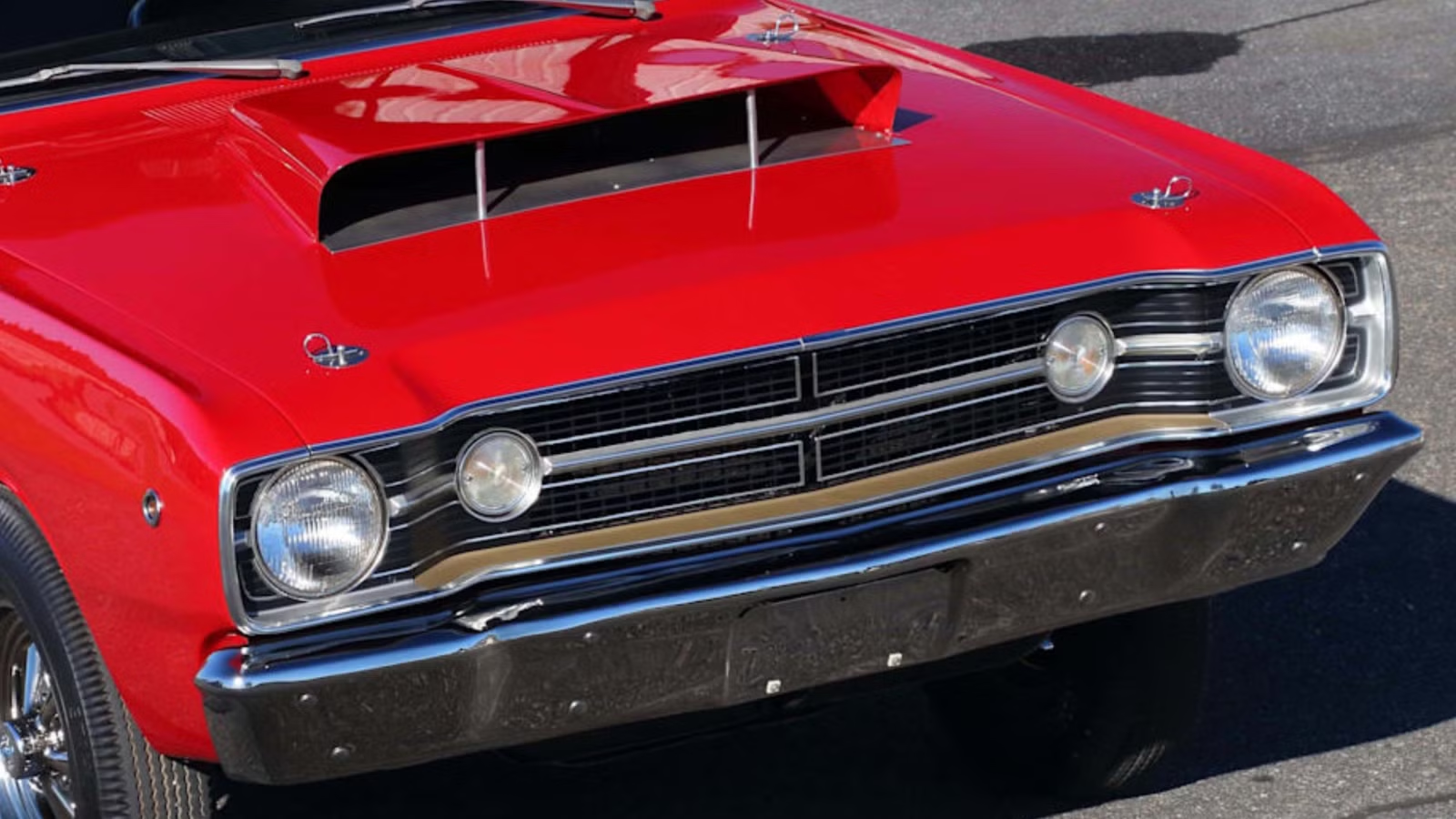
Despite the magical and triumphant aura of the Golden Age of American Muscle, there were actually a lot of bad decisions made by automakers. Ford never unlocked their big blocks until 1968, and even then, presented watered-down versions that weren’t terribly competitive on the streets. Even worse, GM banned engines over 400 cubic inches in intermediate models, dooming their cars to second place for most of the classic age.

Mopar, on the other hand, seemed to do everything right from the amazing styling of the second-gen Charger to the 426 Street Hemi and 440 Six-Pack V8s that dominated the streets. They did, however, make one seriously reckless decision to put a far too powerful engine in a diminutive ride that was a literal death trap for inexperienced drivers. Despite that, it was too cool to believe, and ultimately a great idea.
1966 426 Hemi Coming Out Party
Long before there were memes of angry women with bob haircuts demanding to speak to the manager, Ford was the OG Karen. In 1964, Chrysler introduced the 426 Hemi V8 as a race-only engine that helped Richard Petty kick all the ass in NASCAR, and Ford complained that it was too fast, so it got banned until it could be homologated. Chrysler skipped the easiest route, which would have been to make a limited special edition with this amazing engine, and instead decided to make it available to all Dodge and Plymouth intermediate models. The 426 Street Hemi, which hit the streets in 1966, cranked out 425 horsepower and 490 lb-ft of torque, making any car it was equipped with a 13-second ride straight from the factory. Ironically, Ford is the reason why there were Hemis on the street during the Golden Age, and their rides got abused by them the entire time.
Designated Muscle Car Decision of ’68


The initial introduction of the 426 Hemi was kind of a free-for-all with any intermediate eligible to reap its awesome benefits. Chrysler thought about this for a couple of years and decided that they shouldn’t be encouraging family rides to harbor its terrifying power, so in 1968 they limited the 426 to dedicated muscle cars. For Dodge, that meant the Charger R/T, Coronet R/T and Super Bee, while at Plymouth, only the GTX and Road Runner were eligible. As cool as it would have been for a Belvedere Wagon that could rip a 13.4-second quarter-mile, there are no records of a car like this ever being built. In 1966, however, Dodge built a handful of dorky Coronet four-doors packing the 426 Hemi, which may have also invented the sleeper car.
Compact Mopars Miss Out On Hemi-Mania

While Chrysler was pretty lax on the Hemi applications in the early days, they were adamant that these ferocious V8s were not for compacts. The two-door fourth-gen Dodge Dart and second-gen Plymouth Barracuda were muscle cars in every sense of the word, but because of their shorter wheelbases, they were barred from the Hemi frenzy, and as you will soon see, that was actually a good thing. A 1968 Dart GTS or Barracuda Formula S with a 300-hp 383 V8 was faster than any Ford or GM top-performance model with a 5.8-second 0-60 time, 14.0-second quarter-mile and 130 MPH top speed. In 1969, a small number of Darts and Barracudas with 375-hp 440 V8s were built that got the Mopar compacts running in the low 13s, and that should have been the limit for them, but it was not.
1968 Dodge Hemi Dart Ballistic Missile

Despite banning the Hemi from ever gracing the engine bay of a Dart, Chrysler was okay with Dodge partnering with Hurst Performance in 1968 to build a limited-edition 426 factory drag car. The regular production Darts were built at the Hamtramck, Michigan assembly plant and then shipped to the Hurst facility to get Hemified. In addition to the 426 V8, which only required a slight adjustment of the right shock tower to fit in the compact’s engine bay, the Hemi Dart went on a strict diet that included fiberglass hoods and front fenders, acid-dipped body panels, as well as, deleting everything that was unnecessary to blowing doors off, resulting in a slender 3,000-pound car. Additional mods included relocating the battery to the trunk, heavy-duty suspension components, and a kick-ass Dana 60 rear axle with 4.86:1 gears, making this the most apocalyptic ride ever conceived.
Street Legal Menace

The purpose of the ’68 Hemi Dart LO23 was to crush it in NHRA drag racing, which it did, taking the SS/AH class in both 1968 and 1969, with legends like Dick Landy, Herb McCandless, and Ronnie Sox behind the wheel. While many of these Hemi Darts were delivered to drag racers and teams, some of them were sold through Dodge dealers to generate interest and foot traffic, and that’s where the recklessness comes in. This was a car that was capable of 3.4-second 0-60 acceleration, 10.46-second quarter-mile, and 135 MPH top speed that any dope could have bought and driven off the lot. This kind of power today should be for pros only and that’s with modern safety features, so back in the day, this was potentially an assisted-suicide machine for unskilled wannabes, who were guaranteed to get sideways with its raw power. It also showed why Chrysler didn’t want any Hemi-powered compacts going to the general public.
The Value of Street Violence

Any classic Mopar with a Street Hemi is a unicorn because they only made 9,761 of them between 1966-1971, spread across 13 models, but the ’68 Hemi Dart had a Race Hemi, of which only 734 were produced from 1964-1968. Getting even rarer, there were just 80 Hemi Darts to leave the Hurst facility and many of them were obliterated on the drag strip, with a best case scenario of 65 still in existence. While certainly rare, collectors aren’t keen on actual race cars, so many of them fizzle out on the auction block, failing to hit the reserve. A super clean Hemi Dart with straight paint, however, is quite valuable. The 3,786-mile yellow bruiser pictured above, which isn’t plastered with sponsorship decals or paint, sold for $330,000 at Mecum Kissimmee 2016. The next highest selling drag car with a famous driver is a Terry Pringle car, that sold for more than $100,000 less.
1968 Plymouth Hemi Barracuda Killer Fish

Plymouth also teamed up with Hurst Performance to build a factory drag car out of a second-gen fastback Barracuda. Much like the Hemi Dart, the Hemi Barracuda was fiberglass in the front and acid-dipped panels in the back. On the inside, there was pretty much front seats, a steering wheel, pedals, and a shifter, as all comforts were deleted to shed weight. Interestingly enough, this car came with two front bucket seats in case you wanted to bring a friend along for a G-ripping launch, or maybe this is the literal origin of speed dating. The ’68 Hemi Barracuda BO29s were shipped with primer sheet metal and raw fiberglass, so they could be painted by the individual racing teams. While the Hemi Dart was rare with 80 units, the Hemi Barracuda was super-rare with possibly only 50 of them ever made.
Car Comes With a Disclaimer

Many write-ups for the ’68 Hemi Barracuda state that it was only sold to professional racers, but it was in fact delivered to some dealerships, and we know that because dealers got a memo about it. Also, buyers were required to sign a disclaimer that they understood the car was intended for track use only, not the streets, and that it was sold without a factory warranty. Chances are, all or most ended up on the track, but maybe a couple were street-bound where they vaporized Chevelles and likely ended up wrapped around telephone poles. While there’s no concrete proof of the ’68 Hemi Barracuda’s performance on the concrete, running down the track, drag legend Ronnie Sox shredded the quarter-mile in 10.22-seconds at 134.32 MPH, which is a couple ticks faster than the Hemi Dart. Both cars were so dominant that the NHRA required Hemi-equipped cars to carry 200 pounds of extra weight, to slow them down a bit.
The Price of Jet Propulsion

Astonishingly, Hagerty actually has valuations for the 1968 Plymouth Barracuda Super Stock, AKA the Hemi Barracuda BO29. Starting off at $102,000 for a project car and going all the way up to a $235,000 showpiece, this is a pricey Mopar unicorn. Unlike the Hemi Dart, there doesn’t seem to be any non-race car Hemi Barracudas out there, at least not on the auction scene. Bucking the trend, however, Hemi Barracuda race cars are big sellers. Topping the list is a car Ronnie Sox won 15 events in, as well as the 1968 AHRA Driver of the Year, and the 1969 NHRA championship that sold for $258,500 at a 2023 auction. The Hemi Barracuda may have been faster, but it couldn’t beat the Hemi Dart on the auction block, at least not yet. There is the BO29 prototype test mule floating around out there and, with the right set of bidders, could best the Hemi Dart’s $330,000 top sale.
Legacy of Dodge’s Reckless Behavior

You’d think that Dodge would have learned their lesson with the ’68 Hemi Dart about giving raw muscle to amateurs, but in 1992 they came out with the uber-powered Viper RT/10. The Viper may have been even more reckless, because it wasn’t a factory drag car, but rather a sportster, which meant they were all snapped up by mostly inexperienced weekend warriors. Initially, the Viper came with an 8.0-liter V10 that blasted out 400 hp and 465 lb-ft of torque. The problem was, this rear-wheel-drive beast had no ABS, no traction control, and no stability control, which meant when the uninitiated tried to see what the Viper was capable of, they ended up off the road in a ditch. That being said, we are actually grateful that Dodge keeps making cars with more power than most human beings will ever need, from the ’68 Hemi Dart, to the first-gen Viper, to the 1,025 hp 2022 Challenger SRT Demon 170.
Sources:Hagerty, Mecum

Related posts



Latest Post


No Comments